
The Menopause Joint Pain Diagnosis Doctors Keep Missing — And Why Your Hip Hurts in the Morning
Your PCP says "you're getting older." Your orthopedist orders an x-ray that comes back clean. Then he tells you to do PT. The aching keeps coming back. Here's what's actually causing it — and the upstream fix nobody offers you.

If your joints hurt in three different places and nothing showed up on imaging, the cause isn't structural.
It's hormonal. And it's been hiding in plain sight for thirty years.
The pattern: a woman in her late forties or early fifties starts waking up stiff. Her hip aches getting out of bed. Her shoulder won't reach the top shelf. Her knee complains going downstairs. She sees her PCP. She gets told it's age. She gets sent to an orthopedist. The x-ray is clean. She gets sent to PT. The exercises help a little. The pain comes back.
Nobody asks about her periods. Nobody asks about hot flashes. Nobody connects the joints to the hormones.
They should.
Why your joints started hurting after 45
Estrogen does a lot of quiet jobs in a woman's body. One of them — and most doctors never learned this in medical school — is to act as a natural anti-inflammatory across every soft tissue in your joints.
Cartilage has estrogen receptors. Synovium — the lining of the joint capsule — has estrogen receptors. Tendons have them. Fascia has them. The fibroblasts that build and repair connective tissue have them.
For your entire adult life, those receptors have been getting a steady estrogen signal that says: stay calm, repair quietly, don't flare up.
Then perimenopause begins. Estrogen falls. The signal stops.
What you feel is not one bad joint. You feel polyarticular pain — pain that shows up in two or three zones at once and tends to migrate. A hip one month. A shoulder the next. Both knees by spring. That migration is the fingerprint of a hormonal cause, not a structural one.
The North American Menopause Society formally recognized this in its 2022 position statement. Researchers like Watt (2018) have shown that estrogen withdrawal directly increases inflammatory cytokines inside joint tissue. AAOS literature now documents the same pattern under "menopausal arthralgia." It is real. It is common. And it is treatable.
Why your x-ray was normal — and why that doesn't mean you're fine
An x-ray shows structure. It shows bone, joint spaces, and gross damage. It does not show inflammation, and it does not show a hormone level.
When your orthopedist tells you the films look clean, he's telling you the truth. The architecture of your hip is intact. The shoulder isn't torn. The knee isn't grinding bone on bone.
The pain is not coming from broken structure. It's coming from inflamed soft tissue — synovium, capsule, fascia — that the imaging can't see.
A clean x-ray actually argues for a hormonal cause, not against your pain being real. If the bones look fine and you're still hurting, that points upstream. To biochemistry. To estrogen.
Hip pain in menopause
The hip is the most common single zone women describe.
The pattern is consistent enough that it's almost diagnostic. It hurts worst in the morning, getting out of bed. It hurts to lie on it at night, which is why so many women stop sleeping on their side. And it often radiates down the outer thigh, which makes it look like classic trochanteric bursitis on an exam.
It isn't really bursitis. The iliotibial band — the long fascial sheet that runs from your hip down to your knee — is loaded with estrogen receptors. When estrogen drops, that fascia stiffens and gets inflamed along its whole length. The "bursitis" diagnosis catches the inflammation at one spot. The cause is systemic.
This is why so many women get a cortisone shot in the hip, feel better for six weeks, and then watch the same pain creep back. The shot quiets one inflamed pocket. The hormone causing the inflammation everywhere never got addressed.
Physical therapy helps mobility. Stretching the IT band helps the radiating ache. Neither one fixes the root.
Frozen shoulder in menopause
If the hip is the most common zone, frozen shoulder is the most specific.
Adhesive capsulitis — the medical name for frozen shoulder — has a strange demographic. Women between 40 and 60 account for more than 70% of all cases (Wong, 2017). That is not a coincidence. That is a hormonal signature.
The pattern: it starts gradually. You notice you can't quite reach overhead to put a plate away. Within a few months, you can't fasten a bra clasp behind your back. You can't put on a coat without wincing. Sleeping on that side is impossible. The classic untreated course is two to three years — a long, slow freeze and a slow thaw.
The mechanism: the joint capsule of the shoulder is built and maintained by fibroblasts — cells that are exquisitely sensitive to estrogen. When estrogen drops, those fibroblasts shift into an inflammatory phenotype and start laying down dense, contracted scar-like tissue inside the capsule. The shoulder doesn't get injured. It gets tightened from the inside.
Multiple recent reviews have found that restoring estrogen short-circuits this process. The capsule fibroblasts calm down. The inflammation drops. The thaw, which takes years on its own, can take months.
Why PT and ibuprofen stop working
Both of those tools are excellent. They just aren't aimed at the right target.
Physical therapy addresses mobility. It restores range of motion that pain and stiffness have taken away. That's real and worth doing — but it doesn't change the chemistry of the tissue you're stretching.
Ibuprofen and the rest of the NSAIDs suppress pain signaling. They damp down the inflammatory cascade for a few hours at a time. That's also real and useful — but the underlying tissue stays inflamed the moment the dose wears off.
What neither one does is replace the hormone that was doing the work in the first place. You can move better. You can hurt less in the moment. But you'll be doing both forever, because the source keeps generating new inflammation.
This is the part that wears women down. Not the pain itself. The feeling of running uphill against a body that won't stop reinflaming.
The real fix — restore the hormonal buffer
If the cause is missing estrogen, the obvious fix is to put estrogen back.
Not a supplement. Not a turmeric tea. The actual molecule your body recognizes — bioidentical estradiol, paired with progesterone for safety, in the same forms major medical societies have endorsed for thirty years.
When you restore estrogen, the synovium calms. The fascia softens. The capsule fibroblasts step back out of their inflammatory phenotype. Pain signaling drops because there's less inflammation to signal. Most women report meaningful change within 6 to 8 weeks.
The North American Menopause Society lists musculoskeletal symptoms — joint pain, stiffness, arthralgia — as a recognized indication for HRT in its 2022 position paper. This is not off-label. This is what HRT was originally for.
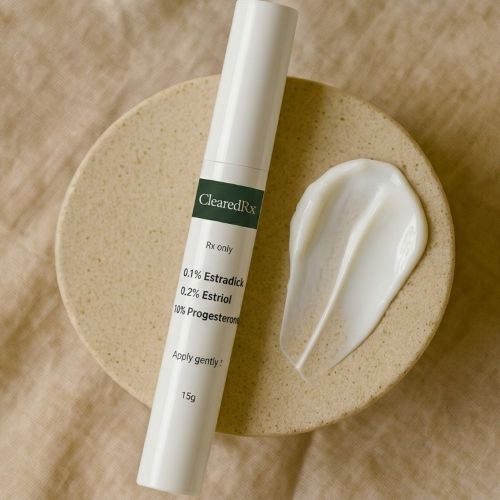
The ClearedRx Estrogen + Progesterone Cream
The simplest delivery is a compounded cream that combines bioidentical estradiol, estriol, and micronized progesterone in one twice-daily application. It's the same hormone combination OB-GYNs prescribe for vasomotor and musculoskeletal symptoms, formulated for daily use, made in a U.S. licensed pharmacy.
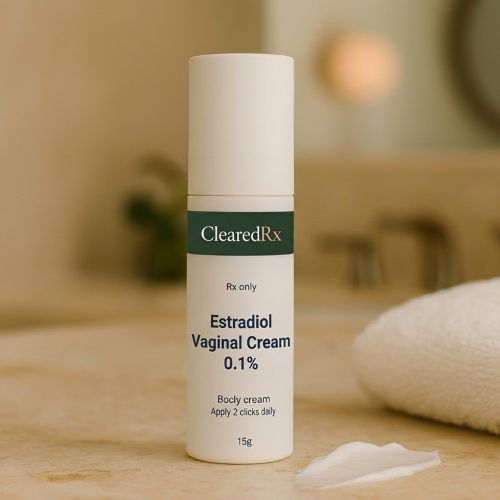
Bioidentical hormones, twice-daily application
One compounded prescription cream. The same active ingredients OB-GYNs prescribe for musculoskeletal and vasomotor symptoms.
- Bioidentical estradiol + estriol + micronized progesterone
- Doctor-prescribed, compounded in a U.S. licensed pharmacy
- Same active ingredients OB-GYNs prescribe for musculoskeletal + vasomotor symptoms
- $95 first month, regularly $189/mo
- Free, discreet shipping in 49 states
What 6-8 weeks looks like
Most women follow roughly the same arc. It is not instant, and any service promising overnight relief is overselling. Here is what to actually expect:
- Weeks 1–2. Morning stiffness starts to ease. The first joint out of bed isn't the event it used to be.
- Weeks 3–4. Range of motion on the worst joint — the hip you couldn't lie on, the arm you couldn't lift — begins to open back up.
- Weeks 6–8. Most women report sleeping through the night without rolling pain waking them up. Reaching overhead stops being a calculation.
From there it tends to keep improving for the first six months. Sleep is usually the first thing to come back. The deepest pain is usually the last.
How ClearedRx works
ClearedRx is a doctor-supervised HRT service for women, online.
You take a two-minute quiz. A U.S. licensed physician in our network reviews your symptoms and history within 24 hours. If you're a fit, they prescribe — and your treatment ships to your door, discreetly, the same week.
- Step 1. Two-minute quiz about your joints, your cycle, and your history.
- Step 2. A U.S. licensed MD reviews your case within 24 hours.
- Step 3. Free, discreet shipping. Same medication ships from a U.S. compounding pharmacy.
What women on HRT actually report
"The hip was the worst part. I'd been a side sleeper my whole life and I couldn't lie on either side. I went through PT twice, two cortisone shots, and the orthopedist told me to consider hip replacement 'eventually.' I was 52. Seven weeks on the cream and I can sleep on my side again. The pain didn't vanish overnight — it just kept getting quieter every week until I noticed I'd stopped thinking about it."
"Frozen shoulder. Couldn't fasten my bra clasp. Couldn't put on a coat without using my other arm to lift it. My orthopedist said it was a two- to three-year thing and I should ride it out. Nine weeks on HRT and I could clasp my bra behind my back again. I cried in the bathroom. I felt like I'd gotten my arm back."
"Mine was everywhere — both hips and the right shoulder. My PCP said I had 'multiple things going on at once,' which is doctor for I don't know. I started the cream in January. By March it was all easing, not just one joint. The relief was all over, the way the pain had been all over. That's when I understood it had been one cause the whole time."
Common questions
Is this safe if I had breast cancer?
How is this different from anti-inflammatories like ibuprofen?
What if my x-ray was actually abnormal?
How fast does it work?
Will the pain come back if I stop?
What if I'm already doing PT?
— The ClearedRx Medical Network
P.S. The orthopedist was right that the joint structure is fine. He just didn't have the hormone answer. A clean x-ray with persistent pain is one of the clearest signals in medicine that the cause is upstream — biochemical, not mechanical. Once you give the body back the hormone that was quieting the inflammation, the joints stop generating new pain to chase. That's the part nobody explains in a six-minute appointment. But it's the part you'll feel first.