
Last reviewed May 9, 2026
Quick answer: About 50% of postmenopausal women experience genitourinary syndrome of menopause (GSM), and the best cream for vaginal dryness for most of them is a low-dose estradiol vaginal cream — the same molecule the body produced before menopause. Brand-name Estrace runs $300–$500 per month. The identical molecule, compounded by a 503A pharmacy, runs $89–$150 per month. ClearedRx prescribes compounded estradiol vaginal cream with 24-hour MD review.
The 60-second version
The reason no one in your life is talking about this
If you searched best cream for vaginal dryness at 11 p.m. on your phone, you are not alone — you are part of the most under-discussed medical experience in the United States. The Vaginal Health: Insights, Views & Attitudes (VIVA) US survey of 3,520 postmenopausal women found that 63% of women with vaginal symptoms had not raised the topic with a healthcare provider, and only 4% recognized their symptoms as a treatable medical condition rather than a personal embarrassment. The drugstore aisle is full of products. The conversation is not.
Here is the part the brand-name aisle does not say out loud. The best cream for vaginal dryness, by every credible 2026 clinical metric — efficacy, safety, durability of effect, ability to restore tissue rather than mask symptoms — is a low-dose estradiol vaginal cream. That has been the answer in the medical literature since the 1980s. What has changed is that the same active ingredient now exists in two parallel supply chains: an FDA-approved brand channel that retails for roughly $300 to $500 a month, and a 503A compounding-pharmacy channel that delivers the identical 17-beta-estradiol molecule for $89 to $150 a month. Most women only hear about the first one.
This guide ranks every prescription cream for vaginal dryness alongside every credible vaginal dryness OTC product on the U.S. market in 2026 — vaginal dryness cream, vaginal suppository for dryness, ring, gel, and moisturizer — so you can pick yours from the same evidence base your clinician should be using. This is not a "natural alternatives" article. This is the comparison your prescriber should have walked you through but probably did not, including the parts that hurt the brand-name profit margin.
Estrace and compounded estradiol cream contain the same molecule
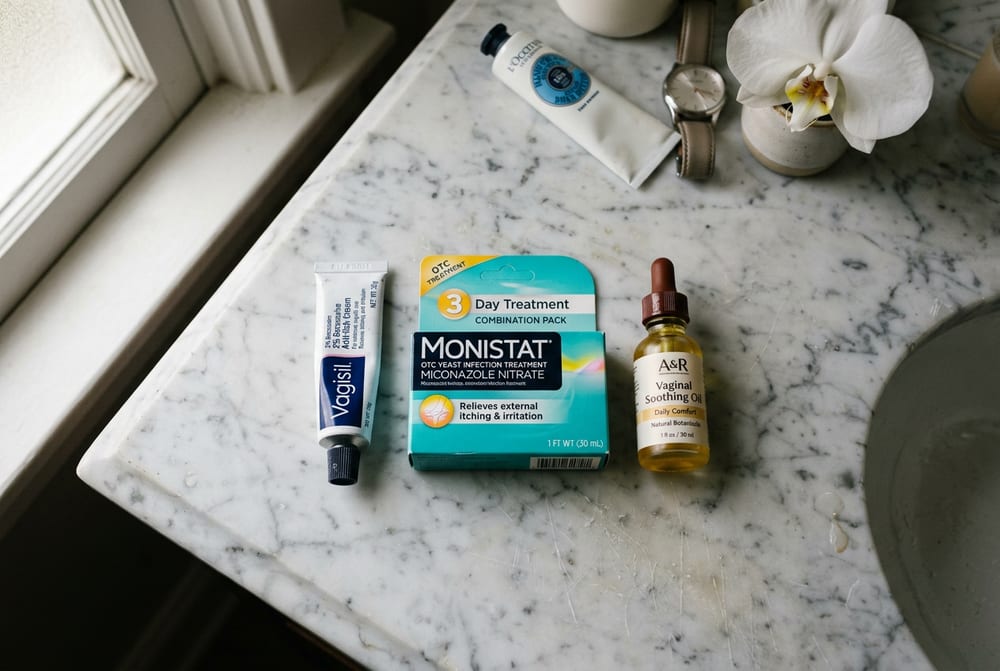
The active pharmaceutical ingredient in Estrace vaginal cream and in a 503A pharmacy's compounded estradiol vaginal cream is identical: 17-beta-estradiol USP. Same molecular formula (C18H24O2), same molecular weight (272.38 g/mol), same affinity for the estrogen receptor, same tissue effect. Both source the API from the same handful of FDA-registered bulk drug manufacturers under USP monograph 1190.
What differs: the FDA approval pathway (Estrace is an NDA-approved finished product; compounded cream is a patient-specific preparation under FDA section 503A), the inactive base ingredients, available strengths (Estrace is fixed at 0.01%; compounded cream can be tailored from 0.01% to 0.05% per the prescriber), and the per-month price. The molecule reaching the vaginal epithelium is the same. ACOG appropriately cautions that compounded products lack FDA-approved standardized testing — but low-dose vaginal estrogen is among the lower-risk compounding categories because systemic absorption is small and the patient population is defined.
The 7-product comparison
Here is every prescription and over-the-counter cream-or-cream-adjacent option for vaginal dryness in 2026, side-by-side. The "best for whom" column is the column most ranking articles skip — and it is the only column that matters when you are picking yours.
| Product | Active ingredient | Delivery | Avg retail $/mo | Rx or OTC | Evidence | Best for whom |
|---|---|---|---|---|---|---|
| Compounded estradiol cream | 17β-estradiol USP | Cream + applicator | $89–$150 | Rx (503A) | Same molecule as FDA-approved estradiol; long observational record | Cost-conscious; uninsured; want adjustable dose |
| Estrace cream | 17β-estradiol | Cream + applicator | $300–$500 | Rx (FDA) | FDA-approved; multiple RCTs | Has insurance coverage; prefers branded option |
| Premarin cream | Conjugated estrogens (equine-derived) | Cream + applicator | $300–$400 | Rx (FDA) | FDA-approved; older trial data | Long-time Premarin user; avoid if vegan or sensitive to conjugated forms |
| Estring vaginal ring | 17β-estradiol | Silicone ring (replaced every 3 months) | $100–$150 (avg over 3 mo cycle) | Rx (FDA) | FDA-approved; high adherence | Wants no daily routine; partner unaware preferred |
| Vagifem / Imvexxy | 17β-estradiol | Vaginal tablet/insert | $200–$350 | Rx (FDA) | FDA-approved; lower mess factor | Hates cream consistency; wants dose-precision |
| Replens | Polycarbophil | Vaginal moisturizer (3x/week) | $20–$30 | OTC | Modest efficacy in mild GSM | Mild symptoms; cannot use hormones; hormone-averse |
| Hyaluronic-acid-based (Hyalo Gyn) | Hyaluronic acid | Gel applicator | $25–$35 | OTC | Modest efficacy; small RCTs vs estrogen | Mild GSM; chemo-related dryness; hormone-restricted |
The pattern that jumps off this table: the four FDA-approved estradiol products (Estrace cream, Estring ring, Vagifem tablet, Imvexxy vaginal suppository for dryness) all deliver the same molecule, ranked by delivery preference. The fifth — Premarin — uses a different (conjugated, equine-derived) estrogen mix; older trials, a fading patient base. The sixth and seventh are non-hormonal moisturizers that treat symptoms, not the underlying atrophy. And the unranked outsider — compounded estradiol cream from a 503A pharmacy — delivers the same molecule as the four FDA products (cream, ring, or vaginal suppository for dryness) at one-third to one-fifth the cost.
1. Estrace vaginal cream — the FDA-approved baseline
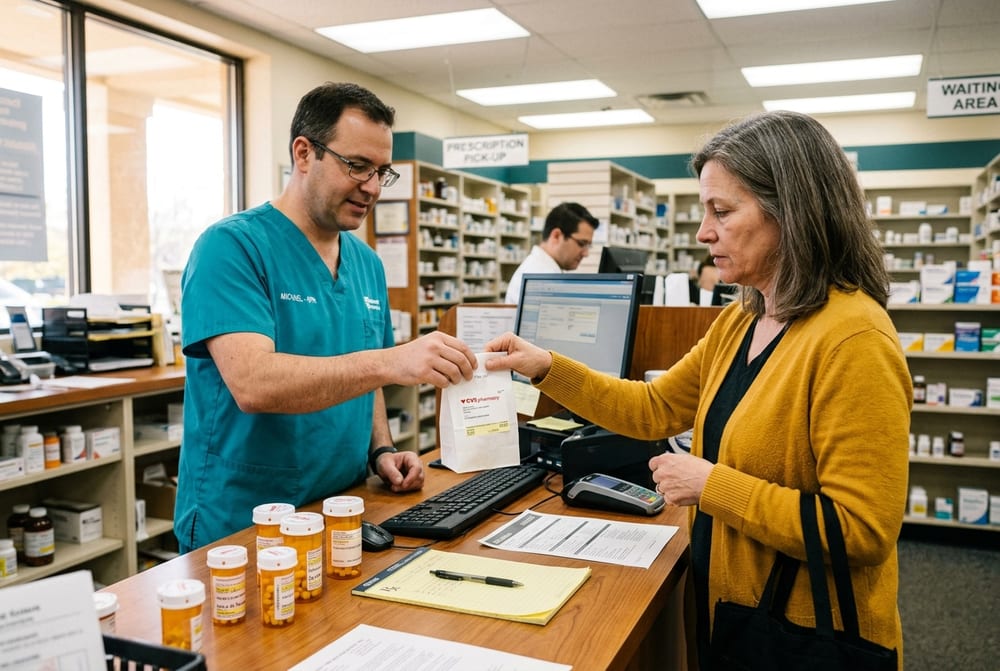
Estrace is the original prescription cream for vaginal dryness most clinicians reach for: 0.01% 17-beta-estradiol in a non-hormonal cream base, FDA-approved for moderate-to-severe vulvar and vaginal atrophy. Two to four grams nightly via applicator for one to two weeks, then one to three times weekly thereafter. The estradiol absorbs into the vaginal epithelium, restores cellular maturity, rebuilds blood flow and lubrication, and lowers vaginal pH toward premenopausal range over 8 to 12 weeks. Evidence is solid — multiple FDA-grade RCTs. Average retail $300 to $500 per month without insurance. Best for women whose insurance covers brand-name Estrace at a tolerable copay. Not the right pick if you are paying cash, because the next entry contains the identical molecule for one-fifth the price.
2. Premarin vaginal cream — the older guard
Premarin is a prescription cream for vaginal dryness that contains conjugated equine estrogens (CEE) derived from pregnant mares' urine — the same active class used in oral Premarin, the original 1942 hormone-replacement product. FDA-approved for vulvar and vaginal atrophy. Half a gram to two grams intravaginally, daily for two weeks then twice weekly. The estrogen mix is more chemically heterogeneous than 17-beta-estradiol — estrone, equilin, equilenin, and several other equine-specific estrogens. Meta-analyses do not show a clear efficacy advantage of Premarin over estradiol for genitourinary syndrome of menopause. Average retail $300 to $400 per month. Skip if you are vegan or want bioidentical estradiol specifically.
3. Estring vaginal ring — set it and forget it
Estring is a soft silicone ring that releases approximately 7.5 micrograms of 17-beta-estradiol per day for 90 days. Inserted by the patient, replaced every three months. The big advantages: no nightly vaginal dryness cream routine, no applicator mess, no remembering. Adherence is excellent because the dose is automatic. Systemic estradiol levels stay in the postmenopausal range. Average retail $300 to $450 for a 90-day ring — roughly $100 to $150 per month amortized. Best for women who want a low-touch routine or whose partner discomfort with cream is a barrier. Not for women who cannot place a ring comfortably, or with prolapse that displaces the ring.
4. Vagifem and Imvexxy — the vaginal suppository for dryness
Vagifem is a 10-microgram estradiol tablet inserted with a single-use applicator; Imvexxy is a 4 or 10-microgram softgel vaginal suppository for dryness that does not require an applicator. Both deliver low-dose estradiol with tight dose control. Daily for two weeks then twice weekly maintenance. The lower 4-mcg Imvexxy vaginal suppository for dryness is a useful option for women who want the lowest effective hormone exposure. Average retail $200 to $350 per month. Best for women who dislike vaginal dryness cream texture, who want precise micrograms-per-dose, or who want the lowest-systemic-dose estrogen product on the market. Not the best choice if you want maximum tissue contact (a vaginal dryness cream typically coats more surface area than a single suppository or tablet).
5. Compounded estradiol cream — the differentiator
This is the prescription cream for vaginal dryness the brand-name aisle does not stock and most ranking articles do not include. A 503A compounding pharmacy — operating under FDA section 503A, state board of pharmacy oversight, and USP <795> non-sterile compounding standards — prepares a patient-specific estradiol vaginal dryness cream from USP-grade 17-beta-estradiol API in a tailored base. The strength is set by the prescriber (commonly 0.01% to 0.05%); the volume is set to a 30-day supply; the inactive base can be selected for sensitivity (e.g., paraben-free, glycerin-free).
Why does a compounded estrogen cream for vaginal dryness make particular sense for vaginal use? Three reasons. First, systemic absorption is small. Low-dose vaginal estrogen produces minimal systemic estradiol — the FDA black-box warning is class-wide labeling rather than evidence of meaningful systemic risk at vaginal doses. That low systemic absorption makes compounded vaginal estrogen one of the lower-risk compounding categories. Second, individualized dosing matters. Some women respond at 0.01%, others need 0.025% or 0.05% to achieve tissue maturity; a compounded preparation can be titrated where a fixed-strength FDA product cannot. Third, cost is the most common reason women stop treatment. A prescription cream for vaginal dryness that works but costs $400 a month produces a different outcome than the same molecule at $89 a month — because the patient who can keep it up is the patient whose tissue stays restored.
The honest counter-argument: ACOG Committee Opinion 532 cautions against compounded bioidentical hormone therapy on grounds of potency variability and lack of FDA-approved standardized testing. That caution applies most strongly to systemic compounded BHRT. Vaginal estrogen is a different conversation: dose precision is forgiving, systemic effects are minimal, and the API is the same FDA-registered estradiol used in finished products. ClearedRx works exclusively with PCAB-accredited 503A pharmacies that perform third-party potency testing on every batch — the operational answer to ACOG's concern.
6. Replens — the leading vaginal dryness OTC moisturizer
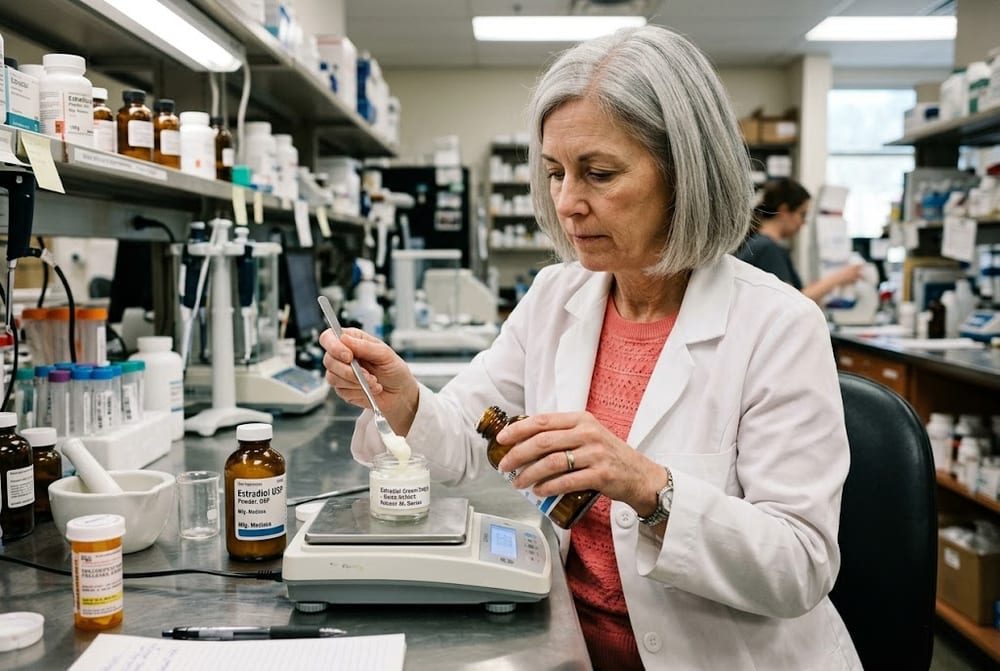
Replens is the leading vaginal dryness OTC product on most pharmacy shelves: a polycarbophil-based moisturizer applied every two to three days. It is not a lubricant — it works mechanically by adhering to the vaginal wall and slowly releasing water to the tissue, producing a hydration effect that lasts 48 to 72 hours. RCT data shows modest improvement in subjective dryness and dyspareunia in mild GSM, with effect sizes smaller than low-dose estrogen cream for vaginal dryness. Average retail $20 to $30 per month. Best for women with mild symptoms or who cannot use estrogen, and as a complement to a vaginal dryness cream containing estradiol during the first weeks before the estrogen has rebuilt tissue. It is not the best cream for vaginal dryness for moderate-to-severe GSM — that is a hormonal answer.
7. Hyaluronic-acid moisturizers (Hyalo Gyn) — the rising vaginal dryness OTC
Hyaluronic acid is a naturally occurring glycosaminoglycan that holds many times its weight in water. Vaginal dryness OTC hyaluronic-acid gels (Hyalo Gyn, Revaree, others) deliver a hydrating film to the vaginal epithelium two to three times per week. Small randomized trials comparing vaginal hyaluronic acid to estrogen cream for vaginal dryness found efficacy roughly comparable for mild symptoms over 8 to 12 weeks, with estrogen pulling ahead for more severe atrophy. Average retail $25 to $35 per month. Best for mild GSM, post-chemo dryness, and as a non-hormonal first-line trial.
Lubricants vs moisturizers vs estrogen — the vaginal dryness OTC reality
Drugstore aisles blur three completely different product categories. The vaginal dryness OTC shelf does not separate them, and the honest framing matters because each one solves a different problem.
Lubricants (silicone-based like Replens Silky Smooth, water-based like Astroglide, hyaluronic-based like Good Clean Love) are designed for use during intercourse only. They reduce friction in the moment. They do not moisturize the tissue or address atrophy. Vaginal moisturizers (Replens, Hyalo Gyn, Revaree) are the vaginal dryness OTC category proper — used 2 to 3 times per week independent of intercourse. They hydrate tissue mechanically and provide modest symptom relief. They do not restore the cellular architecture of the vaginal epithelium. Estrogen cream for vaginal dryness (compounded estradiol, Estrace, Premarin, Estring, Vagifem) treats the cause: it restores cellular maturity, glycogen content, lubrication, blood flow, and pH. A vaginal dryness cream that contains estradiol reverses the underlying tissue change of GSM rather than masking the surface symptom.
For a woman with mild dryness and otherwise normal vaginal tissue, a vaginal dryness OTC moisturizer plus a lubricant for intercourse is a reasonable plan. For a woman with moderate-to-severe genitourinary syndrome of menopause — measurable epithelial atrophy, recurrent UTIs, dyspareunia that does not respond to lubricant — that plan is treating a symptom of a treatable disease and walking past the actual cure. The 2020 NAMS Position Statement on the management of GSM is explicit that low-dose estrogen cream for vaginal dryness is first-line for moderate-to-severe symptoms, and that vaginal dryness OTC moisturizers are appropriate adjuncts or first-line for mild symptoms only. For more on the OTC framing, see our companion guide to vaginal dryness treatment and the genitourinary syndrome of menopause overview.
If you are treating GSM long-term, the math favors a prescription cream for vaginal dryness
Genitourinary syndrome of menopause is a chronic, progressive condition. The 2020 NAMS Position Statement is explicit that GSM does not regress when treatment stops — symptoms return within weeks to months once a prescription cream for vaginal dryness is discontinued. That is not a side note; that is the central financial fact. The decision is not "which vaginal dryness cream do I buy this month" — it is "which prescription cream for vaginal dryness do I buy this month and every month for the rest of my postmenopausal life."
Run the math at one decade. Replens at $25/month over 10 years is $3,000 — and you still have GSM. Estrace at $400/month over 10 years is $48,000 — and your tissue is restored. Compounded estradiol cream from a 503A pharmacy at $99/month over 10 years is $11,880 for the same restored tissue. The cost difference between brand-name and compounded estradiol over a decade — roughly $36,000 — is not a rounding error. It is a midsize used car. It is a year of college tuition. It is the difference between sustainably treating GSM and quietly stopping when the copay reset hits in January.
That is why we lead with the compounded vaginal dryness cream option for cost-conscious patients, and why compounded vaginal estrogen pricing is the question we get more than any other. Our companion piece on compounded vs FDA-approved vaginal estrogen walks through the regulatory differences in detail, and our timeline guide shows what to expect week-by-week. ClearedRx prescribes estradiol vaginal cream, Estring, and compounded HRT vaginal cream with 24-hour MD review, starting at $89 per month for compounded estradiol cream. For broader cost context across all HRT options, see our HRT cost comparison.
"Low-dose vaginal estrogen is the most effective treatment for moderate to severe GSM. There is no evidence that long-term, low-dose vaginal estrogen therapy increases the risk of breast or endometrial cancer." — The North American Menopause Society, 2020 Position Statement on GSM (Menopause, 2020)

If you are also dealing with hot flashes and night sweats
The best cream for vaginal dryness is the right tool for one symptom — but for a woman whose vaginal dryness arrived alongside hot flashes, night sweats, sleep that won't hold, mood changes, and the rest of the menopause picture, vaginal estrogen alone may be incomplete. Systemic hormone replacement therapy — typically transdermal estradiol plus oral micronized progesterone for women with a uterus — addresses the systemic estrogen deficiency that is driving multiple symptoms at once. Many women use both: a vaginal cream for the local tissue and a systemic patch or tablet for the broader symptom set.
Frame it the way a clinician should: vaginal estrogen treats one tissue. Systemic HRT treats the whole environment. Many women need one; many need both. Perimenopause vs menopause walks through which symptom-stage maps to which treatment, and menopause statistics 2026 covers the prevalence numbers across the constellation. ClearedRx prescribes both vaginal estrogen and systemic HRT in a single visit, with one MD reviewing the whole picture. Online intake, 24-hour review, ships nationwide.
Frequently asked questions
Is estrogen cream safe for breast cancer survivors?
Low-dose vaginal estrogen is considered by ACOG (Committee Opinion 659) to be acceptable for many breast cancer survivors with severe genitourinary syndrome of menopause symptoms when non-hormonal options have failed, after a shared-decision conversation with the patient's oncologist. Systemic absorption from low-dose vaginal estrogen is minimal and typically does not measurably raise circulating estradiol levels above postmenopausal baseline. Survivors on aromatase inhibitors should discuss the decision with their oncology team, since some oncologists prefer DHEA (Intrarosa) or non-hormonal moisturizers in that setting.
Can you use vaginal estrogen cream forever?
Yes — and most clinicians now recommend you do, if you tolerate it. The 2020 NAMS Position Statement on genitourinary syndrome of menopause is explicit that vaginal estrogen does not appear to require a stop date for symptom control, because GSM is a chronic, progressive condition that returns when treatment stops. There is no evidence that long-term low-dose vaginal estrogen increases breast cancer, endometrial cancer, or cardiovascular risk in women without a personal history of those conditions.
Does insurance cover vaginal estrogen cream?
Sometimes. Generic estradiol vaginal cream is often covered with a $20 to $80 copay; brand-name Estrace, Premarin, and Estring are increasingly subject to step-therapy or prior-authorization gates. Compounded estradiol cream is generally not covered by insurance, but is HSA and FSA eligible with a prescription. The cash price for compounded estradiol cream from a 503A pharmacy is typically lower than a brand-name copay even for women with good insurance.
What is the difference between Estrace and compounded estradiol cream?
The active ingredient is the same molecule — 17-beta-estradiol, identical to the estradiol your ovaries produced before menopause. The differences are in the FDA pathway, the inactive ingredients in the base, the strength (Estrace is fixed at 0.01%; compounded cream can be tailored from 0.01% to 0.05%), and the price. Estrace retails for roughly $300 to $500 a month without insurance; compounded estradiol cream from a 503A pharmacy typically runs $89 to $150 a month. ACOG cautions that compounded products are not FDA-approved and lack standardized testing across compounding pharmacies — but vaginal estrogen is a particularly low-risk compounding category because systemic absorption is small.
How long does it take vaginal estrogen cream to work?
Most women notice meaningful improvement in dryness, irritation, and discomfort with intercourse by week 3 to week 4 of consistent use, and full benefit by week 12. The 2020 NAMS Position Statement notes that lubrication and tissue elasticity continue to improve over the first 12 weeks. A loading dose (daily for two weeks, then twice weekly maintenance) is the standard regimen across cream, ring, and tablet formulations. See our week-by-week timeline for what to expect at each stage.
Can I use lubricant and estrogen cream together?
Yes — and it is often the right combination for the first few weeks before estrogen has rebuilt tissue. Use silicone-based or hyaluronic-acid-based lubricants for intercourse; avoid petroleum-based products with latex condoms. The estrogen cream addresses the cause (atrophied tissue and lost lubrication); a personal lubricant addresses the symptom in the moment. They are not substitutes for each other.
Are there natural alternatives that actually work for vaginal dryness?
Vaginal moisturizers based on hyaluronic acid or polycarbophil (Replens) provide modest, mechanical relief and are reasonable first-line OTC options for mild symptoms or for women who cannot use hormones. They do not reverse the underlying tissue atrophy of genitourinary syndrome of menopause. Coconut oil and vitamin E suppositories have low-quality supportive evidence; they may help comfort but do not restore vaginal pH or tissue thickness. For women with moderate-to-severe GSM, no non-hormonal option matches the efficacy of low-dose vaginal estrogen.
Why is compounded estrogen cream so much cheaper than Estrace?
Estrace was a brand-name FDA-approved product with associated NDA filing, post-marketing surveillance, and brand-channel distribution mark-ups. Compounded estradiol cream from a 503A pharmacy is a patient-specific preparation made under a state-licensed compounder's USP standards. The active pharmaceutical ingredient — 17-beta-estradiol USP — is the same; the cost difference is regulatory pathway, packaging, distribution, and brand premium, not molecule.
Should I see a gynecologist or use telehealth for a prescription?
Either is appropriate for uncomplicated genitourinary syndrome of menopause. NAMS and ACOG both endorse telehealth prescribing for low-dose vaginal estrogen in women without contraindications. In-person evaluation is preferred if you have abnormal bleeding, a prior breast cancer diagnosis, or symptoms that do not match a typical GSM picture. ClearedRx telehealth can prescribe compounded estradiol vaginal cream with 24-hour MD review, with referral to in-person care for any flag.
Does vaginal estrogen cream cause weight gain?
No. Low-dose vaginal estrogen produces minimal systemic absorption — circulating estradiol levels typically stay within or near the postmenopausal range during chronic use. Weight gain is a risk discussion for systemic HRT (oral, patch, or gel), not low-dose vaginal estrogen. The 2020 NAMS Position Statement on GSM separates vaginal estrogen from systemic HRT for exactly this reason.
Sources & references
- The North American Menopause Society. The 2020 Position Statement on the Management of Genitourinary Syndrome of Menopause. Menopause. 2020;27(9):976-992. PMID: 32852449
- Nappi RE, Kokot-Kierepa M. Vaginal Health: Insights, Views & Attitudes (VIVA) — results from an international survey. Climacteric. 2012;15(1):36-44. PMID: 22168244
- Kingsberg SA, Krychman M, Graham S, et al. The Women's EMPOWER Survey: Identifying Women's Perceptions on Vulvar and Vaginal Atrophy and Its Treatment. J Sex Med. 2017;14(3):413-424. PMID: 28202320
- American College of Obstetricians and Gynecologists. Committee Opinion No. 532: Compounded bioidentical menopausal hormone therapy. Obstet Gynecol. 2012;120:411-415. acog.org
- American College of Obstetricians and Gynecologists. Committee Opinion No. 659: The use of vaginal estrogen in women with a history of estrogen-dependent breast cancer. Obstet Gynecol. 2016;127:e93-e96. acog.org
- U.S. Food and Drug Administration. Section 503A of the Federal Food, Drug, and Cosmetic Act — Pharmacy Compounding. fda.gov
- Bachmann GA, Komi JO; Ospemifene Study Group. Ospemifene effectively treats vulvovaginal atrophy in postmenopausal women. Menopause. 2010;17(3):480-486. PMID: 20032798
- Chen J, Geng L, Song X, et al. Evaluation of the efficacy and safety of hyaluronic acid vaginal gel to ease vaginal dryness: a multicenter, randomized, controlled, open-label, parallel-group, clinical trial. J Sex Med. 2013;10(6):1575-1584. PMID: 23574713
- Bygdeman M, Swahn ML. Replens versus dienoestrol cream in the symptomatic treatment of vaginal atrophy in postmenopausal women. Maturitas. 1996;23(3):259-263. PMID: 8794418
- Internal: genitourinary syndrome of menopause · estradiol vaginal cream · menopause statistics 2026
Get a prescription estradiol cream — compounded or FDA-approved
Tell a board-certified MD what you're experiencing. ClearedRx prescribes compounded estradiol vaginal cream from a PCAB-accredited 503A pharmacy starting at $89/month, plus FDA-approved options if you prefer. 24-hour MD review, free shipping in all 50 states.
Find out if HRT is right for me