Last updated May 8, 2026
What menopause insomnia is
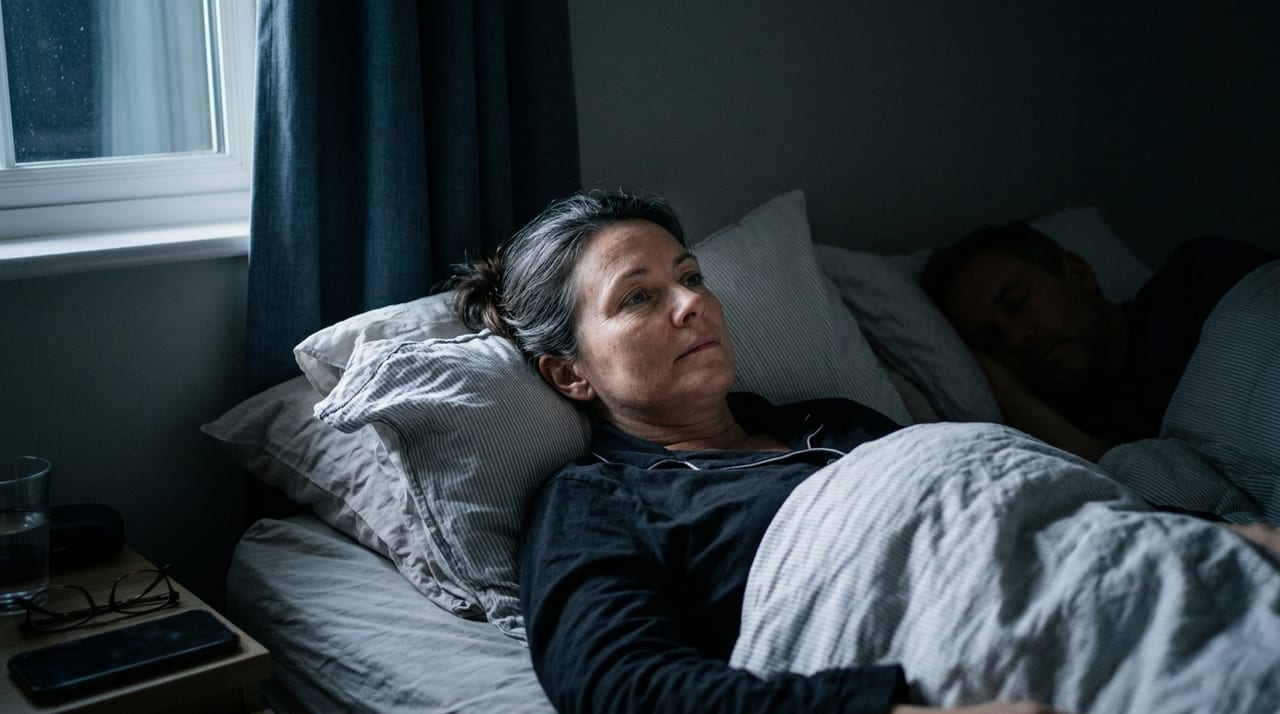
Menopause insomnia has a specific shape. You fall asleep okay. Then your eyes pop open at 2, 3, or 4 AM and you're wide awake — sometimes with your heart racing, sometimes drenched, sometimes just staring at the ceiling. You drag through the next day and start dreading bedtime. About 60% of women in perimenopause and menopause have this pattern.
The cause is a one-two punch. First, progesterone — the hormone that keeps you in deep sleep — drops in perimenopause. Second, night sweats jolt you awake on top of that. Your sleep architecture falls apart from both ends.
Want the science deep-dive? Read our full piece on progesterone for sleep — this page focuses on what to actually do about it. The NAMS 2022 Position Statement covers sleep as a primary indication for HRT.
Treatment options that work
Every option below has solid evidence for menopause-pattern insomnia, ranked by how directly it targets the root cause.
1. Bedtime oral micronized progesterone
How it works: When you swallow micronized progesterone (the bioidentical form), your liver breaks it down into allopregnanolone. That compound activates your brain's calm-down switch (GABA receptors) — the same pathway as anti-anxiety meds, but gentler and without next-day fog. The 100mg capsule at bedtime is the standard sleep dose.
How fast: Most women feel calmer within an hour of the first dose. Deeper sleep through the night usually lands by week 1 to 2.
Who it fits: Most women in perimenopause or menopause, with or without a uterus. If you have a uterus and take estrogen, you need progesterone anyway — bedtime dosing is the smart play.
Effectiveness: The 2011 placebo-controlled trial of 300mg oral progesterone showed measurable improvements in sleep architecture and quality.
Cost at ClearedRx: Progesterone tablets from $25/month.
2. Estradiol patch or gel (when night sweats are part of it)
How it works: If night sweats are jolting you awake, fixing them fixes the second half of the problem. Estradiol through the skin shuts down hot flashes within 2 to 4 weeks.
How fast: Sleep usually improves alongside hot flashes — meaningful change by week 4, full benefit by week 8 to 12.
Who it fits: Women whose insomnia is tied to night sweats specifically.
Cost: Estradiol patches from $29/month, estradiol gel from $39/month.
3. Cognitive behavioral therapy for insomnia (CBT-I)
How it works: A short-term structured program (usually 4 to 8 weekly sessions) that re-trains the wake-up reflex. Your therapist works on sleep restriction, stimulus control, and the catastrophic 3 AM thinking that keeps you awake.
How fast: 4 to 8 weeks. Effects last longer than sleep medications and often outperform them at 6-month follow-up.
Who it fits: Anyone — pairs well with HRT. Apps like Somryst (FDA-cleared digital CBT-I) work for women without local therapist access.
Effectiveness: The American College of Physicians recommends CBT-I as first-line for chronic insomnia.
4. Sleep hygiene fundamentals
These won't fix severe menopause insomnia alone but they multiply the effect of everything else:
- 65-degree bedroom. Cooler is harder to wake from.
- No alcohol after 6 PM. It's the most common 3 AM wake-up trigger.
- No screens for 60 minutes before bed. Blue light suppresses melatonin.
- Same bedtime and wake-up time, every day. Even weekends.
- If you can't sleep, get up. Lying awake trains your brain that bed = anxiety.
5. Non-hormonal sleep medications (last resort)
Trazodone, low-dose doxepin, and gabapentin are sometimes prescribed for menopause insomnia when HRT and CBT-I aren't enough or aren't options. Z-drugs (Ambien, Lunesta) work short-term but the FDA black-box warns about complex sleep behaviors and dependency. Most prescribers reserve these for short courses, not nightly use.
What ClearedRx prescribes for menopause insomnia
ClearedRx is built around the routes major menopause societies recommend first for sleep. The three most-prescribed options:
Progesterone tablets
From $25/month- Bedtime oral capsule (100mg or 200mg)
- Bioidentical micronized progesterone
- The single most effective sleep target in menopause
Estradiol patches
From $29/month- Twice-weekly patch
- Cuts night sweats that jolt you awake
- Skin route — skips the liver, lower clot risk
Estradiol gel
From $39/month- Daily pump applied to your arm
- Easier dose adjustments
- Pairs with bedtime progesterone
All ClearedRx plans include 24-hour board-certified MD review, free shipping, and monthly billing — no 3-month or 6-month upfront commitments. Your first order is 50% off.
When to see a doctor in person
Most menopause insomnia is treatable through telehealth. A few situations warrant in-person evaluation first:
- You snore loudly or your partner says you stop breathing. Sleep apnea is the most commonly missed cause of midlife insomnia in women — and it gets worse in menopause. A home sleep study takes one night and changes the whole treatment plan.
- You feel exhausted after 8 hours in bed. Restorative sleep that doesn't restore points to apnea, restless legs, or thyroid issues, not just hormones.
- You wake gasping or with morning headaches. Apnea red flag.
- Your insomnia comes with deep depression or thoughts of self-harm. That's a primary mental-health concern that needs in-person care first.
- Restless legs that get worse at night. Often iron-deficiency related — needs blood work.
For everyone else, telehealth HRT plus CBT-I is a faster, cheaper path to real sleep. We laid out the full comparison in ClearedRx vs in-person HRT clinics.
Common questions about menopause insomnia
Why do I wake up at 3 AM in menopause?
Progesterone — the hormone that keeps you in deep sleep — drops first in perimenopause. Without it, you fall asleep easily but bounce out of deep sleep around 2 to 4 AM. Night sweats add a second hit. Bedtime oral progesterone targets this pattern directly.
Will progesterone help me sleep?
Oral micronized progesterone at bedtime is one of the most underrated menopause sleep treatments. Your body breaks it down into allopregnanolone — a compound that activates your brain's calm-down switch. Most women feel calmer within an hour and sleep deeper within 1 to 2 weeks. Topical creams do not produce the same effect.
How long does it take for HRT to fix menopause insomnia?
Bedtime oral progesterone usually helps the first night and reaches full effect by week 2 to 3. Estrogen takes longer because it works indirectly by shutting down night sweats. Most women see meaningful improvement within 4 to 8 weeks of starting full HRT.
Should I take melatonin or progesterone?
They do different things. Melatonin shifts your body clock — useful for jet lag, less useful for the 3 AM wake-ups of menopause. Progesterone deepens sleep architecture. For menopause-pattern insomnia, bedtime oral progesterone has stronger evidence and a clearer mechanism.
What if my insomnia isn't menopause?
Sleep apnea is the most commonly missed cause of midlife insomnia in women. Snoring, gasping awake, and morning headaches are red flags. Restless legs, thyroid disease, anxiety, and certain medications can also cause insomnia that feels like menopause. A good prescriber rules out these causes first.
Is it safe to take progesterone every night?
Yes — bedtime oral micronized progesterone is approved for daily use as part of HRT. Side effects are mild: occasional morning grogginess (uncommon at 100mg), breast tenderness, mild bloating early on. Long-term safety data are reassuring for healthy women.
The bottom line
Sleep is fixable. The right combination depends on your symptom pattern, your health history, and whether sleep apnea has been ruled out. ClearedRx prescribers review your full history first, then recommend the right route.
Get a doctor's sleep plan in 24 hours
Tell us how your sleep is broken. A ClearedRx prescriber reviews your story and recommends the right route. Monthly billing — no 6-month upfront.
Get My Sleep Protocol