
Last reviewed May 9, 2026
Quick answer: Of the 12 most-searched vaginal dryness natural remedies, only 4 have published clinical trials specifically for vaginal mucosa hydration: hyaluronic acid gel (Hyalo Gyn, multiple RCTs), polycarbophil moisturizer (Replens, Phase III RCT), virgin coconut oil (one 2023 pilot, n=21), and sea buckthorn oil (one 2014 double-blind RCT, n=116). Vaseline, evening primrose, "natural estrogen" supplements, and OTC DHEA do not. Vaginal dryness natural remedies relieve surface symptoms; if your tissue has thinned from estrogen decline, only estrogen restores it. ClearedRx prescribes compounded estradiol vaginal cream from a 503A pharmacy starting at $89/month with 24-hour MD review.
The 60-second tier ranking
If you're here because of a Reddit thread at midnight
You searched "vaginal dryness natural remedies" because asking your gynecologist felt like one more humiliation in a year already full of them. You ended up on a forum where someone swore by coconut oil, someone else by Vaseline, someone else by an evening-primrose-and-maca combo their naturopath put together. You ordered three of them. Three weeks later your underwear smells off, sex is still uncomfortable, and you're back to searching at midnight.
You are not the problem. The internet is the problem. Almost every "vaginal dryness natural remedies" article on the first page of Google is a list of 12 to 15 options with zero ranking, zero evidence grade, and the standard "talk to your doctor" disclaimer that does not actually tell you which ones work. So you try everything in parallel. None of it gets a fair trial. The one product category with published RCTs - vaginal moisturizers - gets buried below coconut oil because coconut oil is more shareable on social media.
This article is the conversation you should have been offered the first time you searched. We pulled clinical trial counts on the 12 most-searched options. Four have RCTs specifically for vaginal mucosa hydration. Eight do not. Here is the honest tier-ranked breakdown - the moisturizer-vs-lubricant distinction that explains 80% of the confusion, the pH-and-microbiome story most articles skip, and the moment when you should stop trying remedies and consider what actually rebuilds the tissue.
"Wait, aren't moisturizers and lubricants the same thing?"
This is the pattern interrupt. The single biggest reason these products fail is that women buy a lubricant when they need a moisturizer. The two solve different problems:
- A moisturizer (Replens, Hyalo Gyn, Revaree) is used every 2 to 3 days regardless of sexual activity. It hydrates the vaginal mucosa over time, the way a face moisturizer hydrates skin. Benefit accumulates - week 4 looks better than week 1.
- A lubricant (silicone, water-based, hybrid) is used only during intercourse. It does nothing for daily dryness, itching, or burning. Evaporates within an hour.
If your dryness is constant - underwear sticking, walking uncomfortable - you need a moisturizer. If discomfort only shows up during sex, a lubricant alone might be enough. Most women with menopause-related dryness need both. Almost every "best natural remedies" listicle conflates the two, which is why women use KY Jelly three times a week and wonder why nothing changes.
Of the 12 most-searched options, only 4 hold up to clinical trials.
For each remedy below, we searched PubMed and PMC with "vaginal dryness," "vaginal atrophy," or "GSM" in randomized controlled trial filters as of May 2026. The numbers are sobering.
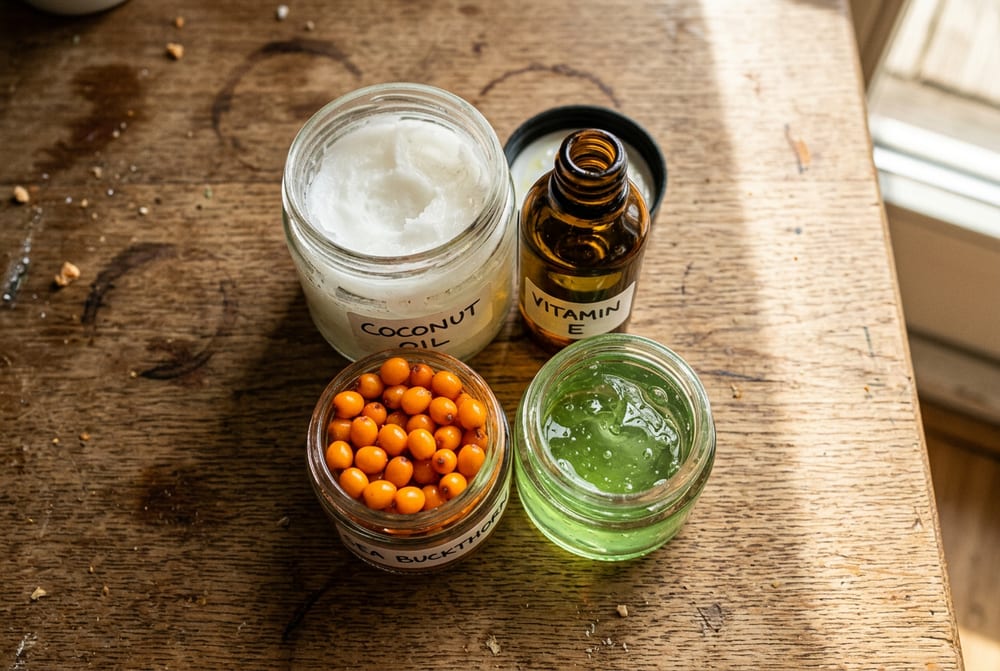
The four that hold up: hyaluronic acid vaginal gel (multiple RCTs including Hyalo Gyn 2021, n=80), polycarbophil-based moisturizer Replens (Phase III RCT in breast cancer survivors, JCO 1997; multiple subsequent comparison trials), virgin coconut oil (one 2023 pilot, Cureus, n=21, no placebo), and oral sea buckthorn oil (one 2014 double-blind RCT, Maturitas, n=116). Everything else - Vaseline, evening primrose, maca, "natural estrogen" supplements, OTC DHEA, plain oral vitamin E - has zero published RCTs specifically for vaginal mucosa hydration.
Tier 1: Genuinely evidence-supported moisturizers
These are the only vaginal dryness natural remedies with serious published evidence. If you buy one product from this whole article, buy from this tier.
Hyaluronic acid vaginal gel (Hyalo Gyn, Revaree, generic HA gel)
Hyaluronic acid is a sugar molecule that holds up to 1,000 times its weight in water. Applied vaginally as a gel, it draws water into the mucosa. The Hyalo Gyn 2021 trial (Pertyński et al., Menopause Review) randomized 80 postmenopausal women to Hyalo Gyn vs water-based control and found statistically significant improvement in dryness scores at 3 months. Subsequent head-to-head trials show hyaluronic acid is roughly as effective as low-dose vaginal estriol for mild-to-moderate atrophy (Costantino & Guaraldi 2008; Jokar et al. 2016).
How to use: One applicator every 2 to 3 days. pH-buffered to 4.0-4.5. Cost: ~$25-$40/month. Caveat: hydrates surface, does not rebuild tissue. Sufficient indefinitely for mild dryness; adjunct to estrogen for moderate-to-severe GSM.
Polycarbophil-based moisturizer (Replens)
Replens is the only nonhormone vaginal moisturizer with a Phase III double-blind RCT. Loprinzi et al. (JCO 1997, n=45 breast cancer survivors) found a 64% reduction in dryness scores and 60% improvement in dyspareunia. Subsequent head-to-head trials (Nachtigall 1994; Bygdeman & Swahn 1996) found Replens approaches local estrogen on dryness scores short term, though not on tissue maturation.
How to use: One applicator every 3 days. Cost: ~$18-$25/month. Caveat: the polycarbophil bioadhesive leaves slight residue some women dislike. Most-studied nonhormone option, period.
Practical takeaway: of every product in every "natural remedies" article you have ever read, the two with the strongest published evidence are Replens and Hyalo Gyn. Run an 8-week trial on either before buying anything else.
Tier 2: Lubricants that work, but only during sex
The Tier 2 products do something real, but only in a narrow window. They are useful as adjuncts. They are not solutions to constant daily dryness.
Silicone-based personal lubricants
The most evidence-supported lubricant category. Silicone is inert, does not absorb into mucosa, is latex-condom-compatible, and lasts 30 to 90 minutes. Default NAMS 2020 recommendation for sexual-activity comfort. Does absolutely nothing for non-sex daily dryness - this is Tier 2, not Tier 1.
Water-based and hybrid lubricants
Water-based lubricants (Sliquid, Good Clean Love) are condom- and toy-compatible but evaporate within 10 to 20 minutes. Glycerin-free, paraben-free, pH-balanced (3.8-4.5) is the rule - high-osmolality water-based lubricants have been associated with epithelial damage in WHO bench studies. Hybrid (water-silicone blend) lubricants split the difference.
Coconut oil for vaginal dryness (the Reddit favorite)
Coconut oil for vaginal dryness is the most-discussed natural option online and one of the most over-claimed. Honest evidence: Salido-Burgos et al. (Cureus 2023, n=21) ran a single-arm pilot of intra- and peri-vaginal virgin coconut oil paste. 83% reported improved dryness; 87% reported improved moisture duration. Small study, no placebo, one trial.
Caveats on coconut oil for vaginal dryness: (1) oil-based - degrades latex condoms within minutes; (2) lauric acid is antimicrobial broadly including against beneficial Lactobacillus, occasionally provoking yeast/BV; (3) does nothing for estrogen-driven tissue thinning.
How to use coconut oil for vaginal dryness if you try: organic, virgin, unrefined only. Pea-sized amount externally as needed, or 1/4 teaspoon internally on a panty liner overnight 3x/week. The "how to use coconut oil for vaginal dryness" answer nobody gives honestly online: stop at 4 weeks if not measurably better, and never with latex condoms.
The pH and microbiome angle most articles skip
Healthy premenopausal vaginal pH sits between 3.5 and 4.5, maintained by Lactobacillus species producing lactic acid. After menopause, estrogen-dependent glycogen drops, Lactobacillus populations crash, and pH drifts to 5.0 or higher. The 2020 NAMS GSM Position Statement and microbiome work (Brotman et al., Menopause 2014; Mitchell & Marrazzo, Curr Opin Microbiol 2020) describe the postmenopausal vagina as a fundamentally different microbial ecosystem - higher pH, more BV, UTIs, and vulvar irritation.
The pH of whatever you put inside the vagina matters as much as what is in it. Several popular options fail this test:
- Vaseline: non-pH-buffered, hard to clear, associated with increased BV in case-control data.
- Mineral oil / "natural" baby oil: same problems as Vaseline.
- Glycerin-heavy water-based lubricants: high osmolality (>1200 mOsm/kg) draws water out of epithelial cells (WHO 2012).
- Yogurt vaginally: wrong Lactobacillus strain (L. bulgaricus, not L. crispatus), high sugar feeds Candida, zero evidence.
Tier 1 products are deliberately pH-buffered to 4.0-4.5 - that is part of why they outperform homemade oils. If nonhormone treatment is your strategy, the pH question is the one to ask first about every product on your shelf.
Tier 3: Popular but evidence-thin (most herbs for vaginal dryness live here)
The Tier 3 products show up in every "vaginal dryness natural remedies" listicle. Most herbs for vaginal dryness sold in the supplement aisle land in this tier - they have small studies, real-but-weak mechanisms, and real anecdotes. They also have nothing close to the evidence base of Tier 1. Try them only after Tier 1, and only with a 4-to-8-week stop-and-reassess. Note: when shopping for herbs for vaginal dryness, the question to ask is not "is this natural" but "is there a published RCT" - the answer for most herbs marketed for this purpose is no.
Vitamin E vaginal suppositories
The 2022 systematic review (Park, Hwang & Cho, J Menopausal Med 2022, PMC9086347) found 4 small RCTs of vaginal vitamin E for GSM, all under 100 participants. Vitamin E suppositories outperformed placebo (one 8-week trial, n=42, mean difference 5.3 on symptom scale); vaginal estrogen still outperformed vitamin E on tissue maturation. Verdict: small RCTs, real signal, modest effect; reasonable third-line. Oral vitamin E does NOT have RCT evidence for vaginal dryness - the route matters.
Sea buckthorn oil (the best supplement for vaginal dryness with actual RCT evidence)
Sea buckthorn berries are rich in palmitoleic acid (omega-7), concentrated in mucosal tissue. Larmo et al. (Maturitas 2014, n=116, double-blind placebo-controlled) randomized postmenopausal women to 3g oral sea buckthorn oil daily vs placebo for 3 months. Vaginal epithelial integrity improved significantly more in the sea buckthorn group (OR 3.1; 95% CI 1.11-8.95). Verdict: the best supplement for vaginal dryness with actual RCT evidence. Cost ~$20-30/month. Of supplements sold for this, this is the only systemic one with a real placebo-controlled trial.
Aloe vera in formulated vaginal gels
One small Iranian RCT (Mansouri et al. 2017, n=60) found a 5% aloe vera vaginal cream improved dryness vs placebo at 6 weeks. Verdict: reasonable in formulated products. Do NOT apply raw aloe plant gel internally - osmolality, pH, and contamination risks are real. Combination products with aloe + HA + pH buffering are plausible Tier 1.5 options.
Tier 4: Skip these
The Tier 4 products are either harmful, useless, or actively interfere with vaginal microbiome health. Listing them is a public-service section of any honest vaginal dryness natural remedies article.
Vaseline for vaginal dryness
Vaseline for vaginal dryness shows up on Reddit threads. Skip it: (1) Vaseline degrades latex condoms within 60 seconds (Voeller, Contraception 1989); (2) Vaseline for vaginal dryness is associated with bacterial vaginosis (Brown, Obstet Gynecol 2013); (3) no published RCTs support Vaseline for vaginal dryness, and petroleum jelly's occlusive properties interfere with normal mucosal physiology.
Vaseline for vaginal dryness is the lowest-evidence, highest-risk choice on the entire vaginal dryness natural remedies shelf. Use a Tier 1 moisturizer (Replens, Hyalo Gyn) instead.
OTC DHEA supplements (oral)
FDA-approved prescription vaginal DHEA (Intrarosa/prasterone) has solid RCT evidence for moderate-to-severe GSM (Labrie, Menopause 2016). Oral OTC DHEA pills are NOT the same: inconsistent doses, do not target vaginal mucosa, no RCT evidence for vaginal dryness. If you want DHEA, you want prescription Intrarosa or a compounded suppository - not the GNC shelf.
"Natural estrogen" and phytoestrogen herbs for vaginal dryness
The category sold as "herbs for vaginal dryness" - black cohosh, red clover, soy isoflavone capsules, evening primrose, dong quai, "natural HRT" branded blends - has no published RCTs for vaginal dryness. Most have been studied for hot flashes (mixed results), not vaginal mucosa hydration. The phytoestrogen content is roughly 1/1,000th the potency of estradiol on estrogen receptors and does not rebuild tissue.
If you spend $50/month on one of these, that money buys 2 months of a Tier 1 product or a month of compounded estradiol vaginal cream. The honest answer to "what's the best supplement for vaginal dryness" is sea buckthorn oil (one RCT) or, in most cases, a Tier 1 topical moisturizer instead of any supplement.
Yogurt, douching, scented soaps, "feminine hygiene" sprays
Yogurt vaginally: wrong Lactobacillus strain, sugar feeds yeast, no evidence. Douching: associated with BV and PID, never recommended. Scented soaps and sprays irritate fragile postmenopausal mucosa and make dryness worse. Soap never goes inside the vagina, premenopausal or post-.

When natural remedies aren't enough
Here is the framing most articles dodge. Moisturizers, lubricants, and supplements treat surface symptoms. They do not rebuild vaginal mucosal tissue. After menopause the vaginal walls thin (vulvovaginal atrophy, part of the broader genitourinary syndrome of menopause). Estrogen-dependent glycogen drops. Lactobacillus collapse. Connective tissue loses elasticity. The clitoris and labia minora can shrink. Urinary urgency starts. UTIs recur.
None of that is fixable by a moisturizer. The 2020 NAMS GSM Position Statement (PMID 32852449) states the case plainly: "nonhormone therapies available without a prescription provide sufficient relief for most women with mild symptoms. Low-dose vaginal estrogens, vaginal DHEA, systemic estrogen therapy, and ospemifene are effective treatments for moderate to severe GSM." Translation: nonhormone options work for mild symptoms. For thinned atrophic tissue with daily pain, recurrent UTIs, and painful sex - estrogen restores the tissue, and no natural remedy substitutes because none carry estrogen.
Decision tree: if your dryness is intermittent and mild, run an 8-to-12-week trial of a Tier 1 moisturizer. If at week 12 you still have painful sex, urinary symptoms, or recurrent UTIs, you have moderate-to-severe GSM, and these natural remedies have hit their ceiling. Next step: low-dose vaginal estrogen. See our compounded vs FDA-approved vaginal estrogen deep-dive and how long until vaginal estrogen cream works.
The honest bridge: when compounded estradiol cream fits
Compounded estradiol vaginal cream is not a natural remedy in the strict sense - it is a prescription. It is also the same molecule (17-beta estradiol) your body produced before menopause, and it is the most direct fix for the actual mechanism behind menopause-related dryness. After 8 to 12 weeks of nightly use tapered to twice weekly, vaginal pH normalizes, Lactobacillus return, tissue thickens, urinary symptoms improve, and most women find sex genuinely comfortable again.
For women who tried Tier 1 moisturizers for 12 weeks and still have daily symptoms, this is the bridge. ClearedRx prescribes compounded estradiol vaginal cream from a 503A pharmacy starting at $89/month with 24-hour MD review and free shipping in all 50 states. We also prescribe FDA-approved options like the Estring vaginal ring. For the cost picture without insurance see our compounded vaginal estrogen cost without insurance breakdown. For prescription cream options head-to-head, read best cream for vaginal dryness.
"Nonhormone therapies available without a prescription provide sufficient relief for most women with mild symptoms. Low-dose vaginal estrogens, vaginal DHEA, systemic estrogen therapy, and ospemifene are effective treatments for moderate to severe GSM." - The 2020 Genitourinary Syndrome of Menopause Position Statement, The North American Menopause Society (PMID 32852449)
Frequently asked questions
Does coconut oil really help vaginal dryness?
It can help some women, but the evidence is one 2023 pilot (Salido-Burgos et al., Cureus, n=21, no placebo) showing 83% reported improved dryness with virgin coconut oil paste. Coconut oil for vaginal dryness has two real limitations: it degrades latex condoms within minutes, and it can disrupt vaginal pH (the lauric acid is broadly antimicrobial). It does nothing for the underlying tissue thinning of estrogen decline. How to use coconut oil for vaginal dryness if you try: pea-sized amount externally as needed, or 1/4 teaspoon internally on a panty liner overnight 3x/week. Stop-and-reassess at 4 weeks.
Is vaseline safe for vaginal dryness?
No - skip it. Vaseline for vaginal dryness is the lowest-evidence highest-risk option on the shelf: it degrades latex condoms in under 60 seconds (Voeller, Contraception 1989), is associated with bacterial vaginosis (Brown, Obstet Gynecol 2013), and there is no published RCT supporting vaseline for vaginal dryness as an effective treatment. Use a Tier 1 moisturizer (hyaluronic acid or polycarbophil) instead.
What's the difference between a vaginal moisturizer and a lubricant?
The single most important distinction. A moisturizer (Replens, Hyalo Gyn, Revaree) is used every 2-3 days regardless of sex to hydrate the mucosa over time. A lubricant (silicone, water-based) is used only during intercourse for friction reduction and does nothing for daily dryness. Constant dryness needs a moisturizer. Sex-only discomfort needs a lubricant. Most women with menopause-related dryness need both.
Are there supplements that actually help with vaginal dryness?
Mostly no. Only sea buckthorn oil has a published double-blind RCT (Larmo, Maturitas 2014, n=116) showing improvement in vaginal epithelial integrity at 3g/day for 3 months. Evening primrose, black cohosh, maca, and "natural estrogen" blends have no RCTs for this. The best supplement for vaginal dryness with actual evidence is sea buckthorn oil. Anything you swallow underperforms products you apply locally.
Can I use natural remedies WITH estrogen cream?
Yes, and often the right answer. Estrogen restores tissue thickness over 8-12 weeks; moisturizers and lubricants give immediate relief meanwhile. The 2020 NAMS GSM Position Statement endorses combining nonhormone moisturizers with low-dose vaginal estrogen for moderate-to-severe symptoms. Most ClearedRx patients use HA moisturizer alongside compounded estradiol cream weeks 1-8, then taper.
How long should I try natural remedies before considering a prescription?
Eight to twelve weeks is a reasonable trial of the Tier 1 vaginal dryness natural remedies above (moisturizer 3x weekly, lubricant for sex). Improvement should be noticeable by week 4, meaningful by week 8. If at week 12 you still have daily dryness, painful sex, urinary urgency, or recurrent UTIs, those are signs of GSM nonhormone products cannot fix - they cannot rebuild estrogen-dependent tissue. NAMS: nonhormone therapies suffice for mild symptoms; moderate-to-severe GSM requires low-dose vaginal estrogen, DHEA, or systemic HRT.
Why does vaginal pH matter for natural remedies?
Premenopausal vaginal pH sits at 3.5-4.5, maintained by Lactobacillus producing lactic acid. After menopause, estrogen-dependent glycogen drops, Lactobacillus crash, pH drifts to 5.0+ - which is why postmenopausal women get more BV, UTIs, and itching. Vaseline, mineral oil, and coconut oil for some women disrupt pH or feed wrong bacteria. Tier 1 products are pH-buffered to 4.0-4.5 - part of why they outperform homemade oils.
Do menopausal vitamins help with vaginal dryness?
Menopause multivitamins have no RCT evidence for vaginal dryness. Two micronutrients with limited evidence: vitamin E (vaginally as 100 IU suppository, not orally - small RCTs in J Menopausal Med 2022) and oral sea buckthorn oil (one 2014 RCT). Oral vitamin D, B-complex, magnesium do not move the needle. The best supplement for vaginal dryness with actual published evidence is sea buckthorn oil.
What about evening primrose oil?
Evening primrose oil has been studied for hot flashes and breast tenderness. It has no published RCT for vaginal dryness or atrophy, despite frequent listing in herbs for vaginal dryness blog posts. The mechanism (gamma-linolenic acid) does not address mucosal estrogen deficiency. Skip it. If you want a systemic supplement, sea buckthorn oil has the actual RCT evidence.
Are there any actually-helpful natural alternatives to prescription estrogen?
For mild dryness only, yes: a Tier 1 HA or polycarbophil moisturizer 3x/week plus silicone lubricant for sex is the evidence-supported nonhormone protocol endorsed by the 2020 NAMS GSM Position Statement. For moderate-to-severe GSM (daily dryness, painful sex, recurrent UTIs), no nonhormone product substitutes for estrogen because the problem is estrogen-dependent atrophy. Compounded estradiol cream is the same molecule your body produced before menopause and restores tissue thickness over 8-12 weeks. ClearedRx prescribes it from a 503A pharmacy starting at $89/month with 24-hour MD review.
Sources & references
- The 2020 Genitourinary Syndrome of Menopause Position Statement of The North American Menopause Society. Menopause. 2020;27(9):976-992. PMID 32852449
- Loprinzi CL, Abu-Ghazaleh S, Sloan JA, et al. Phase III randomized double-blind study to evaluate the efficacy of a polycarbophil-based vaginal moisturizer in women with breast cancer. J Clin Oncol. 1997;15(3):969-973. PMID 9060535
- Pertyński T, Stachowiak G, Stetkiewicz T. Hyaluronate-based vaginal gel (Hyalo Gyn) for vulvovaginal atrophy: randomized controlled trial. Menopause Rev / Prz Menopauzalny. 2021. PMID 34096694
- Costantino D, Guaraldi C. Effectiveness and safety of vaginal suppositories for the treatment of vaginal atrophy in postmenopausal women: an open, non-controlled clinical trial. Eur Rev Med Pharmacol Sci. 2008. PMID 19146203
- Salido-Burgos LV, Blasco-Hernández T, et al. Virgin Coconut Oil in Paste Form as Treatment for Dyspareunia and Vaginal Dryness in Patients With and Without Rheumatic Autoimmune Diseases: An Efficacy and Safety Assessment Pilot Study. Cureus. 2023;15(6):e40743. PMID 37461787
- Larmo PS, Yang B, Hyssälä J, Kallio HP, Erkkola R. Effects of sea buckthorn oil intake on vaginal atrophy in postmenopausal women: A randomized, double-blind, placebo-controlled study. Maturitas. 2014;79(3):316-321. PMID 25104582
- Park J, Hwang S, Cho A. Vaginal Vitamin E for Treatment of Genitourinary Syndrome of Menopause: A Systematic Review of Randomized Controlled Trials. J Menopausal Med. 2022. PMC9086347
- Mansouri H, Khorvash F, et al. Effect of vaginal aloe vera cream on vulvovaginal atrophy in postmenopausal women: a randomized clinical trial. Iran J Nurs Midwifery Res. 2017.
- Voeller B, Coelho IM, Mayer KH, et al. Mineral oil lubricants and the integrity of latex condoms. Contraception. 1989;39(1):95-102. PMID 2540955
- Brown JM, Hess KL, Brown S, et al. Intravaginal practices and risk of bacterial vaginosis and candidiasis infection. Obstet Gynecol. 2013;121(4):773-780.
- Brotman RM, Shardell MD, Gajer P, et al. Association between the vaginal microbiota, menopause status, and signs of vulvovaginal atrophy. Menopause. 2014;21(5):450-458.
- Internal: genitourinary syndrome of menopause · estradiol vaginal cream · Estring vaginal ring · menopause statistics 2026 · menopause symptom score · best cream for vaginal dryness · compounded vs FDA-approved vaginal estrogen · compounded vaginal estrogen cost without insurance · how long until vaginal estrogen cream works
Tried natural remedies for 12 weeks and still dry?
If a Tier 1 moisturizer didn't fix it, your tissue may have thinned past the point a moisturizer can reach. ClearedRx prescribes compounded estradiol vaginal cream from a 503A pharmacy starting at $89/month - same molecule your body made before menopause - with 24-hour MD review and free shipping in all 50 states.
Find Out If HRT Is Right For Me