
Last reviewed May 10, 2026
Quick answer: Perimenopause cramps without a period are usually anovulatory cycles or endometrial atrophy — both benign and estrogen-mediated. But fibroids flare in the same hormonal window, adenomyosis often worsens before resolving post-menopausally, and pelvic floor dysfunction commonly masquerades as uterine cramping. The cramp pattern tells you which one — and which needs imaging. Any bleeding after menopause is urgent regardless of cramps (NAMS 2022).
The 60-second version
If you're 48 and cramping without bleeding, this is for you
You're 48. Your last period was four months ago. Yesterday you had two days of cramps that felt like the prelude to a period — the same dull pull in your lower abdomen, the same heat, the same urge to lie down with a pillow against your stomach — and not a drop of blood followed. You opened the bathroom drawer where the tampons live and looked at the box for a minute. You took a pregnancy test out of force of habit. Negative. You went to bed thinking maybe tomorrow. The cramps faded by the next afternoon. There was no bleeding. There was no period.
You are not imagining it. This is one of the most disorienting symptoms of the perimenopause transition because the entire pattern recognition system you spent thirty years building was based on "cramps mean a period is starting." When the cramps show up and the period does not, the brain searches for an explanation. Almost every search ends up at the same vague answer: perimenopause is confusing. That is not an answer. There are five distinct mechanisms that produce perimenopause cramps without a period, and you can tell them apart by what the cramps feel like, when they hit, and what is happening in the rest of your body.
This article is the differentiated explainer. We will walk through each of the five mechanisms — anovulatory cycles, endometrial atrophy, fibroids, adenomyosis, pelvic floor dysfunction — with the specific cramp pattern that points to each. We will cover when to get imaging (and what kind), what helps each mechanism, and when cramping crosses into urgent-workup territory. The most important rule appears throughout: any bleeding after 12 months without a period is urgent regardless of cramps, and that rule does not bend.

Most articles lump all perimenopause cramps without a period into one explanation. There are five distinct mechanisms, each with a different pattern and a different action.
Pulling from Hale et al.'s 2014 Climacteric review of bleeding patterns in perimenopause, Wegienka et al.'s 2003 prevalence data on fibroids by age, Vannuccini et al.'s 2017 Human Reproduction Update review of adenomyosis epidemiology, the 2022 NAMS Hormone Therapy Position Statement on bleeding workup, and ACOG Practice Bulletin 226 on the PALM-COEIN framework for abnormal uterine bleeding — five distinct mechanisms produce perimenopause cramps without bleeding, and they require different responses.
Citations: Hale GE, Hughes CL, Burger HG. Atypical estradiol secretion and ovulation patterns in perimenopause. Climacteric. 2014;17 Suppl 2:5-9. PMID: 24502443 · Wegienka G, et al. Self-reported heavy bleeding associated with uterine leiomyomata. Am J Epidemiol. 2003;157(7):641-647. PMID: 12628866 · Vannuccini S, Petraglia F. Recent advances in understanding and managing adenomyosis. Hum Reprod Update. 2017;23(6):723-737. PMID: 28910899 · NAMS 2022 Hormone Therapy Position Statement. Menopause. 2022;29(7):767-794. PMID: 35797481 · ACOG Practice Bulletin 226: Diagnosis and management of abnormal uterine bleeding. Obstet Gynecol. 2020;136(2):e88-e102. PMID: 32852927.
The five distinct mechanisms
Each section below covers one mechanism. The order matters: anovulatory cycles are most common and most benign; the list ends with the most under-recognized mimic. The key insight is that the same surface symptom — perimenopause cramps without a period — comes from physiologically different sources, and the right treatment depends on which one is driving yours.
1. Anovulatory cycles — the phantom period
This is the most common explanation for perimenopause cramps without a period. In a normal cycle, your ovary recruits a follicle, estrogen rises, an LH surge releases the egg (ovulation), the corpus luteum produces progesterone, the endometrium thickens, and if no pregnancy occurs the lining sheds about two weeks later, producing your period. In an anovulatory cycle, the first half of that process happens — estrogen rises, the follicle develops, prostaglandins are released into the local uterine environment — but ovulation fails. The corpus luteum never forms. Progesterone never surges. The endometrium doesn't shed in the typical synchronized way. But the prostaglandins are already in circulation, and prostaglandins are exactly what produce the muscle-contraction cramping of a period.
The result: you feel the cramps your body was preparing to use, but you do not get the bleeding. Hale, Hughes, and Burger's 2014 Climacteric review documented that anovulatory cycles become progressively more common through late perimenopause — by the year before the final menstrual period, more than half of cycles fail to ovulate. The cramping pattern is mid-cycle (around when ovulation would have occurred), sharp and brief, often lasting one to three days. There is no bleeding because the hormonal cascade for shedding never completes. This is the textbook "phantom period." It is benign in itself. The cramps are usually mild-to-moderate, respond to NSAIDs, and resolve as cycles either eventually do ovulate again or stop entirely.
The clinical action for anovulatory cramps without a period is: track the pattern, use NSAIDs around expected cramp days, and consider HRT if the broader perimenopause symptom cluster (hot flashes, sleep, mood) is also impactful. HRT addresses the upstream estrogen volatility that drives the erratic ovulation in the first place. The anovulatory cramp pattern is the one mechanism on this list that is almost always benign — but only if the pattern fits and no red flags are present.
2. Endometrial atrophy and low-estrogen contractions
Toward the late perimenopause and early postmenopause window, estrogen settles to a low baseline. The endometrium — the inner lining of the uterus — thins out (atrophies) in response. A thin, atrophic lining can become irritable: the uterus contracts intermittently on a lining that has lost its hormonal support, producing a different cramp pattern than the anovulatory one. The pain is typically dull, persistent, low-grade rather than the sharp prostaglandin-driven spike of a normal period cramp. It often lasts days at a time and may be present in the background most of the time without ever spiking.
The mechanism is straightforward: estrogen receptors are present on uterine smooth muscle and contribute to its baseline tone and contractility regulation. When estrogen falls, this regulation is disrupted, and the uterus can contract in response to minor stimuli. The same mechanism that produces atrophic vaginitis and recurrent UTIs in this window — generalized urogenital atrophy — extends to the endometrium itself. Atrophic endometrial cramping is benign but uncomfortable, and it tends to track the hot-flash/sleep cluster because all three are driven by the same low-estrogen baseline.
The action for atrophic cramps is the action for the broader atrophy syndrome: systemic HRT often helps; vaginal estrogen can help if the symptoms are predominantly urogenital; NSAIDs work for the breakthrough pain; and reassurance after imaging confirms a thin lining without other pathology. The atrophic pattern can coexist with the next mechanism on this list — when a thin atrophic endometrium produces any bleeding, the workup escalates immediately regardless of the cramp picture.
3. Fibroids — when the quiet ones become symptomatic
Uterine fibroids (leiomyomas) are estrogen-responsive smooth-muscle tumors that grow in or on the uterine wall. They are extraordinarily common: Wegienka et al. (2003) and subsequent imaging-based prevalence studies report point prevalence approaching 50-70 percent in women in their late 40s when assessed by transvaginal ultrasound. Most are small, asymptomatic, and never noticed. But the wild estrogen swings of perimenopause — which can include extended high-estrogen phases on top of a generally declining trend — are a perfect environment for previously-quiet fibroids to grow and become symptomatic.
The cramp pattern with symptomatic fibroids is heavy, pressure-like, often with bloating — not the sharp focal pain of a normal period cramp. Women describe it as a "heaviness in the pelvis," a feeling of being weighed down, urinary frequency from a fibroid pressing on the bladder, or constipation from one pressing on the rectum. The cramping is dull and continuous rather than sharp and cyclic. Submucosal fibroids (growing into the uterine cavity) can also cause unpredictable bleeding alongside the cramps. Intramural and subserosal fibroids (in the muscle wall or on the outer surface) more commonly produce the pressure-and-bloat picture without bleeding.
The action for suspected fibroids is transvaginal ultrasound to confirm and characterize them. Most fibroids do not require intervention. For symptomatic fibroids that disrupt life, options include GnRH agonists or antagonists (medical shrinkage), uterine artery embolization (minimally invasive), or myomectomy/hysterectomy (surgical). HRT is more nuanced with fibroids: it can stabilize the swings that drive growth, but it can also feed fibroid growth if the estrogen dose is high. The decision is individual and depends on fibroid size, location, symptom burden, and the patient's other priorities. Fibroids typically shrink after menopause once estrogen falls and stays low — so if symptoms are tolerable, watchful waiting through the transition is often reasonable.
4. Adenomyosis — under-diagnosed, often worse in perimenopause
Adenomyosis is the presence of endometrial-like glandular tissue embedded within the muscular wall of the uterus. It overlaps in presentation with fibroids and endometriosis, and it has historically been under-diagnosed because the gold-standard diagnosis required hysterectomy specimens. Modern transvaginal ultrasound (with attention to specific features) and MRI now diagnose it noninvasively. Vannuccini and Petraglia's 2017 Human Reproduction Update review estimated prevalence at 20-35 percent in symptomatic women presenting in their late reproductive years.
Adenomyosis frequently flares in perimenopause because the condition is fed by both cumulative estrogen exposure across the reproductive years and by the erratic high-estrogen swings of perimenopause itself. The cramping pattern is the most severe on this list: severe, prolonged, "worse than any normal period," often with a generalized pelvic ache, sometimes lasting most of the month rather than tracking a cycle. Many women describe a marked escalation in pain in their 40s relative to their normal cycle pain in their 30s — that escalation is often adenomyosis becoming clinically apparent. Heavy bleeding when periods do occur is common, but in the "cramps without a period" scenario, adenomyosis can produce severe cramping during anovulatory months as well.
The action for suspected adenomyosis is imaging — transvaginal ultrasound first, with MRI added if the picture is unclear. Treatment options range from NSAIDs and hormonal suppression (continuous combined HRT, levonorgestrel IUD) for symptom control, to GnRH agonists for medical management, to hysterectomy for definitive cure. Adenomyosis typically resolves post-menopausally as estrogen falls and the ectopic tissue regresses — which means many women navigate the worst of it for three to seven years in the late-perimenopause window with non-surgical management before symptoms remit naturally.
5. Pelvic floor dysfunction — the under-recognized mimic
This is the mechanism that gets missed most often. The pelvic floor muscles — a hammock of muscle and fascia that supports the pelvic organs and runs from the pubic bone to the tailbone — can become chronically tight (hypertonic) and produce a deep, aching cramp that is indistinguishable from menstrual pain by feel. Women describe it as exactly the same lower-pelvic cramp they have always associated with their period. But the source is muscular, not uterine. The uterus is not contracting. The pelvic floor is in a sustained spasm.
The tells that point to pelvic floor dysfunction rather than uterine cramping: tightness in the lower pelvis with a lower-back component, pain with deep penetration during sex (deep dyspareunia), pain with bowel movements or with sitting for long periods, no clear correlation between the cramping and where you are in your cycle (because there is no cycle driver — the muscles are tight from biomechanical and stress-related causes), and pain that worsens with prolonged sitting or with stress. Perimenopause makes pelvic floor symptoms more common because estrogen-deficiency-driven vaginal atrophy alters the tissues, and because cumulative life stress in this age window destabilizes the autonomic regulation of muscle tone.
The action for pelvic floor dysfunction is pelvic floor physical therapy — specialty-trained PTs who do internal and external manual work to release the muscles. Vaginal estrogen often helps as an adjunct by restoring tissue health. Diaphragmatic breathing, hip-mobility work, and trauma-aware stress reduction also help. The diagnostic catch is that imaging is normal because the uterus is normal — and women often spend years cycling through inconclusive workups before someone recognizes the muscular source. If your cramps fit the pelvic floor pattern and the imaging is clean, ask explicitly for a pelvic floor PT referral.
The cramp pattern: how to tell which one is yours
The single most useful diagnostic move you can make at home is to characterize your cramp pattern carefully. The five mechanisms above produce distinguishable pain signatures. Match yours below — and bring the answer with you to your clinician visit. Pattern recognition saves diagnostic time and points the imaging at the right question.
Sharp, brief, mid-cycle
Anovulatory cycles. Cramps last 1-3 days, hit when you would have ovulated, feel like normal mild-to-moderate period cramps but no bleeding follows. Usually benign.
Dull, persistent, low-grade
Endometrial atrophy. Background ache for days at a time, no sharp spike. Tracks the hot-flash/sleep cluster. Estrogen-deficiency mediated. Common in late perimenopause and early menopause.
Heavy, pressure, with bloating
Fibroids. Sensation of pelvic weight and fullness, not focal pain. May include urinary frequency, bowel pressure, abdominal protrusion. Common in 40s; needs imaging.
Severe, prolonged, worse than normal period
Adenomyosis. Pain dramatically worse than your historical period pain. Often diffuse across most of the month. Frequently under-diagnosed. Needs imaging (TVUS plus possibly MRI).
Tight, lower-back component, painful sex
Pelvic floor dysfunction. No cycle correlation, worse with sitting/stress, deep dyspareunia. Imaging is clean. First-line: pelvic floor physical therapy.
ANY bleeding after 12 months without a period
URGENT — postmenopausal bleeding rule. Cramps secondary. Stop reading patterns. Call your clinician for same-week workup. Endometrial cancer until proven otherwise (NAMS 2022).
The pattern is rarely a clean single match. Most women in late perimenopause have two or three of these running simultaneously — anovulatory cramps plus low-grade atrophic cramps, or fibroid pressure plus pelvic floor tightness. The point is not to self-diagnose definitively but to bring an organized symptom story into the exam room so the imaging and workup target the right question.
When to get imaging (and what kind)
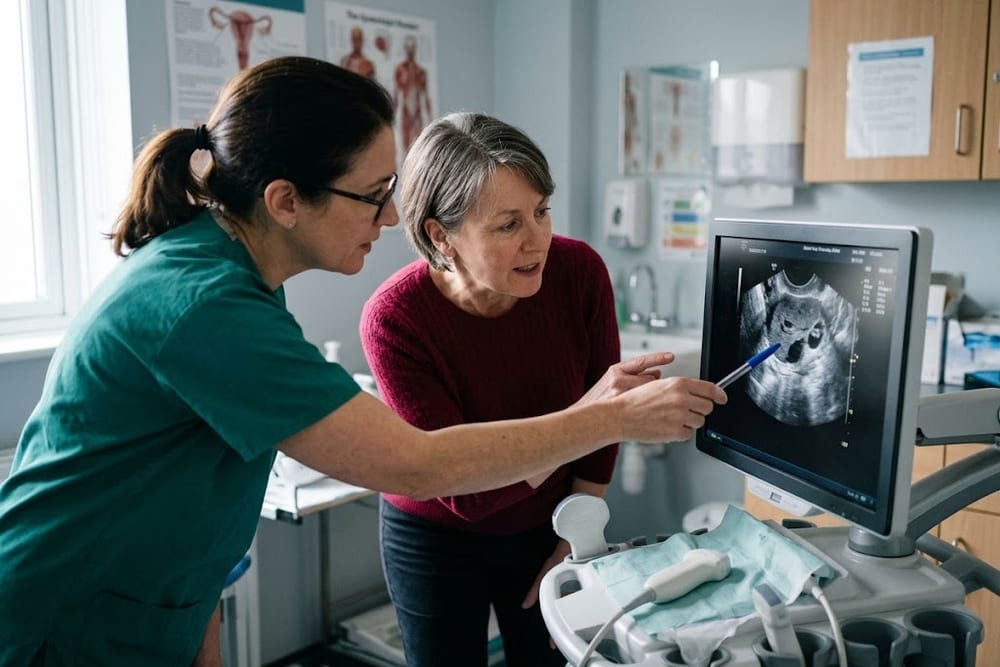
Transvaginal ultrasound (TVUS) is the standard first-line imaging for perimenopause cramps without a period. It visualizes uterine size, endometrial thickness, fibroids, ovarian morphology, and most cases of adenomyosis. It is non-invasive, fast, well-tolerated, and widely available. MRI is reserved for unclear cases — specifically when adenomyosis is suspected but TVUS is equivocal, or when fibroid mapping for surgical planning is required.
The clinical thresholds for imaging:
- Persistent cramps longer than 2 months without obvious cycle correlation or resolution — image to clarify.
- Severe pain that interrupts sleep, work, or daily function — image. Severity escalates the differential toward adenomyosis or symptomatic fibroids.
- Cramps with pressure, bloating, urinary frequency, or constipation — image. The fibroid picture.
- Cramps that escalated sharply in your 40s relative to your historical period pain — image. The adenomyosis picture.
- Postmenopausal cramps with ANY bleeding — urgent imaging and endometrial biopsy. Different rule. Different workup. Do not wait.
- Cramps with bloating plus early satiety plus unintentional weight loss — image and workup. The ovarian cancer rule-out picture; this triad warrants a specific evaluation that goes beyond TVUS alone.
Non-negotiable rule: ANY bleeding after 12 consecutive months without a period (postmenopausal bleeding) is an urgent workup, regardless of cramping. NAMS 2022 and ACOG Practice Bulletin 226 both state this clearly. About 9 percent of postmenopausal bleeding has underlying endometrial cancer — the diagnostic yield justifies same-week TVUS plus endometrial biopsy in every case. This rule does not bend for any cramp pattern, any reassuring family history, any "but it's only a little." Call your clinician.
What helps each mechanism
Treatment matches mechanism. There is no one-size-fits-all answer for perimenopause cramps without a period — and the treatments that work for one mechanism can be neutral or even counterproductive for another. The hierarchy below maps each tool to the mechanism it actually addresses.
- HRT (systemic estradiol +/- progesterone). Helps the anovulatory and atrophic mechanisms by stabilizing estrogen volatility. Neutral-to-cautious with fibroids (can shrink swings but can also feed growth at higher doses). Less helpful for adenomyosis with high estrogen exposure, though continuous combined HRT or progesterone-dominant regimens can help. Not the tool for pelvic floor dysfunction. Decision should be individualized after imaging clarifies the picture. Our broader signs you need HRT piece walks through when this conversation is worth having.
- NSAIDs (ibuprofen 400-600 mg, naproxen 220-440 mg) around expected cramp days. Block prostaglandin production. Most effective for anovulatory cramps; useful for adenomyosis flares; secondary for fibroids and atrophy. Avoid if you have GI ulcers, kidney disease, or are on anticoagulants.
- Magnesium glycinate 200-400 mg/day. Modest evidence for reducing menstrual and uterine cramping severity. Mechanism is partly muscle-relaxant. Cheap and low-side-effect; not a substitute for mechanism-specific treatment but a useful adjunct.
- Pelvic floor physical therapy. First-line for the pelvic floor mechanism. Also a powerful adjunct for women with adenomyosis or atrophy who develop secondary pelvic floor guarding. Look for a PT with specialty training in pelvic health (APTA pelvic health certification).
- Surgical and procedural options for fibroids and adenomyosis. Uterine artery embolization, myomectomy, endometrial ablation, hysterectomy. Reserved for severe and persistent cases. Consult a gynecologist who specializes in uterine pathology.
- Vaginal estrogen. Targeted at urogenital atrophy. Useful adjunct for pelvic floor dysfunction with atrophic component. Minimal systemic absorption — different risk profile than systemic HRT.
- Heat (heating pad, warm bath). Universal symptomatic relief. Works on every mechanism. Underrated.
- Levonorgestrel IUD (Mirena). Strong evidence for reducing adenomyosis pain and abnormal bleeding. Also reduces fibroid-related bleeding in many cases. A conversation worth having with a gynecologist.

When to worry — the red flags
The same anatomical region that produces benign perimenopause cramps also houses several conditions with much higher stakes. The following symptom combinations move out of the "track the pattern and consider HRT" lane and into "same-week clinician visit" lane. Memorize them.
Red flags that require prompt evaluation (most warrant same-week, several warrant same-day):
- Cramps PLUS any postmenopausal bleeding. Urgent. The single most important rule on this page. Endometrial cancer rule-out via TVUS + endometrial biopsy regardless of how the cramps feel.
- Cramps PLUS unintentional weight loss (more than 5 percent body weight over months without trying). Concerning for malignancy. Workup includes imaging, basic labs, and age-appropriate cancer screening.
- Cramps PLUS persistent bloating PLUS early satiety (feeling full after small amounts of food). The classic ovarian cancer triad. About 1 in 78 women develop ovarian cancer over their lifetime and the late perimenopause / early postmenopause window is a peak presentation age. Same-week pelvic ultrasound and CA-125 are reasonable.
- Cramps PLUS fever PLUS pelvic pain. Possible pelvic inflammatory disease or other infection. Same-day evaluation.
- Sudden severe pelvic pain unlike previous pain. Ovarian torsion, ruptured cyst, or other acute pathology. Same-day or ER evaluation depending on severity.
- Cramps with a palpable mass or visible abdominal protrusion that was not there before. Image promptly.
- Cramps with blood in stool or urine. GI or urologic source — not a perimenopause symptom. Workup according to the bleeding source.
The good news: most perimenopause cramps without a period are benign and fit one of the five mechanisms above. The bad news: the conditions on the red-flag list share a region with the benign mechanisms, and triage is essential. Pattern-matching saves time and lives. Always rule out the dangerous things first, then treat the hormones.
How ClearedRx prescribes HRT for perimenopause cramps
ClearedRx is a doctor-supervised HRT service for women, online. You take a one-minute quiz. A licensed physician in our network reviews your symptoms and history within 24 hours. If you are a fit, they prescribe — and your treatment ships to your door, discreetly, the same week. We prescribe both compounded and FDA-approved HRT preparations; the patient picks based on cost, format preference, and clinical fit.
For perimenopause cramps specifically, the HRT picture depends on which of the five mechanisms is driving yours. For anovulatory and atrophic cramps, systemic HRT smooths the estrogen volatility and atrophy that are the upstream causes — most women see improvement in 4-8 weeks, in parallel with hot-flash and sleep improvement. For fibroids and adenomyosis, the decision is more nuanced: the right preparation can stabilize symptoms, but high-dose unopposed estrogen can feed estrogen-responsive growths, so the clinician will tailor the formulation, dose, and progesterone strategy. For pelvic floor dysfunction, HRT is not the lever and the recommendation will be pelvic floor PT first; vaginal estrogen is sometimes a useful adjunct.
Most women who add systemic HRT for the estrogen-deficiency mechanisms see meaningful change in 4-8 weeks. ClearedRx HRT starts at $49 per month for compounded preparations and $89 per month for FDA-approved generics, all-in (medication, doctor reviews, free shipping in all 50 states). New patients receive 50% off their first month. There are no surprise fees and no insurance paperwork. For broader cost context, our HRT cost comparison walks through every formulation across every channel.

"Abnormal uterine bleeding in midlife requires a structured evaluation. The PALM-COEIN classification framework separates structural causes (polyps, adenomyosis, leiomyomas, malignancy) from non-structural causes (coagulopathy, ovulatory dysfunction, endometrial, iatrogenic, not classified). The same framework applies to cramping without bleeding — the differential is structural plus functional, and imaging targets the structural side first." — ACOG Practice Bulletin 226. Management of abnormal uterine bleeding. Obstet Gynecol. 2020;136(2):e88-e102.
The intervention comparison table
Side by side, here is how the major interventions map onto the five mechanisms. The matrix is the working version of "what to do based on what your cramps are doing" — bring it to your clinician visit.
| Mechanism | Cramp pattern | First imaging | First-line intervention |
|---|---|---|---|
| Anovulatory cycles | Sharp, brief, mid-cycle | Optional if pattern clean | NSAIDs PRN; HRT for cluster |
| Endometrial atrophy | Dull, persistent, low-grade | TVUS to confirm thin lining | Systemic or vaginal HRT |
| Fibroids | Heavy, pressure, bloating | TVUS | Watchful waiting or UAE / surgery |
| Adenomyosis | Severe, prolonged, worse than baseline | TVUS + MRI if unclear | Levonorgestrel IUD; surgical if severe |
| Pelvic floor dysfunction | Tight, lower-back, painful sex | Imaging clean | Pelvic floor PT (specialty) |
| RED FLAG — postmenopausal bleeding | Any bleeding after 12 mo amenorrhea | Urgent TVUS + endometrial biopsy | Cancer rule-out; same-week workup |
If you also want to map the rest of the picture
Perimenopause cramps almost never travel alone. The same low-and-erratic-estrogen environment that drives the anovulatory and atrophic mechanisms typically also produces hot flashes, night sweats, sleep disruption, mood changes, irregular periods, and the broader symptom cluster. Mapping the constellation is the cheapest diagnostic move before deciding what to do next. Our free Menopause Symptom Score is a 60-second self-check that scores the cluster as a single hormonal-fingerprint number, and our perimenopause self-check is a 10-question screen specifically targeted to where you are in the transition. For the broader symptom catalogue, see our menopause symptoms overview; for the pillar article on the 34 symptoms see our 34 symptoms of perimenopause piece; for the perimenopause-vs-menopause distinction see our perimenopause vs menopause explainer. Sister symptom articles: our perimenopause headaches piece covers another estrogen-volatility symptom, and the perimenopause-bloating sister article — coming soon — completes the GI-cluster picture. For the most-relevant statistics see menopause statistics 2026, and for the HRT-eligibility conversation see signs you need HRT.
Frequently asked questions
Why do I have cramps but no period in perimenopause?
Five distinct mechanisms cause perimenopause cramps without bleeding. The most common is anovulatory cycles — your ovary builds toward ovulation, releases prostaglandins, but no egg releases and no period follows. Next is endometrial atrophy from sustained low estrogen, where the uterus contracts on a thinning lining. Fibroids that were quiet can become symptomatic when estrogen swings; adenomyosis often flares in the late perimenopause window before resolving post-menopausally; and pelvic floor dysfunction frequently masquerades as uterine cramping. The cramp pattern — sharp and brief vs dull and persistent vs heavy and pressure-laden — points to which mechanism is driving yours.
Can perimenopause cause period-like cramps without bleeding?
Yes — and it is one of the most disorienting symptoms of the transition. The anovulatory mechanism is the textbook example: prostaglandins are released by the developing follicle the same way they are released around a normal period, the uterus contracts, you feel cramps, but ovulation does not occur and bleeding never follows. This is benign in itself, but the same cramp-without-bleeding presentation can mask fibroids or adenomyosis, so pattern matters. Anovulatory cramps are usually sharp, brief, and mid-cycle; persistent or worsening cramps without periods warrant imaging.
When should I get an ultrasound for perimenopause cramps?
Transvaginal ultrasound (TVUS) is the standard first-line imaging. Get it if: cramps persist more than 2 months without resolution; cramps are severe enough to interrupt sleep or work; cramps come with pressure, bloating, or a feeling of fullness suggesting fibroids; cramps come with severe pain worse than your prior periods suggesting adenomyosis; or — critically — if you are postmenopausal (12+ months without a period) and develop ANY bleeding at all alongside cramps. The postmenopausal-bleeding rule is non-negotiable: any bleeding after menopause is endometrial cancer until proven otherwise (NAMS 2022 position statement).
Does HRT help perimenopause cramps?
It depends on the mechanism. HRT helps the two estrogen-deficiency mechanisms most clearly — anovulatory cramps and endometrial atrophy — by stabilizing estrogen levels and smoothing the volatility that drives the prostaglandin and contraction signals. HRT is less helpful or potentially counterproductive for fibroids and adenomyosis, both of which are estrogen-responsive growths; the calculus depends on size and symptom burden. For pelvic floor dysfunction, HRT is not the lever. A clinician should map your cramp pattern, image as needed, and then decide whether HRT helps, helps partially, or is the wrong tool. See our signs you need HRT piece for the broader eligibility conversation.
Are cramps after menopause normal?
Mild, intermittent cramps after menopause can occur — most often from pelvic floor dysfunction, GI causes, or endometrial atrophy. But the rule is strict: ANY bleeding after menopause is urgent. Postmenopausal bleeding (PMB) has approximately a 9 percent overall risk of underlying endometrial cancer (ACOG Practice Bulletin 226), and that risk rises with age and risk factors. Cramps with PMB, cramps with unintentional weight loss, cramps with bloating and early satiety, or cramps with a palpable mass all warrant urgent workup. Isolated mild cramps without bleeding are not emergencies but should still be evaluated if persistent.
Can fibroids cause cramps without a period?
Yes, frequently. Fibroids (uterine leiomyomas) are estrogen-responsive smooth muscle growths in or on the uterus, and their prevalence rises through the 40s — Wegienka et al. (2003) reported point prevalence approaching 50-70 percent by the late 40s on imaging-based studies. In perimenopause, the wild estrogen swings can stimulate fibroid growth even as periods become irregular or stop. Symptomatic fibroids typically present with heaviness, low pelvic pressure, bloating, urinary frequency, and dull achy cramping — not the sharp prostaglandin-style of period cramps. Imaging diagnoses them; treatment depends on size, location, and symptom burden.
What is adenomyosis and why does it flare in perimenopause?
Adenomyosis is the presence of endometrial-like tissue embedded in the muscular wall of the uterus. It is under-diagnosed because MRI or detailed TVUS is needed to see it well, and because it overlaps in presentation with fibroids and endometriosis. Vannuccini et al. (2017) in Human Reproduction Update reviewed prevalence at 20-35 percent in symptomatic women presenting in late reproductive years. Adenomyosis tends to flare in late perimenopause because cumulative estrogen exposure plus erratic high-estrogen swings feed the ectopic tissue. The cardinal symptom is severe cramping worse than baseline period pain, often with heavy bleeding or — in this article's scenario — cramps without a period during anovulatory months. It typically improves post-menopausally as estrogen falls.
Is it pelvic floor dysfunction or my uterus?
Pelvic floor dysfunction is the most under-recognized mimic of uterine cramping. Tight, hypertonic pelvic floor muscles can produce a deep aching cramp that feels indistinguishable from menstrual pain — but the location is muscular, not uterine. Tells that point to pelvic floor: pain with sex (deep dyspareunia), pain with bowel movements or sitting, a lower-back component, pain that worsens with stress or after long periods of sitting, and no correlation with cycle timing. Pelvic floor physical therapy is the first-line treatment; estrogen-deficiency makes pelvic floor symptoms worse via vaginal atrophy, so vaginal estrogen often helps alongside PT.
How long can perimenopause cramps last?
Perimenopause averages 4 to 8 years (Hale et al., Climacteric 2014), and cramp patterns shift through that window. Early perimenopause produces more anovulatory cramps as cycles become irregular; mid-perimenopause adds fibroid and adenomyosis flares from high-estrogen swings; late perimenopause and early menopause shift toward atrophic cramping as estrogen settles low. Most cramping resolves within 1 to 2 years after the final menstrual period, except where fibroids or adenomyosis persist. HRT can shorten the window for the estrogen-mediated mechanisms; surgical options exist for fibroids and adenomyosis when symptoms are severe and persistent.
When should I see a doctor for perimenopause cramps?
See a clinician promptly if: any bleeding occurs after 12 consecutive months without a period (postmenopausal bleeding — urgent workup); cramps come with unintentional weight loss, persistent bloating, or early satiety (ovarian cancer rule-out); cramps are severe enough to interrupt daily life; cramps persist longer than 2 months without obvious cycle correlation; or you suspect fibroids or adenomyosis based on pattern. For mild cramps without red flags that fit the anovulatory or atrophic pattern, a routine well-woman visit is appropriate. Imaging (transvaginal ultrasound) is the standard first step when in doubt.
Sources & references
- Hale GE, Hughes CL, Burger HG. Atypical estradiol secretion and ovulation patterns in perimenopause. Climacteric. 2014;17 Suppl 2:5-9. PMID: 24502443
- Wegienka G, Baird DD, Hertz-Picciotto I, et al. Self-reported heavy bleeding associated with uterine leiomyomata. Am J Epidemiol. 2003;157(7):641-647. PMID: 12628866
- Vannuccini S, Petraglia F. Recent advances in understanding and managing adenomyosis. Hum Reprod Update. 2017;23(6):723-737. PMID: 28910899
- The North American Menopause Society. The 2022 Hormone Therapy Position Statement of The North American Menopause Society. Menopause. 2022;29(7):767-794. PMID: 35797481
- ACOG Practice Bulletin No. 226: Management of abnormal uterine bleeding associated with ovulatory dysfunction. Obstet Gynecol. 2020;136(2):e88-e102. PMID: 32852927
- ACOG Committee Opinion 734: The role of transvaginal ultrasonography in evaluating the endometrium of women with postmenopausal bleeding. Obstet Gynecol. 2018;131(5):e124-e129. PMID: 29683910
- Bulun SE. Uterine fibroids. N Engl J Med. 2013;369(14):1344-1355. PMID: 24088094
- Endocrine Society. Menopause and Hormone Therapy Clinical Practice Guideline (2024 update). endocrine.org
- Internal: menopause symptoms overview · 34 symptoms of perimenopause · perimenopause vs menopause · perimenopause headaches · menopause statistics 2026 · menopause symptom score tool · perimenopause self-check · signs you need HRT
If you want to address the cause and not just the symptom — talk to a clinician
ClearedRx prescribes evidence-based HRT — bioidentical estradiol, progesterone, or a combined cream — based on your full picture, with 24-hour MD review and free shipping in all 50 states. Compounded preparations from $49/month, FDA-approved generics from $89/month. No insurance hassle. New patients save 50% on the first month.
Find out if HRT is right for me