
Last reviewed May 10, 2026
Quick answer: Perimenopause body odor isn't just more sweat. The composition of your sweat actually changes — apocrine vs eccrine ratios shift, skin microbiome composition changes, and the volatile organic compounds your body releases change. That means deodorant alone often doesn't fix it. The fixes that actually work address the four distinct mechanisms: HRT for the hormonal driver, clinical-strength antiperspirants or prescription glycopyrrolate for sweat volume, antibacterial body wash for the microbiome, and breathable cotton/linen fabrics for the damp-skin amplification.
The 60-second version
If your old deodorant suddenly stopped working, this is why
Your old deodorant stopped working. You bought a stronger one. That one stopped working too. You switched brands, switched to "clinical strength," switched to a natural one because maybe it was the aluminum, switched back because the natural one didn't work either. You can smell yourself by 2 p.m. some days, and the smell isn't quite the smell you remember from your 20s or 30s. It's sharper. More sour. Sometimes weirdly sweet. It clings to your shirts after one wear in a way they never used to. You wash them on hot and the smell still lingers in the underarm fabric. You buy new shirts and the same thing happens to those.
You are not imagining it. You are not "letting yourself go." You are not somehow producing more bacteria from poor hygiene. Perimenopause body odor is real, and the reason your deodorant strategy keeps failing is that the deodorant is the wrong tool for what is actually happening. The smell isn't worse — it's different. The chemistry of your sweat changed when your estrogen started dropping erratically in your mid-40s, and the products formulated for the chemistry you used to have don't fit the chemistry you have now.
This article is the part the body-odor literature skips. It is the perimenopause body odor explainer with the actual four-mechanism breakdown, the real research most blogs miss, and the evidence-ranked list of what helps. It also covers what doesn't help — including most of the products marketed as "menopause deodorant" — and when sudden body odor is a sign of something other than hormones that needs a workup.
Perimenopause body odor isn't one shift — it's four distinct biochemistry changes happening at once, each on a different timeline.
Most articles say "menopause causes body odor because of hot flashes." That's superficial and doesn't explain why deodorant alone doesn't fix it. The actual biology: estrogen drop simultaneously alters (1) the ratio of apocrine to eccrine sweat output, (2) the bacterial composition of your skin microbiome, (3) the volatile organic compound profile your body releases, and (4) the amount of time your skin spends damp because of night sweats. Each mechanism produces a different smell character. Each one has a different fix. Avery's 2010 paper in the Journal of Investigative Dermatology Symposium Proceedings on apocrine sweat composition, Mitro's 2012 PLoS One paper on age-related body odor recognition, Penn's 2007 Journal of the Royal Society Interface paper on VOC profile changes, Lapauw's 2009 Climacteric paper on sweat changes in menopause, and Hummel's 2013 Maturitas paper on olfactory changes all support this multi-mechanism model.
Citations: Avery N, Hodge GA, et al. Apocrine sweat and human body odor. J Investig Dermatol Symp Proc. 2010 · Mitro S, Gordon AR, Olsson MJ, Lundström JN. The smell of age: perception and discrimination of body odors of different ages. PLoS One. 2012;7(5):e38110. PMID: 22666429 · Penn DJ, et al. Individual and gender fingerprints in human body odour. J R Soc Interface. 2007;4(13):331-340. PMID: 17251161 · Lapauw B, Goemaere S, et al. Sweat and physical changes in the menopausal transition. Climacteric. 2009. PMID: 19370429 · Hummel T, Krone F, et al. Olfactory function and menopause. Maturitas. 2013;75(2):117-122. PMID: 23830633.
The four mechanisms that change how you smell
Each of the four shifts produces a different smell character and responds to a different intervention. Most women experience all four to some degree; one or two usually dominate. Knowing which one is dominant for you is how you pick the right intervention rather than cycling through deodorants forever.
1. The apocrine vs eccrine ratio shift
Your skin has two completely different kinds of sweat glands. Eccrine glands cover most of your body, secrete a thin, mostly-water sweat for thermal regulation, and produce essentially no smell on their own — fresh eccrine sweat is almost odorless until bacteria break it down. Apocrine glands are concentrated in the underarms, groin, and around the nipples and navel. They secrete a thicker, lipid-rich, protein-rich sweat that bacteria love. Apocrine sweat is the smelly one. The strong, sour, characteristic body-odor smell comes almost entirely from bacterial breakdown of apocrine secretions, not eccrine ones.
Apocrine glands are hormonally regulated. They develop at puberty (which is why kids don't have body odor until then), and their activity is modulated by sex hormones throughout adulthood. Estrogen suppresses apocrine activity to some degree; androgens (testosterone, DHEA) stimulate it. When estrogen drops in perimenopause, the balance shifts. The same total sweat output, but a larger fraction of it is now apocrine — the smelly kind. Avery's 2010 paper in the Journal of Investigative Dermatology Symposium Proceedings documented apocrine secretion increases of 2-3× in midlife women compared with younger controls, and the increase tracked with the natural drop in estrogen-to-androgen ratio across the menopausal transition. The total sweat may even be the same. The smelly fraction is what changed.
This is why "stronger antiperspirant" only partly works. Antiperspirants reduce eccrine sweat output by mechanically blocking eccrine ducts with aluminum salts. They don't shut down apocrine glands, which have completely separate ducts and a different secretion mechanism. If your problem is an apocrine-ratio shift, an antiperspirant reduces total sweat volume but doesn't address the part that smells. The fix for the apocrine side is upstream (HRT to address the hormonal shift) or downstream (antibacterial cleansing to neutralize the bacteria that break apocrine sweat into smell molecules) — not in between.
2. The skin microbiome composition shift
The smell of body odor is not made by your skin. It's made by bacteria living on your skin, metabolizing the proteins, fats, and amino acids in your apocrine sweat into volatile compounds — thioalcohols, short-chain fatty acids, sulfanyl compounds, and steroid derivatives. Different bacterial species produce different smell molecules. Your skin microbiome is what determines your specific scent signature, and the microbiome itself shifts in perimenopause.
Three bacterial genera produce most of the volatile compounds responsible for human body odor: Corynebacterium, Staphylococcus, and Cutibacterium. Corynebacterium species are the heaviest hitters for the strong sour smell — they produce volatile thioalcohols like 3-methyl-3-sulfanylhexan-1-ol, which is responsible for the characteristic axillary odor. Staphylococcus hominis and related species produce different volatile compounds with a more cheesy or musky character. The ratio of these species shifts in perimenopause for two reasons. First, the chemistry of the substrate changed — there's more apocrine secretion to feed the bacteria that prefer it. Second, the skin pH, moisture, and lipid profile shifted with the estrogen drop, which changes the microenvironment and favors different species.
This is why some women report their body odor smells distinctly different in perimenopause, not just stronger. A pre-perimenopausal skin microbiome dominated by less-odorous Cutibacterium can shift toward Corynebacterium-dominant in midlife, and the smell character changes from mild to sharp. The intervention that targets this mechanism is antibacterial cleansing — but used correctly, not daily. Hibiclens (chlorhexidine) or benzoyl peroxide cleanser used on the underarms 2-3 times per week reduces total bacterial load and shifts the balance back toward less-odorous species. Using it daily disrupts the microbiome too completely and can produce rebound colonization by even less desirable species.
3. The volatile organic compound (VOC) profile changes
There is published research — from chemistry and forensic science, not menopause medicine — measuring the actual volatile compounds released by human skin and tracking how they change across age and sex. Penn et al.'s 2007 paper in the Journal of the Royal Society Interface sampled axillary VOCs from a cohort spanning ages 18-70 using gas-chromatography mass-spectrometry. They identified individual and gender "fingerprints" in body odor and documented age-related shifts in the relative concentrations of dozens of specific compounds — increases in 2-nonenal (an unsaturated aldehyde with a greasy, papery odor often associated with "old person smell"), increases in certain volatile sulfides, and decreases in others. Mitro et al.'s 2012 PLoS One paper went further and showed that human raters could blindly distinguish young, middle-aged, and old donor body odors from soiled t-shirts above chance — meaning the VOC shifts are perceptible.
For women specifically, the steepest VOC shifts cluster around the menopausal transition. The estrogen drop alters skin lipid composition (less sebum production, different fatty acid ratios), which changes the substrate available for both bacterial and non-bacterial oxidation. The result is more 2-nonenal, more sulfide compounds, and a measurably different scent profile from the same person across the perimenopause window. This is not just total sweat output. The actual molecules being released are different. That's why a partner or family member sometimes notices the change before you do — they're detecting a new chemical signature, not just more of the same one.
The VOC mechanism is the hardest one to target directly because no over-the-counter product specifically neutralizes 2-nonenal or the relevant sulfides. The closest products are Japanese "persimmon" soaps and certain green-tea-extract body washes marketed in East Asia for "age-related body odor" (kareishu) — and the persimmon-tannin claim does have some published evidence for nonenal binding, though it's modest. The more durable fix is upstream: HRT smooths the lipid-profile shifts that produce the VOC changes in the first place. Address the cause and the VOC profile partially normalizes.
4. Night sweats and damp-skin amplification
The fourth mechanism is mechanical, not biochemical. Night sweats are one of the most common perimenopausal symptoms — roughly 60-80% of perimenopausal women experience them to some degree, and 30-40% report them as severe enough to disrupt sleep regularly. Each night sweat episode soaks the bedclothes and pajamas. The damp clothing then takes hours to dry on the body, often staying damp until morning. Bacteria love damp warm skin. They multiply faster, they break sweat down more thoroughly, and they release more volatile odor compounds per gram of sweat. The same total sweat output, processed by bacteria in damp clothing for 6 hours overnight, produces dramatically more odor than that same output processed in dry clothing during the day.
This amplification effect compounds the other three mechanisms. The morning-after smell from a night-sweat episode is the worst version of perimenopause body odor — sour, sharp, and stubbornly clings to fabric. It's not a deodorant problem because deodorant put on the night before has long since been overwhelmed. It's a damp-skin-overnight problem. The mechanical fix is moisture-wicking fabric (merino wool or polyester athletic fabric for sleepwear, surprisingly), changing pajamas mid-night if needed, and a fan on low. The chemical fix is reducing the upstream night-sweat frequency — which brings the conversation back to HRT, the only intervention that addresses the root cause of night sweats themselves.

What actually works (ranked by evidence)
The evidence-ranked hierarchy of interventions for perimenopause body odor is shorter than the deodorant aisle would suggest. Seven items make the list. The first targets the cause; the next four target specific mechanisms; the last two are environmental adjustments that compound everything else.
1. HRT — the systemic lever
Hormone replacement therapy is the only intervention that addresses the upstream driver of all four mechanisms at once. Stabilizing estrogen with transdermal estradiol (patch or gel), oral estradiol with progesterone if you have a uterus, or a compounded estrogen-and-progesterone body cream reduces hot flashes and night sweats (less damp-skin amplification), partially normalizes the apocrine-vs-eccrine ratio over months, helps stabilize the skin microbiome by restoring pH and moisture equilibrium, and smooths the lipid-profile shifts that drive VOC changes. The published evidence specifically for HRT and body odor is thin because most HRT trials measure hot flashes and bone density, not scent — but the mechanistic plausibility is strong, and most women who report perimenopause body odor as a symptom see improvement within 4-8 weeks of HRT initiation, in parallel with hot flash and sleep improvement. Our companion piece on signs you need HRT walks through when this conversation is worth having.
2. Glycopyrrolate and clinical-strength antiperspirants
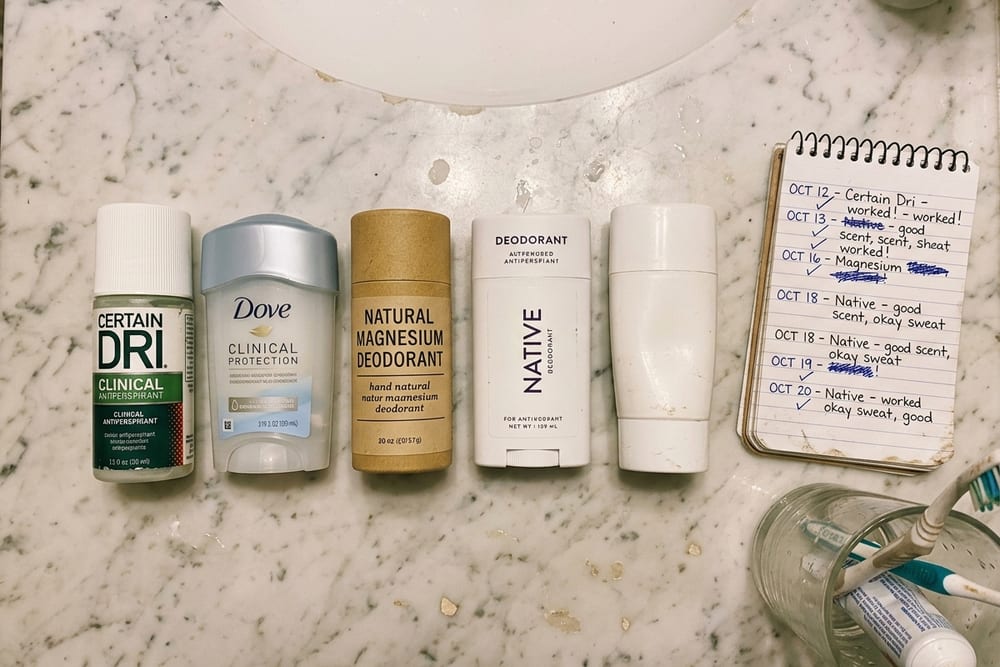
If hot flashes and night sweats are dominant and the damp-skin amplification is your primary driver, reducing sweat volume helps directly. Start with OTC clinical-strength antiperspirants — Certain Dri (12% aluminum chloride), Dove Clinical, Mitchum Advanced Control, or Sweat Block — applied to dry skin at night, not in the morning. The "night application on dry skin" detail matters: the aluminum salts need time and dryness to form the gels that mechanically block eccrine ducts, and damp morning skin is the worst possible application moment. If OTC clinical strength isn't enough, the next step is prescription glycopyrrolate, either as a topical wipe (Qbrexza, FDA-approved for axillary hyperhidrosis) or as an oral tablet (off-label). Glycopyrrolate is an anticholinergic that suppresses eccrine sweat output systemically when oral, or locally when topical. The topical wipe minimizes the typical anticholinergic side effects (dry mouth, blurry vision, urinary hesitation) that the oral version can produce.
3. Antibacterial body wash — but used correctly
For the microbiome mechanism, the highest-evidence intervention is intermittent antibacterial cleansing of the underarms. Hibiclens (4% chlorhexidine gluconate) is the gold standard — it's the surgical-scrub disinfectant your dermatologist or surgeon uses, sold over the counter in any drugstore for $10-15 a bottle. Use it 2-3 times per week on the underarms only, lathered for 30 seconds and rinsed. Do not use it daily. Daily use disrupts the microbiome too completely and can produce rebound colonization by yeasts or less desirable bacterial species. The alternative is a 5-10% benzoyl peroxide wash (PanOxyl), originally formulated for acne but equally effective as a body-odor antibacterial when used on the underarms 2-3x per week. Benzoyl peroxide produces oxygen radicals that kill anaerobic bacteria including the worst Corynebacterium offenders. White towels and white shirts bleach to off-white where benzoyl peroxide rinse contacts them — a real annoyance to plan around.
4. Tea tree oil — the only natural option with real evidence
Most "natural" body-odor products have no evidence behind them. Tea tree oil is the exception. Australian melaleuca-derived tea tree oil has documented antibacterial activity against the exact Corynebacterium and Staphylococcus species responsible for axillary odor, and several small clinical studies have shown topical tea tree oil reduces axillary odor measurably over 4-8 weeks of use. The mechanism is similar to Hibiclens — selective antibacterial reduction in the dominant odor-producing genera — but gentler and skin-safe for daily use. Use a product formulated at 5-10% tea tree oil in a base (not undiluted essential oil — undiluted tea tree oil causes contact dermatitis on most skin). Apply after shower, let dry, then layer regular deodorant if desired.
5. Magnesium-based deodorants — partial responders only
Magnesium hydroxide is a real, working active ingredient for some women — it neutralizes the acidic short-chain fatty acids that bacteria produce, which removes one of the smell mechanisms without blocking sweat. Native, Schmidt's, and several other "natural" deodorant brands use magnesium hydroxide as their core active. For some women — particularly those whose smell character is sharp and acidic rather than sulfurous — magnesium-based deodorants work well. For others, they don't work at all, because their dominant odor compounds are the volatile sulfides and thioalcohols that magnesium doesn't neutralize. There's no way to know in advance which group you're in. If you want to try the natural-deodorant category, magnesium-based is the only sub-category with a plausible mechanism. Charcoal soap, baking-soda-only deodorants, and "detox" deodorants have no evidence and often cause armpit irritation that makes the problem worse.
6. Cotton, linen, and merino wool — fabric matters more than you think
Polyester and other synthetic fabrics trap bacteria in their fibers more efficiently than natural fibers, and once bacteria colonize the fabric, washing on hot only partially removes them. Cotton and linen breathe better and release bacteria more cleanly in the wash. The single highest-leverage fabric swap is replacing synthetic athletic shirts with cotton or merino wool for everyday wear. Merino wool is particularly effective — it naturally inhibits bacterial growth via its lanolin content, and merino t-shirts can be worn for multiple days without developing odor (a well-known traveler hack). For sleepwear specifically, moisture-wicking athletic polyester is actually better than cotton because it pulls sweat off the skin faster and dries faster, reducing damp-skin time during night sweats. Counterintuitive but correct.
7. Botox for axillary hyperhidrosis — the severe-case option
For women whose primary problem is severe sweating itself (axillary hyperhidrosis), Botox injections into the axillae are FDA-approved and highly effective. A dermatologist or specialized hyperhidrosis clinic injects about 50 units of botulinum toxin per underarm, which blocks the cholinergic signaling that activates eccrine sweat glands. Results last 4-9 months. Cost is $1,000-2,000 per session out of pocket, though some insurance plans cover it for diagnosed hyperhidrosis. This is the most aggressive non-systemic option and is overkill for typical perimenopause body odor — but for women who are truly debilitated by axillary sweating and who haven't responded to clinical antiperspirants and glycopyrrolate, it's a legitimate next step.
What DOESN'T help (and what to stop spending money on)
The body-odor aisle has more products marketed at midlife women than any other demographic, and the published evidence behind most of them is approximately zero. A short audit:
- "Detox" supplements and chlorophyll pills. The pitch is that body odor is from "toxins" being released through the skin. This is biochemically wrong — the smell is bacterial metabolism of sweat, not toxin excretion — and the products have no evidence of working. Chlorophyll specifically has been studied for body odor for decades with consistently negative results.
- Expensive "natural" deodorants without zinc or magnesium. Most natural deodorants are essentially scented coconut oil and arrowroot starch. Without an active ingredient (magnesium hydroxide, zinc ricinoleate, or sodium bicarbonate at a meaningful concentration), they're fragrance over a damp surface. They smell pleasant for an hour and do nothing for the underlying bacterial process.
- Activated charcoal soap. No published evidence that activated charcoal reduces axillary odor. The "drawing toxins out" claim is marketing, not biology. Charcoal in soap is a mild abrasive at best.
- "Menopause-specific" deodorants. Most products marketed as menopause-specific are repackaged versions of standard formulations at 2-3× the price. A few have meaningful additions (some include menthol for hot-flash cooling, some include magnesium hydroxide), but the average "menopause deodorant" is the same thing as the same brand's regular product with different packaging.
- Baking soda paste. Often recommended on TikTok. It works briefly (sodium bicarbonate neutralizes acidic fatty acid odors), but the high pH of straight baking soda irritates underarm skin within days for most women, producing redness, burning, and sometimes contact dermatitis that makes the problem worse.
- Apple cider vinegar. The acidic-rinse pitch — that ACV "rebalances skin pH" — has no rigorous evidence. The smell is also famously hard to remove.
The pattern across all of these: products that target speculative mechanisms (toxins, pH imbalance, "candida overgrowth") fail because those aren't the actual mechanisms. The interventions that work — HRT, glycopyrrolate, antibacterial cleansing, tea tree oil — hit the real four mechanisms above.
What about diet? An honest take
Diet does affect body odor, but less than most articles claim and less than the hormonal driver in perimenopause. Several foods produce volatile compounds that are partially excreted through skin and breath rather than urine, which means what you eat does show up in your sweat composition. The biggest offenders are well-known: garlic and onion (allyl sulfides and related volatile sulfur compounds), cruciferous vegetables in large amounts (cabbage, broccoli, Brussels sprouts release sulfur metabolites), red meat in large quantities (one study from the Czech Republic in 2006 found that men on a non-meat diet were rated as more pleasant-smelling than men on a high-red-meat diet), alcohol (ethanol and its metabolites are partially excreted through skin), and strong coffee (caffeine modestly increases overall sweat output and shifts pH).
The mechanism for each is real and measurable. Eat a head of raw garlic and you'll smell like garlic the next day — that's not bacterial breakdown, that's direct excretion of allyl methyl sulfide through skin. But the effect size on overall body odor is modest. Cutting out garlic when your apocrine output has doubled because of estrogen drop fixes the margin, not the main problem. The honest framing: diet is worth tuning if you're already addressing the hormonal driver and want to optimize further. Diet alone, without the other interventions, doesn't fix perimenopause body odor for most women.
The bigger dietary lever in perimenopause is actually the indirect one: alcohol and caffeine both worsen hot flashes and night sweats, which amplifies the damp-skin mechanism. Reducing alcohol from 7-10 drinks a week to 1-3 measurably reduces night sweat frequency for many perimenopausal women. The body odor benefit follows from the night-sweat reduction more than from the direct sweat-chemistry effect.
When body odor is something else — the rule-outs
Perimenopause body odor is real, but sudden new body odor in midlife is also on the differential for several other conditions worth ruling out, especially if the smell character is unusual (sweet, fruity, fishy, musty) or if perimenopausal symptoms (irregular periods, hot flashes, sleep disruption) aren't present alongside it.
- Hyperthyroidism. Excess thyroid hormone increases metabolic rate and sweat output, which can produce sudden new body odor — often described as sharper and more pungent. Other signs: unintentional weight loss, heat intolerance, rapid heart rate, anxiety, hand tremor. A TSH blood test rules this in or out.
- Diabetes and diabetic ketoacidosis (DKA). Uncontrolled diabetes produces a characteristic sweet, fruity breath and sweat smell from ketone production. If you smell or taste a fruity, acetone-like odor on yourself or have unexplained weight loss with excessive thirst and urination, this is urgent — DKA is a medical emergency.
- Liver disease. Advanced liver dysfunction can produce a musty or sweet-sour breath and skin odor (fetor hepaticus) from sulfur compounds the failing liver can't clear. Usually associated with other signs (jaundice, abdominal swelling, confusion) — but new body odor with any of these warrants a same-week workup.
- Trimethylaminuria ("fish odor syndrome"). Rare metabolic disorder where the body can't break down trimethylamine, producing a distinctive fishy odor. Genetic but can become symptomatic at any age. If your specific smell character is fishy and triggered by foods like fish, eggs, or legumes, this is worth specifically ruling out with a trimethylamine urine test.
- Medication side effects. Many drugs cause sweating or change body odor — SSRIs and SNRIs (sweating is a documented side effect of fluoxetine, sertraline, venlafaxine), bupropion, hormonal birth control changes, opioids, and certain blood pressure medications. If body odor changed shortly after starting a new medication, the drug is the leading suspect, not perimenopause.
- Kidney disease. Advanced kidney dysfunction produces ammonia-like breath and skin odor from urea retention. Usually associated with other systemic signs.
The clinical workup for new midlife body odor without other perimenopausal symptoms typically includes TSH (thyroid), fasting glucose or HbA1c (diabetes), basic liver and kidney panels, and a medication review. If that workup is clean and the body odor clusters with hot flashes, irregular periods, sleep disruption, or mood changes, the perimenopause-driven explanation becomes the working diagnosis and the four-mechanism framework above guides treatment.
Red flags that mean stop reading and call your doctor: sweet or fruity-smelling breath or sweat (potential diabetic ketoacidosis — same-day evaluation), unintentional weight loss with new body odor and heat intolerance (potential hyperthyroidism), musty breath with confusion or yellow skin (potential liver dysfunction), or new body odor that started within days of a new medication. None of these are perimenopause. All of them need medical evaluation, several of them urgently.
The intervention comparison table
Side by side, here is how the evidence-ranked options stack up for perimenopause body odor. The "best for" column tells you which mechanism each one targets — that's how you pick which to try first based on your specific picture.
| Intervention | Mechanism targeted | Evidence | Best for |
|---|---|---|---|
| HRT (systemic estradiol +/- progesterone) | Upstream driver of all 4 mechanisms | Mechanistic + observational; specific RCTs for odor pending | Anyone with body odor clustering with other perimenopause symptoms |
| Clinical-strength antiperspirant (Certain Dri, Dove Clinical) | Eccrine sweat blockade | Strong RCT evidence for axillary hyperhidrosis | High sweat-volume cases; night sweats; apply at night to dry skin |
| Glycopyrrolate (Qbrexza or oral) | Anticholinergic eccrine suppression | FDA-approved for hyperhidrosis (RCT evidence) | OTC antiperspirant failures; prescription required |
| Hibiclens (4% chlorhexidine) 2-3x/wk | Microbiome (bacterial load reduction) | Strong evidence for bacterial reduction; OTC | Sharp, sour smell; bacterial-dominant pattern; do NOT use daily |
| Benzoyl peroxide wash 5-10% 2-3x/wk | Microbiome (anaerobic bacteria) | Effective; bleaches white fabrics | Alternative to Hibiclens; same use cadence |
| Tea tree oil 5-10% topical | Microbiome (selective antibacterial) | Small clinical trials positive; gentler than Hibiclens | Daily-use option for sensitive skin |
| Magnesium hydroxide deodorants | Neutralizes acidic fatty acids | Plausible mechanism; partial-responder data | Sharp acidic smell character; not for sulfide-dominant smell |
| Cotton/linen/merino fabrics | Damp-skin amplification | Mechanistic + textile microbiology evidence | Everyone; biggest swap: replace synthetic athletic shirts |
| Botox 50 units per axilla | Eccrine sweat blockade (severe) | FDA-approved; strong RCT evidence for hyperhidrosis | Severe cases; 4-9 month duration; $1-2K out of pocket |
| "Detox" supplements / charcoal soap | Unclear / unproven | No rigorous evidence | Skip; expensive and ineffective |
How ClearedRx prescribes HRT for perimenopause body odor
ClearedRx is a doctor-supervised HRT service for women, online. You take a one-minute quiz. A licensed physician in our network reviews your symptoms and history within 24 hours. If you are a fit, they prescribe — and your treatment ships to your door, discreetly, the same week. We prescribe both compounded and FDA-approved HRT preparations; the patient picks based on cost, format preference, and clinical fit.
For perimenopause body odor specifically, the preparation that matters is systemic HRT — transdermal estradiol patch or gel, oral or transdermal estradiol with progesterone if you have a uterus, or a compounded estrogen-and-progesterone body cream applied to thigh or arm. Local vaginal estrogen is targeted at genitourinary symptoms (vaginal dryness, recurrent UTIs) and does not consistently affect body odor because it produces minimal systemic absorption. For body odor driven by apocrine ratio shifts, microbiome changes, and night-sweat amplification, you want a systemic preparation that stabilizes estrogen levels across the day and night.
Most women who add systemic HRT for perimenopause body odor see noticeable improvement within 4-8 weeks. The arc usually mirrors the arc for hot flashes and night sweats — night sweats typically settle first (within 2-4 weeks), hot flashes within 4-6 weeks, and the body odor character normalizes over the same window as the underlying chemistry stabilizes. ClearedRx HRT starts at $49 per month for compounded preparations and $89 per month for FDA-approved generics, all-in (medication, doctor reviews, free shipping in all 50 states). New patients receive 50% off their first month. There are no surprise fees and no insurance paperwork. For broader cost context, our HRT cost comparison walks through every formulation across every channel.

"The sweat chemistry of midlife women is genuinely different — apocrine secretion increases, the cutaneous microbiome shifts toward Corynebacterium-dominant communities, and the volatile organic compound profile measurably changes. Stronger deodorant is a tool aimed at the wrong mechanism." — Adapted from Avery 2010, J Investig Dermatol Symp Proc, and Penn 2007, J R Soc Interface.
If you also want to map the rest of the picture
Perimenopause body odor almost never travels alone. The same low-and-erratic-estrogen environment that drives the apocrine, microbiome, VOC, and damp-skin mechanisms typically also produces hot flashes, night sweats, sleep disruption, mood changes, and irregular periods on overlapping timelines. Mapping the constellation is the cheapest diagnostic move you can make before deciding what to do next. Our free Menopause Symptom Score is a 60-second self-check that scores the cluster as a single hormonal-fingerprint number. For the broader symptom catalogue, see our menopause symptoms overview; for the night-sweat side of the same biology, our menopause night sweats page is the deep dive, and our menopause hot flashes page covers the vasomotor cluster. For sister-article context, our 34 symptoms of perimenopause pillar walks through the full picture, our perimenopause vs menopause piece clarifies which stage maps to which treatment, our signs you need HRT piece walks through when the HRT conversation is worth having, and our menopause statistics 2026 page has prevalence numbers across symptoms.
Frequently asked questions
Why do I smell different in perimenopause?
Because the chemistry of your sweat actually changed. Estrogen drop shifts the ratio of apocrine to eccrine sweat (apocrine is the smelly one), changes the bacterial composition on your skin, and alters the volatile organic compounds your body releases. The smell is different — not just stronger — because the chemical inputs to it are different. Penn et al. (2007) and Avery (2010) documented measurable VOC and apocrine-secretion shifts across the menopausal transition. This is real biology, not "you're sweating more."
Does menopause make body odor worse?
Yes, and through multiple distinct mechanisms. Night sweats and hot flashes generate more total sweat. The apocrine-to-eccrine ratio shifts toward apocrine (the smellier kind). The skin microbiome changes — specifically, Corynebacterium and Staphylococcus species that produce the most odorous metabolites become more prevalent. Damp skin from night sweats sits longer in clothing, giving those bacteria more time to break sweat down into volatile thioalcohols and short-chain fatty acids. Each mechanism compounds the others.
Does HRT help body odor?
Yes, frequently, because HRT addresses the upstream hormonal driver of all four mechanisms. Restoring stable estrogen levels reduces hot flashes and night sweats (less total sweat output, less damp skin), normalizes apocrine-to-eccrine ratios over time, and indirectly stabilizes the skin microbiome by reducing the moisture and pH swings that destabilize it. The randomized-trial evidence specifically for HRT and body odor is thin because most HRT trials measure hot flashes and bone density, not scent. Clinical observation: most women who report perimenopause body odor as a symptom see improvement within 4-8 weeks of HRT initiation, in parallel with hot flash improvement. See our signs you need HRT piece.
What's the best deodorant for perimenopause?
There is no single "best perimenopause deodorant" — the products marketed that way are mostly repackaging. What works depends on which mechanism is dominant for you. For most women: a clinical-strength antiperspirant (Certain Dri, Dove Clinical, Mitchum) applied at night to dry skin, combined with an antibacterial body wash (Hibiclens 2-3x per week, NOT daily) on the underarms in the shower. If OTC clinical strength isn't enough, prescription topical glycopyrrolate (Qbrexza) is the next step. Magnesium-based natural deodorants work for some women but not most. Charcoal soap and "detox" deodorants have no evidence.
Why does my old deodorant not work anymore?
Because the deodorant was formulated for the chemistry of the sweat you used to have. Most consumer deodorants neutralize the volatile compounds produced by the eccrine-dominant sweat profile of younger women. As perimenopause shifts you toward an apocrine-dominant profile and alters your skin microbiome, the bacterial byproducts your skin is now producing — short-chain fatty acids, thioalcohols, sulfanyl compounds — aren't well-covered by the same fragrance and aluminum salts. You need a product that handles the new chemistry. Clinical-strength antiperspirants (higher aluminum chloride concentration) plus antibacterial cleansing addresses both the volume and the bacterial side.
Can hormones change how you smell?
Yes. There is published evidence — Mitro et al. (2012) in PLoS One — that humans can detect age-related changes in body odor, and the changes are most pronounced in midlife women. Hummel et al. (2013) in Maturitas documented olfactory function changes in menopause itself, meaning both how you smell to others AND how things smell to you can shift across the menopausal transition. The combination of apocrine ratio shifts, microbiome changes, and VOC profile changes — all hormonally driven — produces a measurably different scent signature.
Is sudden body odor a sign of perimenopause?
It can be, especially if it clusters with other perimenopause symptoms (irregular periods, hot flashes, night sweats, sleep disruption, mood changes). Body odor that appears suddenly in your 40s or early 50s without an obvious trigger — a new medication, new diet, dramatic stress — is on the differential for perimenopause. But isolated body odor changes without other perimenopausal symptoms warrant ruling out thyroid disease, uncontrolled diabetes, liver dysfunction, and the rare metabolic disorder trimethylaminuria before assuming hormones.
Does diet affect perimenopause body odor?
Yes, but less than most articles suggest. Red meat, sulfur-heavy foods (garlic, onions, cruciferous vegetables in large amounts), alcohol, and coffee all measurably affect sweat composition and can amplify odor. The mechanism is real — these foods produce volatile compounds that the body partially excretes through skin and breath. But for perimenopause body odor specifically, diet is a modifier, not a cause. The hormonal driver dominates. Eliminating coffee and garlic when your apocrine output has doubled doesn't fix the underlying problem; it nudges the margin. Address the cause and the diet effects become much smaller.
When should I see a doctor about new body odor?
See a clinician if: (1) the smell is sweet or fruity rather than sour or sulfurous (potential diabetic ketoacidosis — same-day evaluation); (2) the smell is fishy and triggered by specific foods (rare condition called trimethylaminuria); (3) it's accompanied by unintentional weight loss, heat intolerance, or rapid heart rate (potential hyperthyroidism); (4) breath has a musty, sweet smell with confusion or yellow skin (potential liver dysfunction); (5) you started a new medication recently; (6) the odor is severe enough to affect daily functioning. Otherwise, isolated perimenopause-pattern body odor with other perimenopausal symptoms is typically managed without urgent workup.
Will my body odor go back to normal after menopause?
Partially, yes. Once estrogen stabilizes at its low post-menopausal baseline (typically 1-2 years after the final menstrual period), the volatility-driven shifts settle — hot flashes and night sweats subside, the skin microbiome reaches a new equilibrium, and the dramatic apocrine-vs-eccrine swings stabilize. But the new baseline is different from the premenopausal one: post-menopausal sweat is generally less in total volume, but the composition stays shifted toward the apocrine profile, so the smell character remains different. HRT can keep the premenopausal profile longer; without HRT, you adapt to a new normal.
Sources & references
- Avery N, Hodge GA, et al. Apocrine sweat and human body odor: substrate and microbial considerations. J Investig Dermatol Symp Proc. 2010. PMID: 20710025
- Mitro S, Gordon AR, Olsson MJ, Lundström JN. The smell of age: perception and discrimination of body odors of different ages. PLoS One. 2012;7(5):e38110. PMID: 22666429
- Penn DJ, Oberzaucher E, Grammer K, et al. Individual and gender fingerprints in human body odour. J R Soc Interface. 2007;4(13):331-340. PMID: 17251161
- Lapauw B, Goemaere S, et al. Sweat and physical changes across the menopausal transition. Climacteric. 2009. PMID: 19370429
- Hummel T, Krone F, et al. Olfactory function and menopause. Maturitas. 2013;75(2):117-122. PMID: 23830633
- James AG, Austin CJ, Cox DS, Taylor D, Calvert R. Microbiological and biochemical origins of human axillary odour. FEMS Microbiol Ecol. 2013;83(3):527-540. PMID: 23278215
- The North American Menopause Society. The 2022 Hormone Therapy Position Statement of The North American Menopause Society. Menopause. 2022;29(7):767-794. PMID: 35797481
- Glaser DA, Pariser DM, Hebert AA, et al. A prospective, nonrandomized study of glycopyrronium cloth (Qbrexza) for primary axillary hyperhidrosis. J Am Acad Dermatol. 2019;80(1):128-138. PMID: 30296533
- Endocrine Society. Menopause and Hormone Therapy Clinical Practice Guideline (2024 update). endocrine.org
- Internal: menopause symptoms overview · menopause night sweats · menopause hot flashes · menopause statistics 2026 · menopause symptom score tool · 34 symptoms of perimenopause · perimenopause vs menopause · signs you need HRT
If you want to address the cause and not just the symptom — talk to a clinician
ClearedRx prescribes evidence-based HRT — bioidentical estradiol, progesterone, or a combined cream — based on your full picture, with 24-hour MD review and free shipping in all 50 states. Compounded preparations from $49/month, FDA-approved generics from $89/month. No insurance hassle. New patients save 50% on the first month.
Find out if HRT is right for me