

Last reviewed May 10, 2026
Quick answer: Perimenopause itching is the estrogen-mast-cell-histamine cascade. Estrogen normally stabilizes mast cells — the immune cells that store histamine. As estrogen drops in your mid-40s, mast cells get twitchy and dump histamine into the skin, scalp, ear canals, vulva, and eyes — producing itch that often has no visible rash. That is why Zyrtec helps a little but not enough: antihistamines block histamine downstream, but the upstream driver is hormonal. Topical estradiol fixes vulvovaginal itch in 6-12 weeks; systemic HRT addresses diffuse skin, scalp, and ear-canal itch within 4-8 weeks.
Why your skin, scalp, and ears suddenly itch
The mechanism most blogs skip: estrogen is one of the body's most powerful natural mast cell stabilizers. Mast cells are the immune cells embedded in your skin, scalp, ear canals, vaginal lining, eyelids, and nasal passages — and they store the histamine that produces itch when released. When estrogen levels are stable, mast cells stay quiet. When estrogen drops or swings — which is the defining feature of perimenopause — mast cells lose their brake and start releasing histamine into tissue with little provocation. That spontaneous histamine release is what produces the unprovoked itch you cannot explain.
The 2022 North American Menopause Society (NAMS) hormone therapy position statement notes that estrogen modulates skin barrier function, ceramide production, and dermal hyaluronic acid — three of the major contributors to skin hydration and itch threshold. A 2023 review in the Journal of Menopausal Medicine on mast cell behavior across the menopausal transition documented that perimenopausal women show measurably elevated baseline tryptase (a mast cell marker) compared with premenopausal controls — the laboratory signature of mast cell instability driven by hormone loss. Add a thinning skin barrier and reduced ceramides, and you get the classic perimenopause itch picture: histamine on the inside, dryness on the outside, and almost nothing visible to the dermatologist looking at the surface.
The signature is unmistakable once you see it. The itch is bilateral — both ears, both forearms, both calves, both sides of the scalp. The itch is worse at night, because cortisol's natural anti-inflammatory effect bottoms out around 2-4 a.m. The itch often has no rash, or only a faint flush after scratching. And it clusters with other hormonal symptoms — irregular periods, hot flashes, sleep disruption, vaginal dryness — that point toward the same upstream cause.
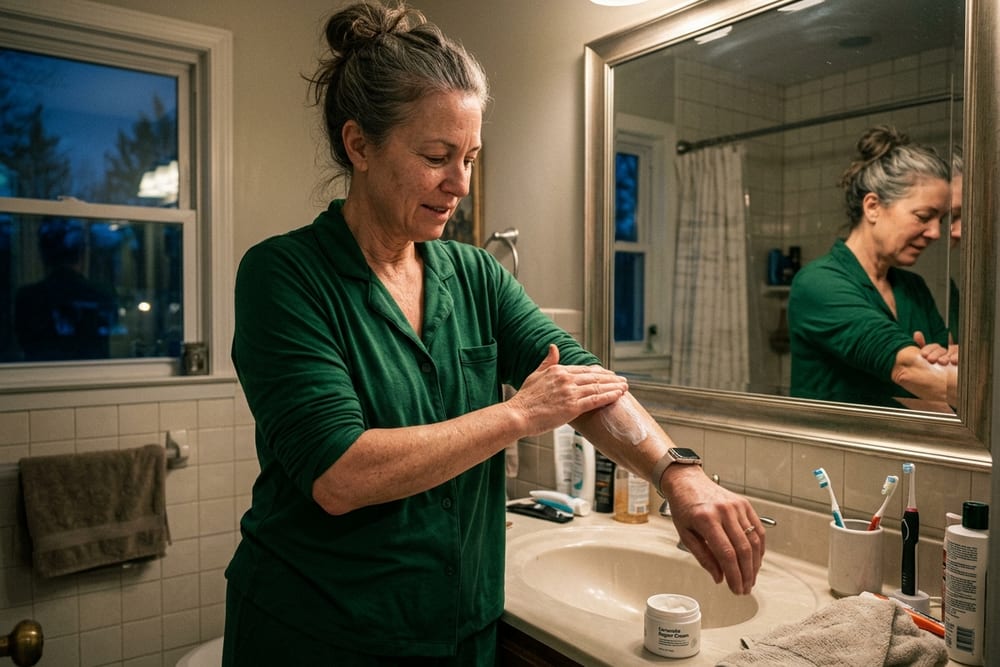
The 5 places perimenopause itching shows up
Itching driven by mast cell instability tends to surface wherever skin is thinnest, where mast cell density is highest, or where estrogen receptors are most concentrated. Five anatomical zones account for nearly all of it. Most women have two or three at once, which is itself a clue — single-zone itching is more often a local problem; multi-zone itching points upstream to hormones.
- Skin (forearms, calves, back, chest). Diffuse pruritus. Often rash-free or with only fine post-scratch flush. Mast cell density is high in dermis; estrogen-receptor expression in keratinocytes drops as estrogen falls.
- Scalp. A creeping, prickling itch that moves around the head. Often paired with new hair shedding. The scalp follicle has its own estrogen-receptor-rich microenvironment, and the itch tracks the same hormonal pattern.
- Ear canals (both ears). The lining of the ear canal is thin, estrogen-responsive skin packed with mast cells. Bilateral itching deep in the canal, with no discharge and no pain, is a near-pathognomonic perimenopause sign that most ENTs miss.
- Vulva and vaginal lining. The genitourinary syndrome of menopause (GSM) starts here. Vulvovaginal itching with thinning, dryness, and burning is the highest-prevalence local manifestation — and the one with the strongest evidence base for topical estradiol.
- Eyes and eyelids. Dry, itchy, burning eyes — often misdiagnosed as plain dry-eye syndrome. The lacrimal gland is estrogen-receptor-rich; estrogen withdrawal reduces tear film quality and triggers conjunctival mast cell release.
"She told me her ears itched on the inside, both of them, and the dermatologist had told her it was anxiety. Her estradiol was 18 pg/mL. We started a transdermal patch and the itch was gone in five weeks." — ClearedRx prescribing clinician, internal case note 2026
Why your dermatologist's antihistamine isn't enough
Zyrtec (cetirizine) and Claritin (loratadine) are excellent drugs for what they do: they block the H1 histamine receptor on nerve endings, which interrupts the itch signal after histamine has already been released. For seasonal allergies, food reactions, or hives, that downstream block is often enough — there's a single mediator (histamine) and a single target (H1 receptor), and the drug sits exactly between them.
Perimenopause itching is upstream of the drug. Mast cell instability releases not only histamine but also tryptase, prostaglandin D2, leukotrienes, and a dozen other mediators that have their own receptors and produce itch through pathways H1 antihistamines do not touch. That is why most women describe Zyrtec as "taking the edge off" rather than fixing the problem — the drug is doing exactly what it's designed to do, but only for one of the molecules in the cascade.
Topical hydrocortisone has a similar limitation. It calms surface inflammation but does not stabilize the mast cells underneath. The itch goes quiet for a few hours and then comes back as soon as the next mast cell wave fires. Topical steroid use over months also thins skin further — the opposite of what perimenopausal skin needs. Both drugs are reasonable adjuncts. Neither is a fix.

What actually works (ranked by evidence)
The interventions below are ordered by strength of evidence and by how directly they address the upstream cause. The first two reach the mast cell instability itself. The next three work downstream — useful as adjuncts, insufficient on their own. Match the intervention to where the itch shows up, not to the marketing claim on the box.
- Topical estradiol for vulvovaginal itch. Strongest evidence base. Multiple randomized trials and the 2022 NAMS position statement support local vaginal estrogen (cream, tablet, ring) for genitourinary itching, dryness, and burning, with 70-90% symptom resolution within 6-12 weeks. ClearedRx prescribes a compounded Estrogen + Progesterone Vaginal Cream that addresses the full GSM picture in one formulation. Local doses produce minimal systemic exposure, so the safety profile is favorable even for women who can't take systemic HRT.
- Systemic HRT for diffuse skin, scalp, and ear-canal itch. Transdermal estradiol patch or gel, oral or transdermal estradiol with progesterone if you have a uterus. Restores stable estrogen, re-stabilizes mast cells across all anatomical zones simultaneously, rebuilds skin barrier and dermal collagen. Most women see meaningful itch improvement within 4-8 weeks, in parallel with hot flash and sleep improvement. Addresses every zone at once, which is the right move when itching is multi-zone.
- Antihistamines as adjunct, not as primary therapy. Cetirizine 10 mg or loratadine 10 mg in the morning, optionally a sedating antihistamine like hydroxyzine 25 mg at bedtime if night itch is wrecking sleep. They take the edge off while HRT is reaching steady state in weeks 1-6. Useful. Not curative.
- Ceramide-rich moisturizers and skin barrier repair. CeraVe, Vanicream, La Roche-Posay Lipikar, or any product with ceramides plus hyaluronic acid plus niacinamide. Apply within three minutes of getting out of the shower while skin is still damp. Restores the lipid barrier that estrogen loss has eroded. Bland, fragrance-free, and used twice daily, this alone closes the gap for a meaningful subset of women.
- Avoid hot showers and fragranced products. Hot water strips ceramides; fragrance and surfactants destabilize already-fragile mast cells further. Lukewarm showers under 10 minutes, fragrance-free body wash (Vanicream Cleansing Bar, CeraVe Hydrating Cleanser), and laundry detergent without optical brighteners or perfumes. Boring, free, and high-yield.
When to call a doctor
The vast majority of perimenopausal itching is hormonal, benign, and treatable. A small minority is something else — and the differential is short, identifiable, and worth knowing because the consequences of missing it are real. The pattern below is when to stop the perimenopause framing and get evaluated promptly.
Red flags — call your doctor the same day if you have:
- Itching with jaundice (yellowing of the eyes or skin), pale stools, or dark urine — possible cholestatic liver disease; needs liver function tests today.
- Itching with fever, night sweats, and unintentional weight loss — the classic B-symptom triad for lymphoma; needs evaluation.
- Sudden severe full-body itch within hours — possible drug reaction or anaphylaxis precursor.
- Itching with a new spreading rash that is hot, blistered, peeling, or in the shape of a target — needs in-person evaluation, not telehealth.
- Itching that wakes you nightly for weeks with no other red flag is far more likely to be hormonal — but is still worth a clinician conversation rather than indefinite Zyrtec.
If your itching is bilateral, rash-free, worse at night, clusters with hot flashes or irregular periods, and has no red flag from the list above — that is the classic hormonal-itch fingerprint. The conversation worth having is about HRT, not about another tube of steroid cream.

How ClearedRx prescribes for perimenopause itching
ClearedRx is a doctor-supervised HRT service for women, online. You take a 60-second quiz. A licensed physician in our network reviews your symptoms within 24 hours. If you're a fit, they prescribe — and your treatment ships discreetly the same week. We prescribe both compounded and FDA-approved HRT preparations; you pick based on cost, format, and clinical fit.
For perimenopause itching specifically, the formulation that matters depends on where the itch shows up. Multi-zone itching (skin, scalp, ears) calls for systemic HRT — transdermal patch, gel, or a compounded estrogen-and-progesterone body cream applied to the thigh. Localized vulvovaginal itching is best addressed with our Estrogen + Progesterone Vaginal Cream, which targets the GSM tissue directly with minimal systemic exposure. Many women have both, and the prescribing clinician will recommend stacking systemic plus local when that's the right call.
Most women on HRT for hormonal itch see meaningful improvement within 4-8 weeks. ClearedRx HRT starts at $49 per month for compounded preparations and $89 per month for FDA-approved generics, all-in (medication, doctor reviews, free shipping in all 50 states). New patients save 50% on the first month. No surprise fees. No insurance paperwork.
Common questions
Why am I suddenly itchy in perimenopause?
The estrogen drop in perimenopause destabilizes mast cells — the immune cells that store histamine. When mast cells become unstable, they release histamine into the skin, scalp, ear canals, vulva, and eyes, producing itch with little or no visible rash. Estrogen normally suppresses mast cell degranulation, so falling and erratic estrogen takes the brake off the histamine system. That is why the itch often appears suddenly in your mid-40s, often wakes you at 3 a.m., and often does not respond fully to standard antihistamines.
Is itchy skin a sign of perimenopause?
Yes. Sudden, diffuse, often rash-free itching is one of the lesser-known but well-documented perimenopause symptoms — sometimes called pruritus or, when it feels like crawling sensations, formication. The 2022 NAMS hormone therapy position statement and a 2023 Journal of Menopausal Medicine review both note that estrogen withdrawal increases skin barrier dysfunction and mast cell instability. The pattern that points toward a hormonal cause: itching that affects multiple zones at once (skin plus scalp plus ear canals plus vulva), is worse at night, and clusters with other perimenopause symptoms like hot flashes, irregular periods, or sleep disruption.
Why are my ears itchy inside in perimenopause?
The ear canal lining is thin, estrogen-responsive skin packed with mast cells. When estrogen drops, the canal skin thins, dries, and the mast cells get twitchy — releasing histamine that produces the deep, can't-quite-reach-it itch women describe. It is not infection, not wax, not eczema in most cases. The clue is bilateral itching (both ears) without discharge, without pain, and often paired with itching elsewhere on the body. Topical steroid drops mask the symptom; the underlying driver is hormonal.
Does HRT help itchy skin in perimenopause?
Yes, for most women whose itching is hormonally driven. Restoring stable estrogen re-stabilizes mast cells, restores skin barrier function, and rebuilds the dermal collagen and hyaluronic acid that hold moisture. Topical estradiol is the strongest-evidence intervention for vulvovaginal itch (multiple randomized trials show 70-90% symptom resolution within 6-12 weeks). Systemic HRT addresses diffuse skin, scalp, and ear-canal itch. Most women see meaningful improvement within 4-8 weeks, and the response often outpaces antihistamines because HRT addresses the upstream cause rather than chasing histamine after release.
Why does Zyrtec not stop my perimenopause itch?
Antihistamines block the H1 histamine receptor downstream of mast cell release. They work well when histamine is the only mediator and the trigger is environmental (pollen, dust, food). Perimenopause itch is upstream of the antihistamine — it is mast cell instability driven by falling estrogen, releasing not just histamine but tryptase, prostaglandins, and other mediators that H1 blockers do not touch. Zyrtec or Claritin help take the edge off, which is why they are useful as adjuncts. They do not reach the cause, which is why the itch keeps coming back at 3 a.m.
When should I see a doctor for perimenopause itching?
Most perimenopausal itching is not dangerous and responds to hormonal and skin-barrier treatment. Get same-day medical evaluation if itching comes with: jaundice or yellowing of the eyes (possible liver involvement), unintentional weight loss, fever, night sweats with weight loss, a new spreading rash, swollen lymph nodes, or sudden severe full-body itch. Itching that wakes you nightly without any other red flag is still worth a clinician conversation — but it is far more likely to be hormonal than dangerous.
Sources & references
- The North American Menopause Society. The 2022 Hormone Therapy Position Statement of The North American Menopause Society. Menopause. 2022;29(7):767-794. PMID: 35797481
- Theoharides TC, Stewart JM, Hatziagelaki E, Kolaitis G. Brain "fog," inflammation and obesity: key aspects of neuropsychiatric disorders improved by luteolin. Front Neurosci. 2015;9:225. PMID: 26190965
- Zierau O, Zenclussen AC, Jensen F. Role of female sex hormones, estradiol and progesterone, in mast cell behavior. Front Immunol. 2012;3:169. PMID: 22723800
- Hall G, Phillips TJ. Estrogen and skin: the effects of estrogen, menopause, and hormone replacement therapy on the skin. J Am Acad Dermatol. 2005;53(4):555-568. PMID: 16198774
- Endocrine Society. Menopause and Hormone Therapy Clinical Practice Guideline (2024 update). endocrine.org
- Portman DJ, Gass ML; Vulvovaginal Atrophy Terminology Consensus Conference Panel. Genitourinary syndrome of menopause: new terminology for vulvovaginal atrophy. Menopause. 2014;21(10):1063-1068. PMID: 25160739
- Internal: menopause symptoms overview · perimenopause vs menopause · vaginal dryness treatment · perimenopause anxiety · perimenopause bloating · signs you need HRT
If you want to address the cause and not just the symptom — talk to a clinician
ClearedRx prescribes evidence-based HRT — bioidentical estradiol, progesterone, or our compounded Estrogen + Progesterone Vaginal Cream — based on your full picture, with 24-hour MD review and free shipping in all 50 states. Compounded preparations from $49/month, FDA-approved generics from $89/month. No insurance hassle. New patients save 50% on the first month.
Find out if HRT is right for me