
Last reviewed May 10, 2026
Quick answer: Perimenopause hair loss has two distinct mechanisms. Telogen effluvium (TE) is diffuse shedding — clumps in the brush and drain — triggered by hormone swings, low ferritin, thyroid shifts, or stress. Female pattern hair loss (FAGA / female androgenetic alopecia) is gradual central thinning — a widening part — driven by follicle sensitivity to androgens in a low-estrogen environment (Camacho-Martínez 2009; Carmina 2008). HRT meaningfully helps TE. HRT alone is much weaker for FAGA — that usually needs minoxidil, spironolactone, or off-label oral finasteride. Many midlife women have both at once.
The 60-second version
If your gynecologist said it was "just stress" — there's more to the story
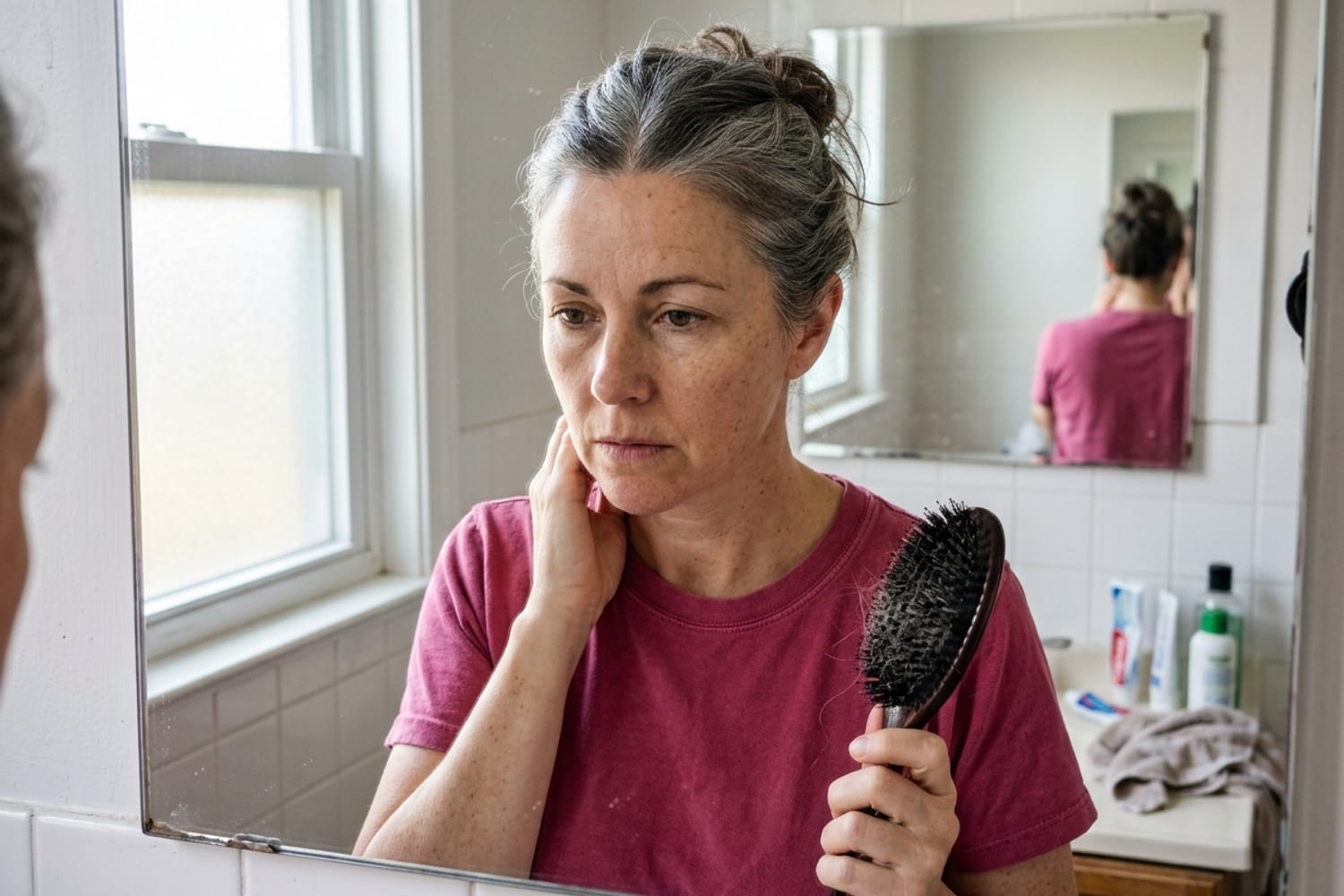
If you are 47 and find clumps of hair in the shower drain, your gynecologist tells you it is "just stress," and no amount of meditation is fixing it — there is a hormonal mechanism at play, and the right answer depends on which type of hair loss you have. Perimenopause hair loss is not one condition. It is two — sometimes overlapping — and most articles online conflate them.
The reason this matters is practical. The treatment that works for one type is partially helpful for the other. The treatment that fully fixes the second is not the right tool for the first. Hormone replacement therapy is one of the most powerful interventions for one type of perimenopause hair loss and a relatively weak intervention for the other. If a clinician hands you HRT and tells you to wait, and you have the kind that needs minoxidil, you will spend six months wondering why nothing is working — when the actual answer is that you needed both.
This article is the part the lecture skips. The two-question diagnostic that distinguishes them. The mechanism behind each. The treatments that have published trial evidence. The supplements that don't. And where ClearedRx fits — honestly, including where it doesn't.
The pattern starts earlier than most women expect. Hair loss in menopause is often a late-perimenopause symptom, sometimes years before the last period, because estrogen swings are sharpest in the perimenopausal phase. The conversation around postmenopausal hair loss is finally catching up to the biology — but the public-facing version still flattens the two mechanisms into one, and women pay for that flattening in time and money.
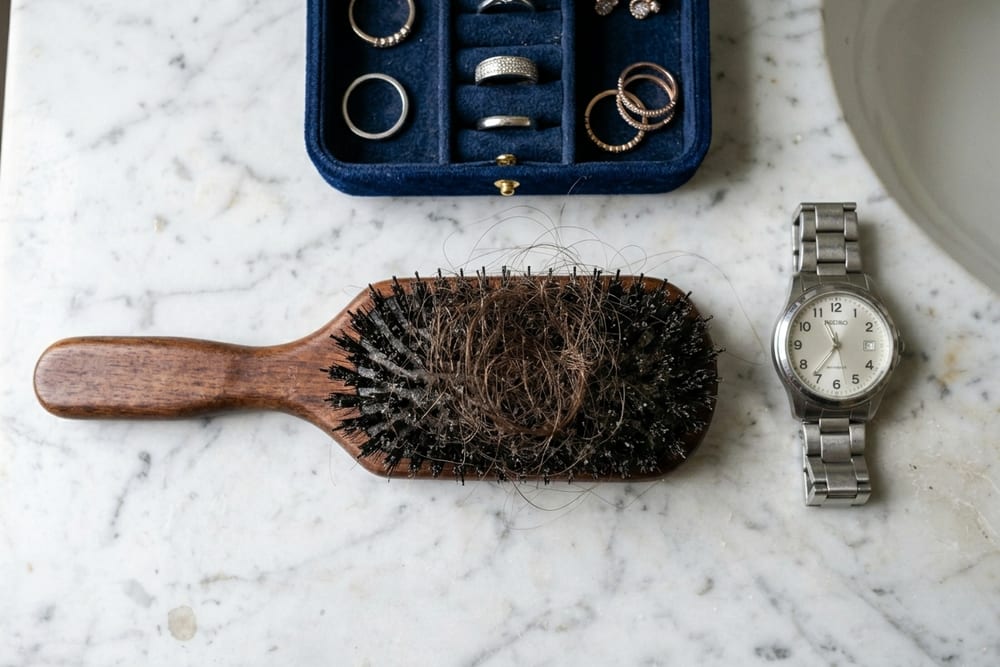
Two questions distinguish telogen effluvium from female pattern hair loss. Most blogs collapse them into "menopause hair loss." The treatments are different.
Question 1 — Are you shedding excessively? Are you finding clumps of hair in the brush, in the shower drain, on your pillowcase, or on your shoulders by midday? If yes — probably telogen effluvium (TE). The mechanism is too many follicles entering the shedding phase at the same time, usually triggered by an estrogen drop, a ferritin drop, a thyroid shift, an illness 2 to 4 months prior, or sustained stress.
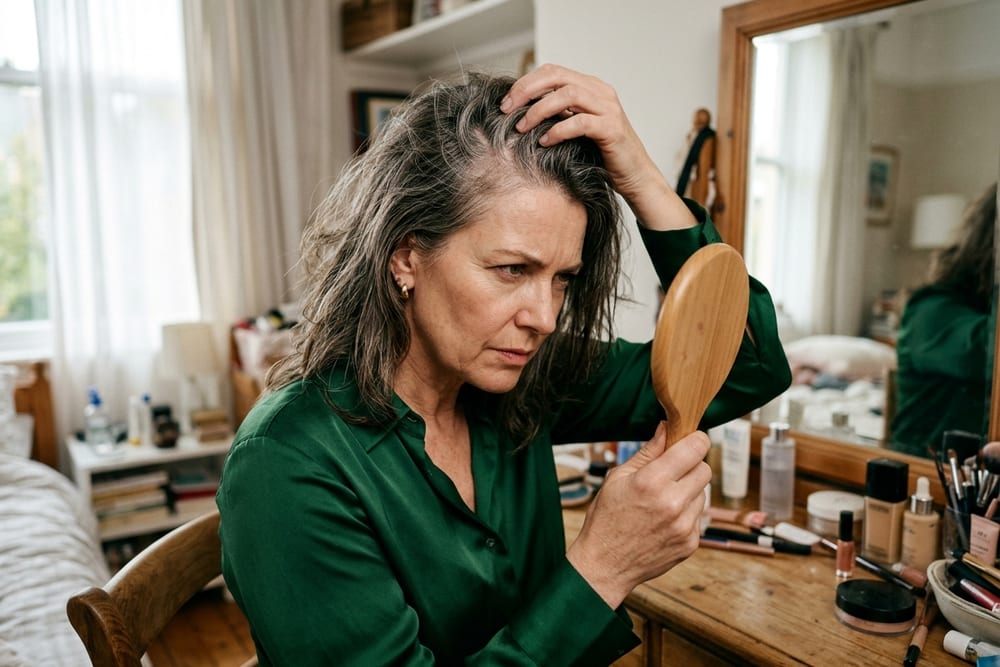
Question 2 — Is your part widening or your scalp showing more? Hold a mirror behind you and look at your part line in the central scalp. Compare it to a photo from two or three years ago. If the part has widened and the scalp shows through more, especially at the crown — probably female androgenetic alopecia (FAGA), the female version of pattern hair loss. The mechanism is follicle sensitivity to androgens (specifically DHT) in a low-estrogen environment, leading to follicle miniaturization over time.
Citations: Camacho-Martínez FM. Hair loss in women. Semin Cutan Med Surg 2009;28(1):19-32. PMID: 19332210 · Mirmirani P. Hormonal changes in menopause: do they contribute to a 'midlife hair crisis' in women? Br J Dermatol 2011;165(s3):7-11. PMID: 21353405 · Carmina E. Diagnosis of hyperandrogenism in midlife women. Endocrinol Metab Clin North Am 2008;37(4):925-939. PMID: 18603069.
The two types: telogen effluvium vs female pattern hair loss
The single most useful frame for understanding perimenopause hair loss is the distinction between telogen effluvium and female androgenetic alopecia. They look different, they feel different, they are caused by different things, and they respond to different treatments. The only thing they share is the timing — both can show up between 40 and 55, often within months of each other, which is why they get lumped together.
Telogen effluvium — the shedding type
Hair grows in cycles. At any moment, about 85 to 90% of your scalp follicles are in the active growth phase (anagen) and about 10 to 15% are in the shedding phase (telogen). The shedding phase lasts about 2 to 4 months, after which the follicle releases the old hair and starts a new growth cycle. In a normal scalp, this is invisible — you shed 50 to 100 hairs per day and your hair stays the same density.
Telogen effluvium is what happens when too many follicles enter the shedding phase at the same time. A trigger pushes a wave of follicles from anagen into telogen prematurely; about 2 to 4 months later, that synchronized wave releases its hairs and you suddenly find 200, 300, sometimes 500 hairs per day on your brush, your pillow, and your shower drain. The shedding feels alarming because it is. The good news: TE is usually self-limiting. Once the trigger is corrected, the same follicles re-enter the growth phase and density returns within 6 to 12 months. Camacho-Martínez 2009 and Mirmirani 2011 both characterize this pattern in midlife women specifically.
The triggers in perimenopause are recognizable: a sudden estrogen drop (especially in late perimenopause when cycles become erratic), low ferritin (under 40 ng/mL — more on that below), a thyroid shift (subclinical hypothyroidism is common in midlife), an illness or surgery 2 to 4 months prior, sustained psychological stress, rapid weight loss, or starting/stopping certain medications. The post-COVID hair shed many women experienced in 2020 and 2021 was textbook TE — driven by inflammation rather than hormones, but the mechanism is the same.
The pattern is diffuse — meaning all over the scalp, not concentrated in one area. The hairline is usually preserved. The part may look thinner overall but does not have the central widening pattern of FAGA. The shed hairs typically have a small white bulb at the root (the telogen bulb) — that is the diagnostic give-away.
FAGA — female pattern hair loss
Female androgenetic alopecia (FAGA), also called female pattern hair loss, is a different condition with a different mechanism. The follicles do not enter a synchronized shedding phase. They progressively miniaturize — each growth cycle produces a slightly thinner, slightly shorter hair, and over years the affected follicles produce vellus (peach-fuzz) hairs instead of terminal (full) hairs. The total number of follicles is preserved; the hair they make gets progressively finer until it does not contribute meaningful coverage.
The driver is androgen sensitivity at the follicle. Specifically, dihydrotestosterone (DHT — the more potent androgen converted from testosterone by 5-alpha-reductase) binds to receptors on susceptible follicles in the central scalp and signals miniaturization. In premenopausal women, high estrogen counterbalances this signal — the estrogen-androgen ratio favors hair growth. In perimenopause and menopause, estrogen falls while androgen levels stay relatively flat (or fall more slowly), so the relative androgen exposure rises. The follicles that were always genetically susceptible now have nothing protecting them. Carmina 2008 details this estrogen-androgen ratio shift in midlife women.
The pattern is recognizable: central widening of the part (the "Christmas tree" pattern in the Olsen classification or the Ludwig pattern in older literature), crown thinning, and — importantly — preservation of the frontal hairline. Women with FAGA usually keep the hairline they had at 25; what they lose is the density behind it. Wolff 2016 documented density changes on standardized photography in postmenopausal women with FAGA over 24 months.
The pattern is gradual — measured in years, not months. Most women describe noticing it as a slowly losing battle: the part keeps getting wider, the ponytail is thinner this year than last year, more scalp shows in the photos at the family wedding. There is no sudden shed. The shed hairs do not have the white telogen bulb because the follicles are not entering synchronized telogen — they are just producing thinner hairs.
Why the distinction matters — and where they overlap
Roughly half of midlife women with one type also have the other. A woman entering late perimenopause with genetic susceptibility to FAGA may have been slowly losing density for years and then experience an acute estrogen drop that adds an overlay of TE. The drain looks dramatic; the part has been widening invisibly for two years. Treating only the shedding (HRT, ferritin) will fix the acute layer but the gradual layer continues. Treating only the pattern (minoxidil) will help the gradual layer but will not stop the active shed. The right move is usually treating both — which is why pattern-recognition by a clinician matters more than the brand-name supplement aisle suggests.
The 2-question rule of thumb. Excessive shedding (clumps in the drain) → think TE first. Widening part with scalp showing → think FAGA first. Both at once → both treatments, in parallel. The companion piece on perimenopause vs menopause walks through which symptom-stage maps to which treatment.
What causes telogen effluvium in perimenopause
The triggers for TE in perimenopause are well-characterized in the dermatology literature, and the differential diagnosis is short. The four most common are estrogen withdrawal, low ferritin, thyroid shifts, and cortisol-driven stress.
Estrogen withdrawal is the most under-appreciated trigger. Estrogen prolongs the anagen (growth) phase of the hair cycle. When estrogen drops sharply — at the end of the luteal phase in late perimenopause, postpartum, or after stopping hormonal contraception — a wave of follicles can shift into telogen 2 to 4 months later. This is why so many women describe the shed starting in late perimenopause and getting worse around the final menstrual period. Mirmirani's 2011 review in British Journal of Dermatology specifically frames this as a "midlife hair crisis" pattern.
Low ferritin is the most under-treated trigger. Ferritin is the storage form of iron, and the threshold for hair growth in midlife women is well above the threshold for ruling out anemia. Most labs flag ferritin as low only when it falls under 15 ng/mL. The dermatology literature — including Trost et al. 2006 in Journal of the American Academy of Dermatology — supports a hair-growth threshold of approximately 40 ng/mL, with many practitioners targeting above 70 for active treatment. Hemoglobin can be perfectly normal while ferritin sits at 18 and the hair cycle is silently struggling. The lab will say you are not anemic; the hair is telling you the iron stores are still inadequate.
Thyroid shifts are the third common trigger. Both subclinical hypothyroidism (TSH 4 to 10 with normal free T4) and overt hypothyroidism produce diffuse shedding. Hashimoto's autoimmune thyroiditis incidence rises in midlife women and often presents first as a hair shed before lab abnormalities are obvious. A complete workup needs TSH and free T4 at minimum.
Stress and cortisol — chronic psychological stress, especially with sleep disruption — produces a similar pattern via cortisol's effect on the hair cycle. The mechanism is real and the effect is real, but the popular telling overstates it. Stress alone rarely produces a dramatic shed in the absence of one of the three above; it potentiates them.
What causes FAGA in perimenopause
Female androgenetic alopecia is genetically programmed and hormonally activated. The genetic susceptibility is set at birth — daughters of mothers and grandmothers with central pattern thinning are at much higher risk. The activation is the estrogen-androgen ratio shift that begins in late perimenopause and accelerates after menopause.
The mechanism is specific: susceptible follicles in the central scalp express the androgen receptor and, in lower density, the type 2 5-alpha-reductase enzyme that converts testosterone to DHT. Premenopausal estrogen levels keep the receptor signal damped; the follicle ignores most of the available androgen. As estrogen falls, the damper lifts. The follicle starts reading the androgen signal, miniaturizes its hair shaft, and shortens its growth phase. Over years, terminal hairs are progressively replaced by vellus hairs in the affected zones. Carmina's 2008 review in Endocrinology and Metabolism Clinics of North America details the androgen-driven miniaturization in midlife women.
The role of total testosterone is less important than the role of the estrogen-androgen ratio. Most women with FAGA have testosterone within the normal range. What changed is the offsetting estrogen. This is why testosterone replacement in midlife women (when used appropriately for libido and mood) does not necessarily worsen FAGA — the ratio is what matters, not the absolute number. It is also why HRT helps FAGA modestly: by restoring the estrogen side of the ratio, HRT reduces the relative androgen exposure at the follicle. The effect is real but small compared to direct anti-androgen or follicle-targeted therapy.
A small subset of FAGA in midlife women is associated with elevated androgens — polycystic ovary syndrome that has gone undiagnosed, late-onset adrenal hyperplasia, or rare androgen-secreting tumors. The diagnostic workup includes total testosterone with sex-hormone-binding globulin (SHBG), DHEA-S, and clinical evaluation for hirsutism and menstrual irregularity. The 2024 British Journal of Dermatology updates on FAGA reinforce this workup as the standard first-line investigation in women with rapid pattern progression.
Treatments that work — by type
The treatments for perimenopause hair loss split cleanly along the TE versus FAGA line. The honest hierarchy, ranked by published effect size and mechanism specificity, looks like this.
For telogen effluvium
HRT is one of the most direct interventions for TE in perimenopause when the trigger is the estrogen drop itself. By stabilizing estrogen, HRT prevents the next wave of follicles from prematurely entering telogen, and over 3 to 6 months the hair cycle re-synchronizes. Mirmirani 2011 reported mixed but generally favorable density signals for HT in TE-pattern shedding, and the practical experience of menopause-trained clinicians supports this strongly.
Ferritin repletion is the most under-prescribed intervention. Target above 70 ng/mL for active hair-loss treatment, not just above 15 (the lab's anemia threshold). Oral iron — ferrous sulfate, ferrous bisglycinate, or iron polymaltose — taken every other day is more efficient than daily dosing, per recent absorption-kinetics work. Vitamin C taken with iron improves absorption; calcium reduces it. Plan on 3 to 6 months of supplementation to move ferritin meaningfully.
Vitamin D repletion if levels are below 40 ng/mL. Vitamin D receptors are expressed on the hair follicle and deficiency is independently associated with diffuse shedding. The dose is typically 2,000 to 5,000 IU daily depending on starting level, with 25-OH retesting at 3 months.
Sleep and stress management address the cortisol overlay. The mechanism is real and the timeline is slow — improvements at 3 to 6 months. Our companion piece on progesterone and sleep covers the sleep half of this.
Time is the underrated treatment. Most TE resolves on its own once the trigger is fixed; the hair will regrow. Patience is part of the protocol.
For FAGA
Topical minoxidil 5% is the FDA-approved first-line treatment for female pattern hair loss. Applied once daily to the affected scalp areas, it extends the anagen phase and reverses follicle miniaturization in responders. Density gains are typically visible at 4 to 6 months, with continued improvement out to 12 months. The 2014 Olsen randomized trial and multiple subsequent studies support 5% strength for women.
Oral low-dose minoxidil (LDOM), 0.625 to 2.5 mg once daily, is increasingly used off-label by dermatologists for women who find the topical inconvenient or who want stronger effect. Oral minoxidil is sometimes more effective than topical and avoids the application irritation that drives many women off the topical at month 2. Side effects to monitor: facial hair growth, mild ankle edema, occasionally lowered blood pressure.
Spironolactone at 50 to 200 mg daily is an aldosterone antagonist with anti-androgen activity. Off-label for FAGA, it reduces androgen signaling at the follicle and is supported by multiple observational studies and clinical experience. It requires monitoring (potassium, blood pressure, kidney function) and is most often combined with topical or oral minoxidil for a follicle-targeted plus systemic-androgen-blocking approach.
Oral finasteride, 1 to 5 mg daily, is the male pattern-hair-loss workhorse and is used off-label for FAGA in postmenopausal women. It blocks 5-alpha-reductase, lowering DHT. Evidence in women is more variable than in men but real in some subgroups. It is contraindicated in premenopausal women who could become pregnant (teratogenic) and is typically reserved for postmenopausal use.
HRT helps modestly. The effect is real but small compared to the dedicated anti-androgen and follicle-targeted therapies. The honest framing: HRT is the right tool for the TE component of mixed perimenopause hair loss and a partial tool for the FAGA component.
For both — the foundation
Adequate dietary protein (approximately 1.2 to 1.6 g/kg/day in midlife women) supports hair structure regardless of which type. Omega-3 fatty acids may have a small inflammatory-modulating effect. Scalp circulation matters in modest ways — gentle daily massage at the part-line for 2 to 5 minutes has limited but supportive evidence. None of these substitute for the type-specific treatment; they are the foundation underneath.
What does NOT help
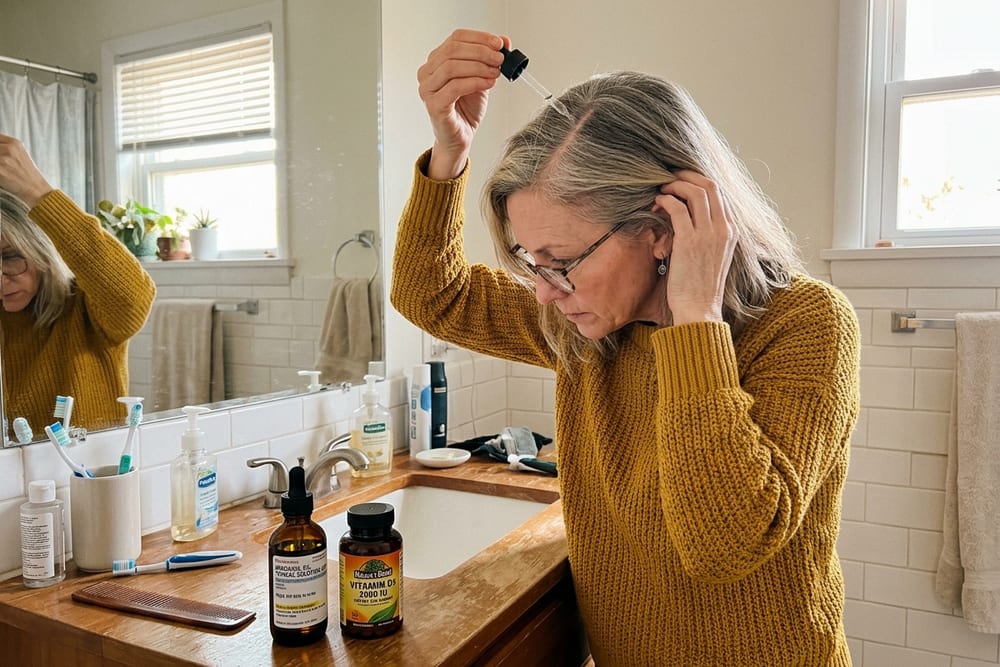
The hair-loss supplement aisle is one of the most expensive and lowest-yield categories in midlife women's health. The honest list of things that do not have meaningful evidence:
Biotin in non-deficient adults. Biotin deficiency is rare; supplementation does not help hair loss in people who have normal levels, per multiple systematic reviews including Patel et al. 2017 in Skin Appendage Disorders. High-dose biotin can also interfere with thyroid and troponin lab tests, masking real medical issues. Most "hair gummies" are biotin in a candy substrate.
Generic "hormone balance" or "cortisol balance" supplements have no rigorous trial evidence for hair loss or for the conditions they target. The category is marketing, not medicine. The supplement aisle's $4 billion in annual sales for hair-loss-adjacent products has not produced a single OTC product with FDA-grade trial evidence comparable to topical minoxidil.
Most expensive serums — caffeine serums, peptide serums, "growth factor" serums — have very limited evidence. The active ingredients with evidence are minoxidil (prescription strength) and, in some cases, low-irritation topical antiandrogens used off-label. Marketing language is not equivalent to a randomized trial.
Collagen powders for hair specifically. Collagen supplementation has some skin and joint evidence but not specifically for hair density in the absence of protein deficiency.
The HRT + minoxidil combination — under-discussed but evidence-based
For perimenopause and postmenopausal women with mixed TE and FAGA — which is the majority — the most effective approach is usually combination therapy: HRT to address the estrogen-driven TE component plus topical or oral minoxidil to address the follicle-miniaturization FAGA component. This combination is mentioned in the dermatology literature but rarely prescribed as a coordinated plan because it usually requires two different clinicians (a menopause-trained provider for HRT and a dermatologist or specialty hair-loss service for minoxidil and spironolactone).
The clinical rationale is straightforward. HRT alone often slows but does not reverse the FAGA pattern — the part keeps slowly widening. Minoxidil alone does not stabilize the estrogen drop driving the active shed. Together, they address both layers. The 2024 British Journal of Dermatology updates note this combination favorably, and Wolff 2016 in Aesthetic Plastic Surgery documented density changes on standardized photography in postmenopausal women on combination therapy out to 24 months. Anecdotally, the women who get the best outcomes in midlife hair loss are usually the ones running both protocols simultaneously rather than sequentially.
For practical purposes: if your symptom set includes both diffuse shedding and a widening part, the conversation with your clinician should include both an HRT plan (estradiol patch, gel, or compounded body cream, with progesterone if you have a uterus) and a minoxidil plan (topical 5% once daily or oral low-dose). If only one is on offer at the visit, ask explicitly about the other.
Where ClearedRx fits — and where it doesn't
ClearedRx is a doctor-supervised HRT service for women, online. The 60-second quiz, the 24-hour MD review, the prescription shipped to your door, all 50 states. We prescribe both compounded and FDA-approved HRT preparations — bioidentical estradiol, micronized progesterone, and combined estrogen-progesterone body creams. The patient picks based on cost, format preference, and clinical fit.
For perimenopause hair loss specifically, here is the honest framing. HRT helps the TE component meaningfully and the FAGA component modestly. If your hair loss is the diffuse-shedding pattern with the drain test positive — HRT through ClearedRx is one of the most direct levers available, and our signs you need HRT piece walks through the broader symptom constellation that often presents alongside TE. If your hair loss is primarily the widening-part pattern with steady gradual progression — HRT will help, but you will likely also need minoxidil and possibly spironolactone, which require a dermatologist or a specialty hair-loss service. We are not a hair clinic. We are hormonal restoration.
The cost framing the way our patients experience it: ClearedRx HRT starts at $49 per month for compounded preparations and $89 per month for FDA-approved generics, all-in (medication, doctor reviews, free shipping). New patients get 50% off the first month. The compounded option is HSA and FSA eligible. For the broader cost picture across formulations and channels, our HRT cost comparison walks through every option. For sister-article context on adjacent levers, our top perimenopause supplements 2026 piece audits the ferritin and vitamin D stack that supports TE recovery.

The intervention comparison table
Side by side, here is how the published evidence stacks up for the most commonly suggested approaches to perimenopause hair loss. Realistic effect sizes are pulled from the trials cited above. The "notes" column is the one most articles skip.
| Intervention | Best for | Realistic effect | Notes |
|---|---|---|---|
| HRT (estradiol +/- progesterone) | TE primarily; FAGA modestly | Stops active shed within 3–6 mo; modest density gain | Direct on the cause for TE; partial for FAGA — see Mirmirani 2011 |
| Topical minoxidil 5% | FAGA | Density gains visible at 4–6 mo; continued out to 12 mo | FDA-approved for female pattern hair loss; once-daily application |
| Oral low-dose minoxidil | FAGA when topical isn't working | Often more effective than topical at low side-effect dose | 0.625–2.5 mg/day off-label; needs BP and edema monitoring |
| Spironolactone | FAGA — anti-androgen layer | Real effect; best in combination with minoxidil | Off-label 50–200 mg/day; monitor potassium and BP |
| Oral finasteride (off-label) | FAGA in postmenopausal women | Variable; real in some subgroups | Contraindicated in premenopausal women; teratogenic |
| Ferritin repletion | TE when ferritin <40 | Shedding slows once ferritin >70 | Target >70 ng/mL, not just >15 (Trost 2006) |
| Vitamin D repletion | TE when 25-OH <40 ng/mL | Modest; supportive role | 2,000–5,000 IU/day; retest at 3 mo |
| Biotin, hair gummies, "balance" pills | None | No measurable effect in non-deficient adults | Biotin can mask thyroid and troponin lab values |
"The midlife 'hair crisis' in women reflects a confluence of hormonal mechanisms — estrogen withdrawal, shifting androgen-to-estrogen ratios, and increased follicle sensitivity to androgens — that can produce both telogen effluvium and accelerated androgenetic alopecia in the same patient. Treatment must address both mechanisms when both are present." — Mirmirani P. Hormonal changes in menopause: do they contribute to a 'midlife hair crisis' in women? British Journal of Dermatology. 2011;165(s3):7-11.
If you also want to map the rest of the picture
Perimenopause hair loss almost never travels alone. The same low-estrogen environment that drives TE and unmasks FAGA typically also produces sleep disruption, hot flashes, mood changes, joint pain, brain fog, vaginal dryness, and the menopause-belly redistribution we cover in our menopause belly piece. Mapping the constellation is the cheapest diagnostic move you can make. Our free Menopause Symptom Score is a 60-second self-check that scores the cluster as a single hormonal-fingerprint number. The perimenopause self-check walks through stage-of-transition. For symptoms-only context, the symptoms overview page indexes the constellation. For broader epidemiology, the menopause statistics 2026 page has prevalence numbers across symptoms.
Frequently asked questions
Why am I losing hair in perimenopause?
Two different mechanisms drive perimenopause hair loss, and they are often confused. Telogen effluvium (TE) is a diffuse shedding triggered by sudden hormone shifts, low ferritin, thyroid changes, or stress — you find clumps of hair in the brush and shower drain. Female androgenetic alopecia (FAGA) is a gradual pattern thinning at the central part and crown driven by follicle sensitivity to androgens in a low-estrogen environment — your part widens and the scalp shows more. The treatments differ. TE responds to HRT, iron repletion, vitamin D, and time. FAGA usually needs minoxidil, spironolactone, or off-label oral finasteride. Many women in midlife have both at once.
Will HRT stop my hair loss?
It depends on which type of hair loss you have. HRT helps telogen effluvium meaningfully because it stabilizes the estrogen drop that pushed too many follicles into the shedding phase. Mirmirani's 2011 review reported mixed but generally favorable density signals for HT in TE-pattern shedding. HRT helps female androgenetic alopecia much less — modest at best. Camacho-Martínez 2009 and the Endocrine Society 2024 guidance both note that FAGA usually requires direct anti-androgen or follicle-targeted therapy (minoxidil, spironolactone) rather than estrogen replacement alone. The honest answer: HRT is the right tool for the TE component and a partial tool for the FAGA component. See our signs you need HRT piece for the broader symptom-set context.
What's the difference between menopause hair loss and pattern baldness?
Menopause hair loss is an umbrella term that covers both telogen effluvium (shedding) and female pattern hair loss (FAGA / female androgenetic alopecia). Pattern baldness is the FAGA part specifically — it follows the Ludwig pattern in women: central widening of the part, crown thinning, but typically preserved hairline. The two-question diagnostic: if you find clumps in the drain, it is probably TE; if your part is widening and the scalp is showing through, it is probably FAGA. Many midlife women have both, and the treatments differ — Carmina 2008 details the androgen-driven FAGA mechanism specifically.
How long does perimenopause hair loss last?
Telogen effluvium typically resolves within 6 to 12 months once the underlying trigger is corrected. Hair shedding usually slows within 3 months of treatment, with regrowth visible at 6 to 9 months. Female androgenetic alopecia is different — it is progressive without intervention. Untreated FAGA continues to thin slowly over years. With minoxidil and/or spironolactone, FAGA stabilizes within 4 to 6 months and modest regrowth is visible at 9 to 12 months in most responders. Wolff 2016 documented density changes on standardized photography out to 24 months in postmenopausal women.
Should I take biotin?
No, unless you have a documented biotin deficiency — which is rare. The American Academy of Dermatology and multiple systematic reviews (including Patel et al. 2017) found no evidence that biotin supplementation helps hair loss in non-deficient adults. Most hair gummies and biotin supplements are marketing, not medicine. Worse, high-dose biotin can interfere with thyroid and troponin lab tests, masking or mimicking real medical issues. The supplements that have actual evidence in midlife women are iron (if ferritin is low), vitamin D (if deficient), and adequate dietary protein — see our perimenopause supplements 2026 piece for the audit.
Does minoxidil work for menopause hair loss?
Yes, especially for the FAGA / pattern component of perimenopause hair loss. Topical minoxidil 5% applied once daily is FDA-approved for female pattern hair loss and is supported by multiple randomized trials including the 2014 Olsen study showing significant density gains at 24 weeks. Minoxidil works regardless of estrogen status because it acts directly on the follicle. It does not help telogen effluvium as much, because TE is a phase-shift problem, not a follicle-miniaturization problem. For women with mixed TE and FAGA — common in perimenopause — minoxidil plus HRT is often more effective than either alone. Oral low-dose minoxidil (0.625 to 2.5 mg) is increasingly used off-label and may be more practical than the topical for many women.
Can I take spironolactone WITH HRT?
Yes, in appropriate clinical circumstances. Spironolactone is an aldosterone antagonist with anti-androgen activity at higher doses (50 to 200 mg/day for FAGA) and is commonly prescribed off-label for female pattern hair loss. It can be combined with HRT — many midlife women take both. The combination requires monitoring (potassium, blood pressure, kidney function) and a clinician comfortable with both. The British Association of Dermatologists guidance supports spironolactone-plus-estrogen as a reasonable combination for FAGA in women without contraindications. ClearedRx prescribes HRT but does not prescribe spironolactone for hair loss; for the anti-androgen layer you need a dermatologist or a service that explicitly handles off-label hair-loss prescribing.
What blood tests should I get for hair loss?
The standard midlife hair-loss workup: ferritin (target above 70 ng/mL for hair growth, not just above the lab's normal lower limit of 15), vitamin D 25-OH (target 40 to 60 ng/mL), TSH and free T4 (thyroid drives diffuse shedding), CBC (rule out anemia), and in selected cases zinc, B12, and total testosterone with SHBG. The under-discussed one is ferritin: most labs flag ferritin under 15 as low, but the threshold for hair growth in midlife women is closer to 40 — well-documented in Trost et al. 2006 in the Journal of the American Academy of Dermatology. A ferritin in the 20s with a normal hemoglobin does not mean iron is fine for your hair.
When will my hair grow back?
Hair grows about half an inch per month at the scalp. Telogen effluvium recovery follows a predictable arc: shedding slows 2 to 4 months after the trigger is corrected, new short hairs are visible at the part line at 4 to 6 months, and density visibly recovers at 9 to 12 months. FAGA is slower because the goal is preventing further loss as much as regrowing — visible thickening on minoxidil arrives at 4 to 6 months, with continued improvement out to 12 to 24 months. The first sign of treatment working is usually a paradoxical increase in shedding around month 1 to 2 of minoxidil — that is the synchronized restart of the growth cycle, not a treatment failure.
Can hair loss be reversed in perimenopause?
Largely yes for telogen effluvium — once the trigger is corrected, density usually returns to baseline within a year. Partially for female pattern hair loss — FAGA can be stabilized and modestly reversed with minoxidil and/or spironolactone, but full reversal to teenage density is uncommon. The earlier treatment starts, the better the outcome, because miniaturized follicles can recover but completely scarred or fibrosed follicles cannot. The window for the best results is the first 12 to 24 months of perceptible thinning. Waiting two or three years and hoping it self-corrects is the most common preventable mistake.
Sources & references
- Camacho-Martínez FM. Hair loss in women. Semin Cutan Med Surg. 2009;28(1):19-32. PMID: 19332210
- Mirmirani P. Hormonal changes in menopause: do they contribute to a 'midlife hair crisis' in women? Br J Dermatol. 2011;165(s3):7-11. PMID: 21353405
- Carmina E. Diagnosis of hyperandrogenism in midlife women. Endocrinol Metab Clin North Am. 2008;37(4):925-939. PMID: 18603069
- Wolff H, Fischer TW, Blume-Peytavi U. The diagnosis and treatment of hair and scalp diseases. Aesthetic Plast Surg / Dtsch Arztebl Int. 2016;113(21):377-386. PMID: 27504707
- Trost LB, Bergfeld WF, Calogeras E. The diagnosis and treatment of iron deficiency and its potential relationship to hair loss. J Am Acad Dermatol. 2006;54(5):824-844. PMID: 16635664
- Olsen EA, Whiting D, Bergfeld W, et al. A multicenter, randomized, placebo-controlled, double-blind clinical trial of a novel formulation of 5% minoxidil topical foam versus placebo in the treatment of androgenetic alopecia in men. J Am Acad Dermatol. 2007;57(5):767-774. PMID: 17761356
- Patel DP, Swink SM, Castelo-Soccio L. A Review of the Use of Biotin for Hair Loss. Skin Appendage Disord. 2017;3(3):166-169. PMID: 28879195
- Sinclair R, Patel M, Dawson TL Jr, et al. Hair loss in women: medical and cosmetic approaches to increase scalp hair fullness. Br J Dermatol. 2011;165 Suppl 3:12-18. PMID: 22171680
- The North American Menopause Society. The 2022 Hormone Therapy Position Statement of The North American Menopause Society. Menopause. 2022;29(7):767-794. PMID: 35797481
- Endocrine Society. Menopause and Hormone Therapy Clinical Practice Guideline (2024 update). endocrine.org
- Internal: menopause symptoms overview · menopause statistics 2026 · menopause symptom score · perimenopause self-check · perimenopause vs menopause · perimenopause supplements 2026 · signs you need HRT · menopause belly
If you want the hormonal layer addressed — talk to a clinician
ClearedRx prescribes evidence-based HRT — bioidentical estradiol, progesterone, or a combined cream — based on your full picture, with 24-hour MD review and free shipping in all 50 states. Compounded preparations from $49/month, FDA-approved generics from $89/month. No insurance hassle. New patients save 50% on the first month. If your hair loss is the FAGA pattern type, we'll tell you so honestly and you'll need a dermatologist for the minoxidil layer.
Find out if HRT is right for me