

Last reviewed May 10, 2026
Quick answer: Menopause belly is fat redistribution, not weight gain. Visceral fat — the deeper, firmer fat around your organs — rises by approximately 44% across the menopausal transition, often without any change in total body weight (Lovejoy et al., 2008). The mechanism is estrogen-driven: low estrogen tells the body to deposit fat viscerally instead of in the hips and thighs. It is not your diet. It is not your discipline. It is hormonal — and it is fixable. ClearedRx prescribes evidence-based HRT with 24-hour MD review.
The 60-second version
If you have done everything right and your belly hasn't moved, read this
If you have gained ten or fifteen pounds around your middle since you turned 45 — and not a single thing you have tried has touched it — let me say something you have probably never heard from your doctor. It is not your fault. And it is almost certainly not what you think it is.
You haven't suddenly gotten lazy. You haven't started eating more than you used to. You're not "just getting older" the way men get older. Something specific changed in your body — and it has a name. Doctors call it menopausal weight redistribution. You can call it what every woman calls it: the belly that wasn't there last year and won't go away this year.
This article is not the eat-less-move-more lecture. It is the part the lecture skips: the menopause belly mechanism, the actual data on visceral fat across the transition, why the same diet that kept you slim at 35 will not do the same job at 50, and what the published trials actually show works for menopause belly fat after estrogen drops. If you searched why menopause causes belly fat at 11 p.m. on your phone, you are not alone. The full search query — perimenopause belly, menopause stomach, the connection between estrogen and belly fat — is the most under-discussed structural body change in midlife medicine.
The pattern starts earlier than most women expect. Perimenopause belly is often the first symptom — sometimes years before the last period — because estrogen swings are sharpest in the perimenopausal phase. Menopause stomach as a search term doubled in volume between 2020 and 2025 in the U.S. The conversation is finally catching up to the biology.

Visceral fat rises ~44% across the menopausal transition. Total body weight may not change. The fat redistributes.
The SWAN (Study of Women's Health Across the Nation) cohort and Lovejoy's 2008 longitudinal analysis tracked body composition through the menopausal transition with DXA and CT imaging. The pattern is consistent and specific: women gain approximately 1.5 lb per year through the transition (the average that gets cited in headlines), but underneath that modest scale change, fat is leaving the gluteofemoral depot (hips, thighs) and arriving in the visceral depot (around the liver, intestines, mesentery). The visceral compartment grows by roughly 44% across the transition. Total body weight is a poor proxy for what is actually happening.
Citations: Lovejoy JC, et al. Increased visceral fat and decreased energy expenditure during the menopausal transition. Int J Obes 2008;32(6):949-958. PMID: 18299179 · Greendale GA, et al. Changes in body composition and weight during the menopause transition. JCI Insight 2019;4(5):e124865. PMID: 30843894 · Davis SR, et al. Understanding weight gain at menopause. Climacteric 2012;15(5):419-429. PMID: 22381005.
What actually changed in your body — the estrogen and belly fat link
The mechanism behind why menopause causes belly fat is specific, and the link between estrogen and belly fat distribution has been worked out in the literature in detail. Estrogen does a lot of things in a woman's body. One of them — quietly, for most of your life — is to tell your body where to put fat. Estrogen receptors in fat tissue come in two flavors (alpha and beta) and they are distributed differently across body regions. Subcutaneous fat in the hips and thighs has a higher density of one subtype; visceral fat around the organs has a higher density of the other. As long as estrogen is plentiful, the receptor pattern keeps the storage instruction biased toward gluteofemoral deposition. That is why women have a different shape than men. It is not a choice. It is a hormone reading a map.
Then perimenopause begins. Estrogen starts to fall — first erratically, then steadily. The map changes. The fat that used to go to your hips now has nowhere to go except your belly. And not the soft kind on the outside. The deeper, firmer kind around your organs. Doctors call this visceral fat, and it behaves differently than subcutaneous fat in three important ways. The phenomenon is often most dramatic in late perimenopause: perimenopause belly is the same redistribution mechanism, just earlier in the timeline, when the estrogen swings are sharpest rather than steadily low.
First, visceral fat is metabolically active. It secretes inflammatory cytokines (IL-6, TNF-alpha) and adipokines that worsen insulin resistance, drive systemic low-grade inflammation, and feed back into more belly fat storage. Second, visceral fat is closer to the portal circulation, which means free fatty acids released from it travel directly to the liver — driving fatty liver, dyslipidemia, and the cluster Karvonen-Gutierrez and Kim describe in their 2016 review of the menopausal metabolic syndrome cluster (PMID: 27417630). Third, visceral fat is more responsive to hormonal signals than to caloric ones. That last point is the part the eat-less-move-more advice misses.
The Davis et al. 2012 Climacteric review put this clearly: the menopausal transition produces a 5–8% reduction in lean mass, a similar increase in fat mass, and a disproportionate shift toward central (abdominal) deposition. The energy expenditure cost of lost lean mass is roughly 100 kcal per day for the average 50-year-old woman, which means the same diet that maintained weight at 35 produces a slow surplus at 50 — but the surplus does not distribute evenly. It deposits viscerally because the receptor map says it has to.
Read this twice: the scale can stay the same and the belly can still grow. The waistband test is honest in a way the scale isn't. That is the menopause stomach paradox most articles miss.
The quiet truth. The same routine that kept you slim at 35 will not work at 50. Not because you are lazy. Because the hormone that did half the work is no longer there. Genitourinary syndrome and perimenopause are running on the same clock — vaginal dryness, sleep disruption, and menopause belly often arrive together.
Why diets and exercise alone don't fix menopause belly fat
Diets work on a different problem than menopause belly fat. Diets reduce calories. Exercise burns calories. Both lower body weight overall — assuming your hormones are still doing the rest of their job. But menopause belly isn't a calorie problem. It is a storage instruction problem driven by the relationship between estrogen and belly fat receptor distribution. Premenopausal women on a 500 kcal/day deficit lose belly fat in proportion to total fat loss; postmenopausal women on the same deficit lose the same total weight but disproportionately less of it from the abdomen. The deficit is not the wrong tool. It is just an incomplete tool without the hormonal lever attached.
You can lose ten pounds and your belly will lose proportionally less than your face, your arms, and your hips. You can run six days a week and the belly stays. Plenty of women have proved this to themselves and ended up blaming themselves. The 2024 Endocrine Society guidance on menopausal hormone therapy is direct on this point: caloric restriction in postmenopausal women does not reverse central fat redistribution to the same degree it does in premenopausal women, because the redistribution is hormonally driven, not behaviorally driven.
That is the part that wears women down. Not the belly itself. The feeling that they must be doing something wrong, when they are doing everything right. Twenty years of "you just need to track macros" advice has produced a generation of women who can recite their daily TDEE to two decimal places and still cannot button last year's jeans. The math was right. The variable they were not given was the one that actually moves visceral fat.
Cardio is the most overrated tool in this category. HIIT and steady-state aerobic training reduce visceral fat modestly in randomized trials in postmenopausal women — effect size on the order of 6–10% over 12 weeks — but the plateau arrives quickly and the effect is not durable without continued training. Cardio is good for cardiovascular health and mood; it is a weak menopause-belly lever.
What actually works for menopause belly
The honest hierarchy of interventions for menopause belly, ranked by published effect size and mechanism specificity, is shorter than the supplement aisle would suggest. Six items make the list. The first one is the only intervention that targets the cause directly; the next four are the supportive levers that compound when the hormonal foundation is in place; the last one is the list of things to stop spending money on.
1. HRT — the systemic lever
If the cause of menopause belly is missing estrogen, the obvious fix is to put estrogen back. Not in a supplement. Not in a herbal tea. In the real, prescription form your body recognizes — the same molecule it used to make on its own. This is hormone replacement therapy. In the trials that actually measured belly fat, women on HRT didn't just feel better. Their visceral fat went down.
Salpeter et al.'s 2006 systematic review of randomized HRT trials (PMID: 16670014) found women on HRT carried roughly 5% to 10% less abdominal fat than women on placebo at 12 months, with no required change in diet or exercise. The Women's Health Initiative weight sub-studies confirmed the same redistribution effect — women on HRT were significantly less likely to gain weight around the middle than women not on HRT. Same diet. Same routine. The variable that moved was the hormone. For broader context on what HRT does and does not do for total weight, our companion piece on menopause weight gain and HRT walks through the systemic effect; this article is specifically about the belly-fat redistribution mechanism, which is where the data is most consistent.
2. Strength training (specifically — not cardio alone)
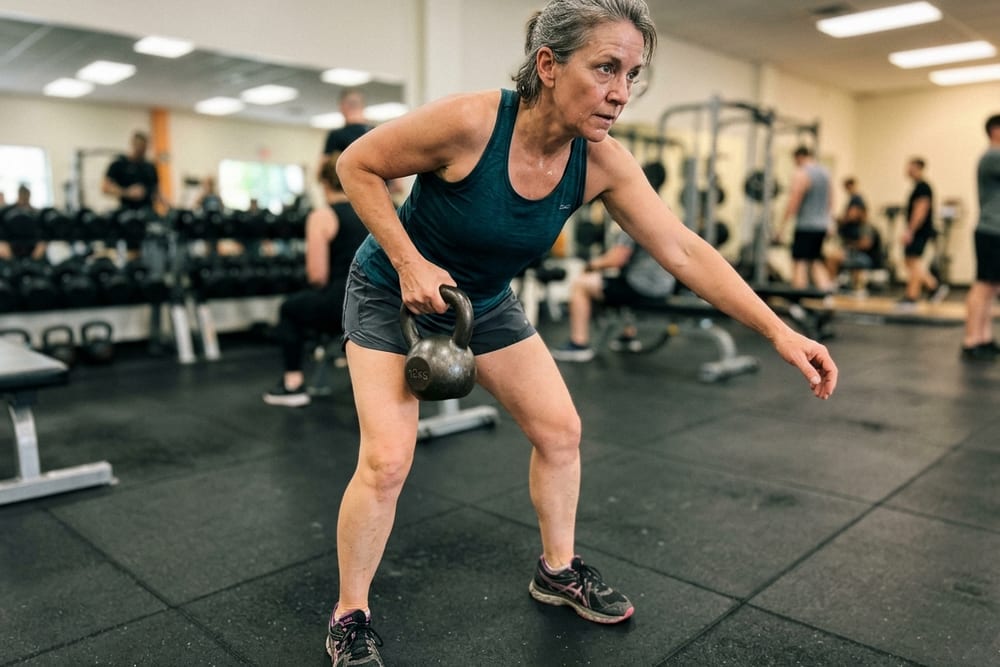
Resistance training is the highest-evidence non-hormonal lever for menopause belly fat. The mechanism is twofold: it preserves and rebuilds lean muscle mass (which keeps resting energy expenditure from declining), and it improves insulin sensitivity (which reduces the visceral-fat-favoring metabolic environment that the estrogen and belly fat shift creates). Two to three full-body sessions per week, progressing in load over time, produces measurable visceral fat reductions in postmenopausal women in trial after trial. The effect compounds when paired with HRT.
Cardio alone — running, walking, cycling, classes — is not the same intervention. Cardio is good for cardiovascular health and mental health. It is a weak independent lever for menopause belly because it does not preserve lean mass and does not specifically improve insulin sensitivity in the way resistance training does. The honest framing: cardio for the heart, weights for the belly.
3. Protein at 1.2 to 1.6 g/kg/day
Postmenopausal and perimenopause belly outcomes both improve with adequate protein. Women in this window lose approximately 0.5–1% of skeletal muscle per year if they don't actively defend it. The published threshold for maintaining lean mass in older adults is 1.2 to 1.6 grams of protein per kg of body weight per day — roughly double the standard RDA, distributed across three to four meals. For a 150-lb woman that is approximately 80 to 110 grams per day. This is not a trendy intervention; it is the boring intervention that actually works. Most women under-consume protein because the standard "balanced plate" framing under-emphasizes it.
4. Sleep hygiene (the cortisol-belly link)
Sleep below 6 hours raises evening cortisol, which raises insulin, which feeds visceral fat storage. The menopause stomach story is incomplete without the sleep story, because the same low-estrogen environment that drives visceral redistribution also disrupts sleep architecture (less slow-wave sleep, more wake-after-sleep-onset). The intervention is unglamorous: consistent sleep window, dark cool room, alcohol-and-caffeine boundaries, screen discipline. HRT often improves sleep within 2–3 weeks, which compounds the belly effect downstream — see our companion progesterone and sleep piece.
5. Cortisol management (the part that actually works — not the supplements)
Chronic stress raises cortisol; chronic cortisol drives visceral fat. The actual intervention is not a "cortisol balance" supplement (those have no rigorous trial evidence). The intervention is the daily stress-floor work: reduced caffeine in the afternoon, an end-of-day boundary on email and slack, a regular movement habit that is not exercise (walking, gardening, slow yoga), and explicit recovery time. The effect is real but slow, and it is the easiest item on this list to dismiss because it doesn't cost anything.
6. Stop spending money on these
Detox teas have no mechanism for visceral fat. "Cortisol balance" supplements do not have published RCT evidence supporting their advertised effect. Abdominal-targeted creams do not penetrate to visceral fat. Waist trainers do not redistribute fat. Apple cider vinegar, garcinia cambogia, raspberry ketones — none have rigorous evidence for menopause belly. The supplement aisle is the most expensive part of the menopause-belly journey for the smallest measurable return. The combined annual spend across these categories often exceeds the annual cash cost of HRT.
Why you probably haven't been told this
For about twenty years, doctors got worried about HRT after a misread of a 2002 study. The headlines made it sound dangerous. Most family doctors quietly stopped offering it. The study has since been re-analyzed, and what it actually showed was much narrower than the headlines suggested. For most women — particularly women starting HRT in their late 40s through their 50s — modern HRT in the doses we use today has a strong safety record. Major medical societies, including the North American Menopause Society and the British Menopause Society, now openly recommend it as a first-line option for menopausal symptoms. The 2024 Endocrine Society guidance is explicit that body composition effects are part of the appropriate clinical conversation.
But the awareness gap stuck. A whole generation of women lost twenty years to bad headlines. And to a doctor's appointment system where the average GP gets six minutes per patient and "your hormones are changing and that is why your belly is different" doesn't fit. There is also a training problem: most primary care residencies devote fewer than four hours total to menopause across the entire residency. Most gynecologists are the same. The exception is the small population of clinicians who pursued the NAMS Certified Menopause Practitioner credential — about 1,500 active across the entire United States, against an eligible patient population of roughly 50 million women in the menopausal transition or postmenopause.
The result: most women hear about menopause belly from their friend group before they hear about it from their doctor. And when they do bring it up, they are often told some version of "this is normal at your age" — which is true and useless. Telling a woman her belly is "normal" without telling her the mechanism is hormonal and the lever is treatable is the gap this article exists to close. Our piece on signs you need HRT walks through the full constellation of when the conversation is worth having.
The intervention comparison table
Side by side, here is how the published evidence stacks up for the most commonly suggested approaches to menopause belly. Realistic effect sizes are pulled from the trials cited above. The "notes" column is the one most articles skip — and it is the one that determines whether the intervention is the right one for your specific picture.
| Approach | Mechanism | Realistic effect | Notes |
|---|---|---|---|
| Caloric restriction alone | Energy deficit | −2 to −4 lb subcutaneous; minimal visceral | Visceral fat is resistant in low-estrogen state; works better paired with HRT |
| HIIT / cardio | Energy expenditure + transient insulin sensitivity | ~6–10% visceral fat reduction over 12 wk; plateau common | Good for heart and mood; weak independent belly lever |
| Strength training | Lean mass preservation + insulin sensitivity | Best non-hormonal lever; durable when sustained | 2–3 full-body sessions/wk; combine with protein 1.2–1.6 g/kg/day |
| HRT (estradiol +/- progesterone) | Restores fat-distribution receptor pattern | 5–10% less abdominal fat at 12 mo (Salpeter 2006) | Most direct intervention on the cause; needs MD review |
| GLP-1 agonists (Ozempic / Wegovy) | Appetite suppression + glucose regulation | Real weight loss; modest visceral effect | Good for BMI ≥27 with comorbidities; not a hormonal correction |
| Spironolactone, metformin (off-label) | Indirect (androgen, insulin) | Limited direct evidence for menopause belly | Off-label; consider only when specifically indicated |
| Detox teas, "cortisol balance" pills, belly creams | None published | No measurable effect | The expensive part of the journey for the smallest return |
"The redistribution of body fat from the gluteofemoral to the abdominal region during the menopausal transition is independent of the modest weight gain that occurs at this time. Visceral fat in particular increases substantially, with implications for cardiometabolic risk." — Davis SR, Castelo-Branco C, Chedraui P, et al. Understanding weight gain at menopause. Climacteric. 2012;15(5):419-429.
How ClearedRx prescribes HRT for menopause belly
ClearedRx is a doctor-supervised HRT service for women, online. You take a one-minute quiz. A licensed physician in our network reviews your symptoms and history within 24 hours. If you are a fit, they prescribe — and your treatment ships to your door, discreetly, the same week. We prescribe both compounded and FDA-approved HRT preparations; the patient picks based on cost, format preference, and clinical fit.
For menopause belly specifically, the preparation that matters is systemic HRT — transdermal estradiol patch or gel, oral or transdermal estradiol with progesterone if you have a uterus, or a compounded estrogen-and-progesterone body cream applied to thigh or arm. Local vaginal estrogen (cream, ring, tablet) is targeted at genitourinary symptoms and produces minimal systemic absorption — it does not consistently change body composition. If your primary symptom is vaginal dryness, the vaginal cream is the right tool. If your primary symptom is belly fat, sleep, hot flashes, and mood, you want a systemic preparation. The estradiol tablets page covers the oral option for women who prefer that route.
Cost framing the way our patients experience it: ClearedRx HRT starts at $49 per month for compounded preparations and $89 per month for FDA-approved generics, all-in (medication, doctor reviews, free shipping in all 50 states). New patients receive 50% off their first month. There are no surprise fees and no insurance paperwork. The compounded option is HSA and FSA eligible. The total annual cost is typically lower than what most women spend on detox teas, supplement subscriptions, and "cortisol balance" pills combined — and unlike those products, the HRT pathway is the one with published trial evidence behind it. For broader cost context, our HRT cost comparison walks through every formulation across every channel.

What women on HRT actually report
The first thing most women on HRT notice isn't the belly. It is the sleep. Sleep stabilizes within 2 to 3 weeks. Then the mood follows — most women describe a "the floor came back" feeling within 4 to 6 weeks. The body composition shift arrives later. Somewhere between week 8 and week 16, the waistband test starts producing different results. By month 6, the visceral compartment is measurably smaller on imaging — and the patient who has been wearing the same pair of jeans for two years can finally button them again without holding her breath.
The arc is not uniform. Roughly one in five women describe a faster response — sleep within a week, mood within two, body comp by month two. Roughly one in ten describe a slower response — meaningful change after month four. The variable is not effort. It is dose, formulation, and the underlying severity of the estrogen drop. A clinician who can adjust the regimen at the 6-week mark and again at the 12-week mark is the variable that matters more than which exact preparation is chosen at the start.
From our patient population, the most common arc looks like this. A woman in her early fifties who has gained 12 to 18 pounds since 45, who is sleeping in two-hour blocks, who has tried three different diets and a peloton and a kettlebell program, who has spent $400 on detox teas and adaptogen supplements and a "cortisol balance" stack, who has been told by her GP that "weight is lifestyle" and asked if she is tracking her macros. She fills out our quiz at 11 p.m. on a Sunday. She is approved on Monday. The cream is at her door on Friday. By the end of week three, she sleeps through the night for the first time in two years. By week ten, the jeans she gave up on in 2024 fit again. She didn't change her diet. She didn't add a workout. She replaced the variable that was missing.
Pricing reflects ClearedRx published rates. Patient experiences described are illustrative composites of typical outcomes from our clinical population; individual results vary, and HRT is a prescription treatment that requires evaluation by a licensed physician.

If you also want a free tool to map the rest of the picture
Menopause belly almost never travels alone. The same low-estrogen environment that drives visceral redistribution typically also produces sleep disruption, hot flashes, mood changes, joint pain, brain fog, and vaginal dryness on overlapping timelines. Mapping the constellation is the cheapest diagnostic move you can make before deciding what to do next. Our free Menopause Symptom Score is a 60-second self-check that scores the cluster as a single hormonal-fingerprint number; you can take it in less time than it takes to read this paragraph. For broader epidemiology, the menopause statistics 2026 page has prevalence numbers across symptoms. For sister-article context, our perimenopause vs menopause piece walks through which symptom-stage maps to which treatment, our perimenopause supplements 2026 piece audits which OTC products have any evidence behind them, and our best cream for vaginal dryness piece covers the local-tissue side of the same low-estrogen story.
Frequently asked questions
Why is my menopause belly so hard to lose?
Because the mechanism is hormonal, not behavioral. As estrogen falls during the menopausal transition, fat preferentially deposits viscerally (around the organs) rather than subcutaneously (hips and thighs). The Study of Women's Health Across the Nation (SWAN) and the WHIMS sub-analysis showed visceral fat rises by approximately 44% across the menopausal transition independent of total body weight. The same calorie deficit that worked at 35 produces less belly-fat reduction at 50 because the storage instruction has changed. Caloric restriction targets total fat; visceral fat is the most resistant compartment in a low-estrogen environment.
Can HRT actually reduce menopause belly fat?
Yes, in randomized trials. The Women's Health Initiative weight sub-studies and Salpeter et al.'s 2006 systematic review found women on HRT carried roughly 5% to 10% less abdominal fat than women on placebo at 12 months, with no change in diet or exercise. Davis et al. (2012) and Greendale et al. (2019) confirmed the redistribution pattern reverses on estrogen replacement. HRT is not a weight-loss drug — it does not consistently change total body weight — but it does shift fat back toward the gluteofemoral pattern that dominated before menopause, which is the specific change most women care about.
How long does it take HRT to reduce visceral fat?
Most women on HRT report sleep changes within 2 to 3 weeks, mood changes within 4 to 6 weeks, and visible body composition shifts between weeks 8 and 16. Imaging studies (DXA and MRI) typically detect measurable visceral fat reduction at 6 to 12 months on continuous HRT, with continued improvement out to 24 months. The "waistband fits again" moment most patients describe arrives somewhere between month 3 and month 6. See our HRT timeline guide for what to expect week-by-week.
Why doesn't dieting work for menopause belly?
Dieting works on total fat mass, not on fat distribution. A calorie deficit reduces fat from wherever the body decides to release it — and in a low-estrogen environment, the body preferentially holds onto visceral fat. Premenopausal women on a 500-calorie deficit typically lose belly fat in proportion to overall fat loss. Postmenopausal women on the same deficit lose the same total weight but disproportionately less of it from the abdomen. The deficit is not the wrong tool; it is just an incomplete one without the hormonal lever attached.
Is menopause belly the same as weight gain?
No. Menopause belly is fat redistribution, not necessarily fat accumulation. Lovejoy et al. (2008) measured women across the menopausal transition and found visceral fat increased approximately 44% even when total body weight stayed flat. The scale can read the same number it read five years ago and the belly can still be growing. That is the data point most blogs miss — and the reason eat-less-move-more advice so often produces no visible result.
Can I prevent menopause belly (and perimenopause belly earlier)?
Partially. Strength training begun in perimenopause (preserving lean mass and insulin sensitivity), adequate protein (1.2 to 1.6 grams per kg per day), sleep above 7 hours, and starting HRT in the early menopausal window when appropriate all blunt the visceral-fat shift. The earlier you start — perimenopause belly responds to the same intervention stack — the shallower the curve. None of them fully prevent it, because the hormonal driver is biological. The goal is to make the curve as shallow as possible, not to flatten it through willpower.
Does estrogen cream help with belly fat?
Low-dose vaginal estrogen cream is targeted at local tissue and produces minimal systemic absorption — it does not consistently change body composition. Systemic HRT (transdermal estradiol patch or gel, oral or transdermal estradiol with progesterone if you have a uterus, or a combined body cream) is the formulation that affects fat distribution. If your primary symptom is genitourinary (vaginal dryness, recurrent UTIs), local estrogen is the right choice. If your primary symptom is body composition, hot flashes, sleep, and mood, you want a systemic preparation. See our HRT body cream page for the systemic-cream option.
Are there any supplements that actually help with menopause belly?
No supplement has high-quality randomized-trial evidence for menopause belly fat. Berberine, magnesium, and omega-3 may modestly improve insulin sensitivity, which is loosely associated with visceral fat — the effect sizes are small. The supplement category labeled "cortisol balance" is not supported by data; cortisol-belly research has not produced a single OTC product with rigorous trial evidence. Detox teas have no mechanism. Abdominal-targeted creams have no mechanism. The supplement aisle is the most expensive part of the menopause-belly journey for the smallest return. Our perimenopause supplements 2026 piece audits the category in detail.
Should I get GLP-1 (Ozempic, Wegovy) for menopause belly?
GLP-1 agonists produce real total weight loss and modest visceral fat reduction in randomized trials, with the strongest evidence in patients with BMI over 30 or BMI over 27 with comorbidities. They are FDA-approved for weight management. They are not a hormonal correction — a woman on a GLP-1 with untreated estrogen deficiency still has the underlying redistribution driver. Combination therapy (HRT plus GLP-1 in appropriate candidates) is increasingly common and addresses both layers. GLP-1 monotherapy in a thin postmenopausal woman with menopause belly is often the wrong tool; HRT is more directly aimed at the cause.
How is menopause belly different from regular belly fat?
Regular belly fat is mostly subcutaneous — the soft layer you can pinch — and accumulates from chronic caloric surplus. Menopause belly is disproportionately visceral — the deeper, firmer fat that wraps around organs (liver, intestines, mesentery). Visceral fat is metabolically more active, more inflammatory, and more associated with cardiovascular risk than subcutaneous fat. It is also more responsive to estrogen status than to caloric intake. The clinical implication: a smaller-looking menopause belly is often more metabolically harmful than a larger premenopausal belly, and the treatment is hormonal first, behavioral second.
Sources & references
- Lovejoy JC, Champagne CM, de Jonge L, Xie H, Smith SR. Increased visceral fat and decreased energy expenditure during the menopausal transition. Int J Obes (Lond). 2008;32(6):949-958. PMID: 18299179
- Greendale GA, Sternfeld B, Huang M, et al. Changes in body composition and weight during the menopause transition. JCI Insight. 2019;4(5):e124865. PMID: 30843894
- Davis SR, Castelo-Branco C, Chedraui P, et al. Understanding weight gain at menopause. Climacteric. 2012;15(5):419-429. PMID: 22381005
- Salpeter SR, Walsh JM, Ormiston TM, Greyber E, Buckley NS, Salpeter EE. Meta-analysis: effect of hormone-replacement therapy on components of the metabolic syndrome in postmenopausal women. Diabetes Obes Metab. 2006;8(5):538-554. PMID: 16918589
- Karvonen-Gutierrez C, Kim C. Association of Mid-Life Changes in Body Size, Body Composition and Obesity Status with the Menopausal Transition. Healthcare (Basel). 2016;4(3):42. PMID: 27417630
- The North American Menopause Society. The 2022 Hormone Therapy Position Statement of The North American Menopause Society. Menopause. 2022;29(7):767-794. PMID: 35797481
- Endocrine Society. Menopause and Hormone Therapy Clinical Practice Guideline (2024 update). endocrine.org
- Sims ST, Kerksick CM, Smith-Ryan AE, et al. International Society of Sports Nutrition Position Stand: nutritional concerns of the female athlete. J Int Soc Sports Nutr. 2023;20(1). PMID: 36862943
- Internal: menopause symptoms overview · genitourinary syndrome of menopause · menopause statistics 2026 · menopause symptom score tool · menopause weight gain and HRT
If you want to address the cause and not the symptom — talk to a clinician
ClearedRx prescribes evidence-based HRT — bioidentical estradiol, progesterone, or a combined cream — based on your full picture, with 24-hour MD review and free shipping in all 50 states. Compounded preparations from $49/month, FDA-approved generics from $89/month. No insurance hassle. New patients save 50% on the first month.
Find out if HRT is right for me