
Last reviewed May 10, 2026
Quick answer: The four estrogen delivery routes have meaningfully different safety profiles. Transdermal (patch or gel) is first-line for most women per the 2022 NAMS Position Statement — it bypasses first-pass liver metabolism and has lower VTE, stroke, and gallbladder risk than oral pills. Vaginal cream, ring, or tablet is best for GSM-dominant symptoms (vaginal dryness, painful sex, recurrent UTIs) — minimal systemic absorption, safe for many breast cancer survivors with oncology coordination. Oral pill is fine for lower-risk women who prefer convenience. The estrogen cream vs pill vs patch decision is symptom-driven and risk-driven, not preference-driven.
The 60-second version
If your friend takes a patch and your sister takes a pill, this is for you
You searched estrogen cream vs pill vs patch because somebody you know is on a different version of the same hormone, and the gap between what they were prescribed and what you were offered does not make sense. Why does your friend's gynecologist prescribe a patch as a default while your GP wrote you a pill? Why did your sister-in-law's NP put her on a vaginal cream when she has the same hot flashes you do? Are these the same drug or not? And which one is actually right for you?
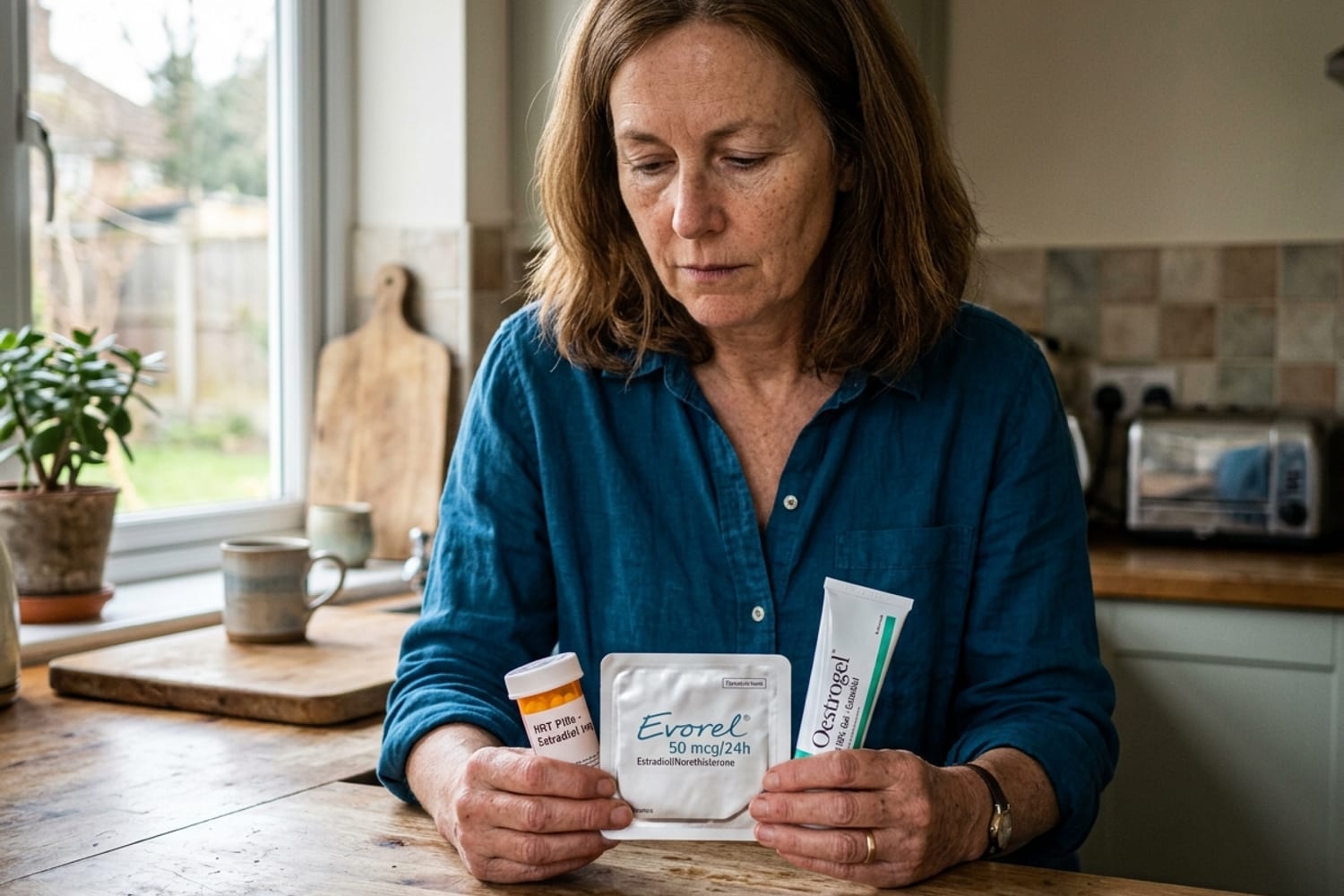
The honest answer most clinicians do not say out loud: many prescribers default to whatever delivery route is on the formulary they trained with, in the dose range they remember best. That is not the same thing as picking the right delivery for your specific situation. Estrogen pills, patches, gels, and vaginal preparations are all estradiol (or close cousins like conjugated equine estrogens), but they reach your bloodstream through different routes — and the route changes the safety profile and the symptoms each one actually treats.
This article is the head-to-head comparison the prescription pad does not include. We walk through the four delivery routes, what each one does well, where each one fails, and the decision tree clinicians actually use when they pick between them. The estrogen cream vs pill vs patch question is a real medical decision; it deserves a real medical answer.

"First-pass hepatic metabolism" is the phrase that explains the entire estrogen cream vs pill vs patch decision.
When you swallow an estrogen pill, it travels through your stomach and small intestine into the portal vein, which dumps directly into your liver. The liver is a busy chemical factory; it metabolizes the hormone, but it also reacts to it — increasing production of clotting factors, sex-hormone-binding globulin, triglycerides, and inflammatory markers before the active estrogen ever reaches your bloodstream and your brain. The net effect is real estrogen replacement plus a liver-driven shift in your clotting and lipid chemistry that the patch and gel do not produce. That is why Vinogradova et al. 2019 in BMJ, analyzing 80,000+ women in UK general-practice databases, found oral estrogen carried meaningfully higher VTE risk while transdermal estrogen carried no measurable increase versus non-users. Mohammed et al. 2015 in J Womens Health reached the same conclusion for cardiovascular outcomes overall. L'Hermite 2017 documented the same first-pass mechanism for stroke and gallbladder disease. The 2022 NAMS Position Statement and the Stuenkel 2015 Endocrine Society Guideline both designate transdermal as first-line for women with any VTE-cardiovascular-gallbladder risk factors.
Citations: Vinogradova Y, Coupland C, Hippisley-Cox J. Use of hormone replacement therapy and risk of venous thromboembolism: nested case-control studies using the QResearch and CPRD databases. BMJ. 2019;364:k4810. PMID: 30626577 · Mohammed K, Abu Dabrh AM, Benkhadra K, et al. Oral vs transdermal estrogen therapy and vascular events. J Clin Endocrinol Metab. 2015;100(11):4012-4020. PMID: 26204625 · L'Hermite M. Bioidentical menopausal hormone therapy: registered hormones (non-oral estradiol/progesterone) are optimal. Climacteric. 2017;20(4):331-338. PMID: 28323647 · The 2022 Hormone Therapy Position Statement of The North American Menopause Society. Menopause. 2022;29(7):767-794. PMID: 35797481 · Stuenkel CA, Davis SR, Gompel A, et al. Treatment of Symptoms of the Menopause: An Endocrine Society Clinical Practice Guideline. J Clin Endocrinol Metab. 2015;100(11):3975-4011. PMID: 26444994.
The four estrogen delivery routes — head-to-head
Below is the actual comparison. Each of the four routes has a distinct profile: a different absorption pathway, different first-line indications, and a different list of side effects and contraindications. The estrogen cream vs pill vs patch decision is what falls out of these four boxes when you map your symptoms and your risk profile against them.
Oral pill — the convenience route, with a liver tradeoff
Oral estrogen — usually estradiol 0.5-2 mg daily, or conjugated equine estrogens (Premarin) 0.3-1.25 mg — is the original HRT delivery route. You swallow a tablet once a day, the gut absorbs it, and it goes through your liver before reaching the rest of your body. That liver pass is what generates the safety asymmetry. Pros: cheap (generic estradiol is one of the lowest-cost prescriptions in the formulary), well-studied across decades of trials, convenient, no skin reactions, no application step. Cons: first-pass hepatic metabolism increases VTE risk, stroke risk in women with migraine with aura, gallbladder disease risk (cholelithiasis, cholecystitis), and triglyceride elevation. The Vinogradova 2019 BMJ analysis pegs the VTE risk at roughly 2× over baseline for oral estrogen specifically. Best for: lower-risk women without VTE history, who are non-smokers, BMI under 30, no migraine with aura, no gallbladder disease, who prefer the simplicity of a pill. Not appropriate for women with any of the above risk factors — for them, NAMS 2022 designates transdermal as first-line. Common dose-equivalent: 1 mg oral estradiol is roughly equivalent to a 0.05 mg/day transdermal patch.
Transdermal patch — the safety-first default for most women
The estradiol patch is a small clear adhesive square (about the size of a quarter) that you apply to lower abdomen, hip, or lower back and replace every 3-7 days depending on the brand. The hormone is absorbed through the skin into capillaries, which deliver it directly to systemic circulation — bypassing the liver entirely. The 2022 NAMS Position Statement and the 2015 Endocrine Society Guideline both call transdermal the first-line route for most women, especially those with any of the risk factors that flag oral estrogen. Pros: no first-pass hepatic metabolism, no measurable VTE increase versus non-users (Vinogradova 2019), no measurable stroke increase, no gallbladder risk increase, no triglyceride elevation, steady serum estradiol levels (no peaks-and-troughs the way pills produce), no missed-dose vulnerability. Cons: skin reactions in roughly 15-20% of users (irritation, contact dermatitis at application site), patches occasionally fall off (especially in heat, water, or with adhesive-incompatible lotions), visible to others if applied somewhere visible, can be uncomfortable in hot or humid climates. Best for: any woman with VTE history or family history of clots, smokers (current or former), women with migraine with aura considering systemic estrogen, BMI 30+, gallbladder concerns, hypertriglyceridemia, women on oral estrogen who experience side effects. Doses: 0.025, 0.0375, 0.05, 0.075, and 0.1 mg/day patches are standard; most women start at 0.05 mg/day and titrate.

Topical gel or spray — transdermal benefits without the patch adhesive
Topical estradiol gels (Divigel single-dose packets, Estrogel pump dispenser, Elestrin metered-dose pump) and the Evamist spray are the under-recognized members of the transdermal family. Same first-pass-bypass mechanism as the patch, same general safety profile, but applied as a measured liquid or gel to the upper arm, thigh, or inner forearm and absorbed in 2-5 minutes. Pros: all the safety advantages of transdermal (no first-pass metabolism, no VTE increase, no stroke increase, no gallbladder issue), no patch adhesive irritation, no falls-off-during-exercise problem, easy to titrate dose by adjusting number of pumps or packets, no visible patch. Cons: daily application required (vs. 3-7 days for patches), transfer risk to family members or pets if they touch the application site before it absorbs (small but real, especially relevant for partners and young children), application area must stay dry for 60 minutes after, slightly more expensive than generic patches, dosing can drift if pump dispensers are used inconsistently. Best for: women who tried a patch but had skin reactions or kept losing the patch, women who want transdermal benefits but dislike the patch aesthetic, women whose insurance covers gel better than patch. Doses: Divigel 0.25-1.0 mg/day, Estrogel 0.75-1.5 mg/day, Evamist 1-3 sprays daily.
Vaginal cream, ring, or tablet — the local route for genitourinary symptoms
Vaginal estrogen is a fundamentally different category. Where oral and transdermal preparations deliver estrogen to your whole body to address vasomotor symptoms (hot flashes, night sweats), brain-fog, and bone density, vaginal estrogen is delivered directly to vaginal tissue to treat genitourinary syndrome of menopause (GSM): vaginal dryness, painful sex, recurrent UTIs, vulvar atrophy, urinary urgency. The systemic absorption from low-dose vaginal estrogen is minimal — serum levels stay near or below normal post-menopausal baseline — which is why low-dose vaginal estrogen is generally considered safe even for many breast cancer survivors when coordinated with oncology. Pros: highly effective for GSM symptoms, minimal systemic absorption (so most VTE / stroke / gallbladder concerns do not apply at low doses), safe in many breast cancer survivors with oncology coordination, can be added as adjunct to systemic HRT without dose adjustment. Cons: does not consistently treat hot flashes, night sweats, or other vasomotor symptoms (because it does not reach systemic levels at standard doses), application can feel awkward initially, ring and tablet forms have a learning curve. Best for: women whose dominant symptoms are GSM (vaginal dryness, painful sex, recurrent UTIs, urinary urgency), women using systemic estrogen who still have residual vaginal symptoms, post-cancer survivors with severe GSM under oncology coordination. Variants:
- Estrace Cream / generic estradiol vaginal cream — applied with a measured applicator 2-3× per week after a 2-week loading phase. Cheapest format.
- Estring — a flexible silicone ring inserted vaginally, replaced every 3 months. Hands-off.
- Vagifem / Imvexxy — small vaginal tablets inserted 2× per week.
- Compounded Estrogen + Progesterone Vaginal Cream — ClearedRx's flagship preparation. Combines estradiol + estriol with progesterone in one cream, addressing both vaginal atrophy and the local progesterone considerations some compounders prefer for endometrial balance. Compounded; not FDA-approved as a single product but each component is FDA-recognized.

The decision tree clinicians actually use
Here is how a thoughtful prescriber walks the estrogen cream vs pill vs patch decision in clinic. It is shorter than you might expect.
VTE risk, smoker, migraine with aura, BMI 30+
Transdermal first. Patch is preferred over pill because of first-pass-bypass safety. NAMS 2022 explicitly designates transdermal as first-line for any of these risk factors.
GSM-dominant symptoms (dryness, painful sex, recurrent UTIs)
Vaginal cream, ring, or tablet. Local delivery, minimal systemic exposure, directly addresses the tissue-level cause. Compounded E+P cream is an option for combined progesterone consideration.
Vasomotor + GSM symptoms (full-spectrum menopause)
Systemic transdermal (patch or gel) PLUS adjunct vaginal cream. The two routes do different jobs. The systemic dose handles hot flashes, sleep, mood, bone density. The vaginal preparation handles the local atrophy that the systemic dose alone may not fully reverse.
Patch intolerance (skin reactions, falls off)
Switch to gel or spray. Same transdermal class, no adhesive. Divigel, Estrogel, or Evamist all work. Most patch-failure women tolerate gel without issue.
Convenience priority + low risk profile
Oral pill is acceptable. If you have no VTE risk, no migraine with aura, BMI under 30, no gallbladder disease, no smoking history, the pill is a reasonable choice. Convenience matters; adherence matters more than route in lower-risk patients.
Breast cancer survivor with severe GSM
Low-dose vaginal estrogen, coordinated with oncology. ACOG and NAMS both support this approach when other GSM interventions have failed and quality of life is significantly impaired. Systemic estrogen generally avoided.
Notice what is not in this decision tree: aesthetic preference, brand familiarity, "what your last doctor prescribed." The route follows the symptoms and the risk profile. Once those two inputs are mapped, the right delivery is usually obvious; the dose-titration conversation is what comes next.
What about estrogen pellets?
Estrogen pellets get heavy direct-to-consumer marketing on social media — small subcutaneous implants that release estrogen over 3-6 months, typically inserted at boutique anti-aging clinics. They show up so often in patient questions that they deserve a dedicated section, because the marketing claims do not match the evidence base. Honest take: NAMS 2022 does not recommend estrogen pellets for hormone replacement therapy. The reasons are specific and worth understanding.
First, pellets are not FDA-approved for HRT. The pellets used in clinical practice are compounded products that fall outside the FDA-approval pathway. Compounded preparations are not categorically bad — many compounded products serve legitimate clinical purposes, including ClearedRx's flagship vaginal cream — but the pellet-specific evidence base is weaker than the patch, gel, pill, or vaginal-cream evidence base. Second, pellets produce supraphysiologic peaks. The steady-state estradiol levels measured in pellet patients are routinely 2-5× higher than the normal premenopausal range — well above what the patch, gel, or oral pill produce at standard doses. Whether those supraphysiologic levels translate to harm in the long run is not yet clear, but they are not what a clinician would target if they were trying to replicate normal physiology. Third, pellets are non-titratable and non-reversible. Once implanted, the dose cannot be reduced. If side effects emerge — breast tenderness, mood changes, bleeding, headaches — you wait 3-6 months for the pellet to dissolve. Fourth, insertion costs $300-700+ per visit, which adds up across a year of use, while the patch and pill cost $30-90/month with full titratability. Most academic menopause specialists advise against pellets except in extremely narrow research contexts. The estrogen cream vs pill vs patch comparison is where the actual evidence base lives; pellets are an outlier modality.
How ClearedRx prescribes across all four routes
ClearedRx is a doctor-supervised online HRT service. You take a one-minute quiz. A licensed physician in our network reviews your symptoms and history within 24 hours, picks the right delivery route for your specific picture, and ships the prescription to your door within the same week. We prescribe across all four estrogen delivery routes — patches, oral pills, topical gels, and vaginal preparations (FDA-approved and compounded) — because the right answer is patient-specific and we want the formulary to match what NAMS 2022 actually recommends, not just what the cheapest single SKU is.
For most new HRT patients, the conversation our clinicians have follows the decision tree above: any VTE / smoker / migraine-with-aura / BMI-30+ flag pushes us toward transdermal as first-line. GSM-dominant symptoms get vaginal estrogen; full-spectrum menopause gets systemic transdermal plus adjunct vaginal estrogen if needed. The flagship product in our formulary is the compounded Estrogen + Progesterone Vaginal Cream, which combines estradiol + estriol with progesterone for women whose primary picture is GSM and who benefit from the combined preparation. We also stock the systemic body cream for systemic-route patients who prefer a cream format over a patch.
Pricing is intentionally transparent. ClearedRx HRT starts at $49 per month for compounded preparations and $89 per month for FDA-approved generics, all-in (medication, doctor reviews, free shipping in all 50 states). New patients receive 50% off their first month. Our HRT cost comparison walks through every formulation across every channel for full price context. For the safety conversation specifically — when HRT is right and when it is not — see our signs you need HRT piece, which walks through the symptom-eligibility framework before you even pick a delivery route.

"Transdermal estradiol bypasses first-pass hepatic metabolism and is associated with lower risk of venous thromboembolism, stroke, and gallbladder disease compared with oral estrogen. For women with elevated baseline risk for these outcomes, transdermal estradiol should be considered first-line." — The 2022 Hormone Therapy Position Statement of The North American Menopause Society. Menopause. 2022;29(7):767-794.
Side-by-side comparison table
Same comparison, in the format that scans fastest. The "first-line for" column is the one that drives the decision in clinic.
| Route | First-pass liver? | VTE / stroke risk | Treats hot flashes? | Treats GSM? | First-line for |
|---|---|---|---|---|---|
| Oral pill | Yes | ~2× baseline (Vinogradova 2019) | Yes | Partially | Lower-risk women, convenience priority |
| Transdermal patch | No | No measurable increase | Yes | Partially | Most women per NAMS 2022 |
| Topical gel / spray | No | No measurable increase | Yes | Partially | Patch-intolerant women |
| Vaginal cream / ring / tablet | No (minimal systemic) | Negligible at low dose | No | Yes — primary indication | GSM-dominant symptoms |
| Pellet | No | Unclear; supraphysiologic peaks | Yes | Partially | Not recommended (NAMS 2022) |
If you want to map the full picture before you pick
Picking a delivery route is the second decision. The first decision is whether systemic HRT is the right move for your stage and symptoms at all. Our free Menopause Symptom Score is a 60-second self-check that scores your symptom cluster as a single hormonal-fingerprint number, and our perimenopause self-check is a 10-question screen targeted to where you are in the transition. Our signs you need HRT piece walks through the eligibility conversation. For the broader symptom catalogue, see our 34 symptoms of perimenopause; for the safety side specifically, our HRT and breast cancer 2026 evidence walks through the post-WHI risk conversation. For dose comparison across formulations, our HRT dose equivalency tool converts between routes (1 mg oral estradiol ≈ 0.05 mg/day patch). For prevalence and population data, our menopause statistics 2026 page has the numbers across symptoms.
Frequently asked questions
What is the difference between estrogen cream, pill, and patch?
The estrogen cream vs pill vs patch comparison comes down to delivery route. The pill is swallowed and processed by the liver before it reaches systemic circulation (first-pass hepatic metabolism), which raises the risk of blood clots, stroke, and gallbladder disease. The patch and topical gel are absorbed through the skin and bypass the liver entirely, so the systemic safety profile is better. Vaginal cream, ring, and tablet deliver estrogen locally with minimal systemic absorption, which makes them ideal for genitourinary symptoms (dryness, painful sex, recurrent UTIs) but they do not consistently treat hot flashes.
Is the estrogen patch really safer than the pill?
Yes, for venous thromboembolism (VTE), stroke, and gallbladder outcomes. Vinogradova et al. 2019 in BMJ analyzed 80,000+ women in UK general-practice databases and found oral estrogen carried meaningfully higher VTE risk while transdermal estrogen carried no measurable increase versus non-users. Mohammed et al. 2015 in J Womens Health reached the same conclusion for cardiovascular outcomes. The 2022 NAMS Position Statement designates transdermal as first-line for women with VTE risk factors, smoking history, migraine with aura, BMI 30+, or gallbladder concerns.
Can I switch between estrogen delivery methods?
Yes, and many women do. Switching from oral to transdermal mid-treatment is common when a clinician identifies a new risk factor or when side effects emerge. The dose-equivalency between routes is approximate — 1 mg oral estradiol is roughly equivalent to a 0.05 mg/day transdermal patch or 1.25 g of estradiol gel. Vaginal estrogen can be added as an adjunct to systemic therapy at any time without dose changes, because absorption is local. Discuss any switch with your prescriber.
Does vaginal estrogen cream work for hot flashes?
Not consistently. Standard low-dose vaginal estrogen (Estrace Cream, Premarin Cream, Estring, Vagifem) produces minimal systemic absorption — that is the whole point of the local delivery — so it does not consistently reach the brain temperature-regulation centers that drive vasomotor symptoms. For hot flashes you need a systemic preparation (patch, gel, oral pill, or compounded body cream). Vaginal estrogen is targeted at genitourinary syndrome of menopause: vaginal dryness, painful sex, recurrent UTIs, vulvar atrophy. Many women on systemic transdermal estrogen also use vaginal estrogen as an adjunct because the systemic dose alone is often not enough to reverse advanced vaginal atrophy.
Are estrogen pellets safe?
The 2022 NAMS Position Statement does not recommend estrogen pellets. Pellets are not FDA-approved for hormone replacement therapy. The dose is non-titratable and produces supraphysiologic peaks (estradiol levels well above the normal premenopausal range). If side effects emerge, the pellet cannot be removed easily — you wait 3-6 months for it to dissolve. Despite heavy direct-to-consumer marketing, pellets are an outlier modality with weaker safety data than patches, pills, and creams. Most academic menopause specialists advise against them.
Which estrogen delivery is best for migraines?
Transdermal — patch or gel. Oral estrogen produces estradiol peaks and troughs that can trigger migraines, especially in women with migraine with aura, where oral estrogen also raises stroke risk. The transdermal route delivers steady serum levels and does not increase stroke risk beyond baseline. NAMS 2022 specifically calls out migraine with aura as a setting where transdermal is preferred over oral. Many migraine patients tolerate the patch when oral estrogen worsened their headaches.
Which estrogen is best after breast cancer?
This is a decision that requires oncology coordination. Systemic estrogen is generally avoided after estrogen-receptor-positive breast cancer. However, the 2022 NAMS Position Statement and ACOG both note that low-dose vaginal estrogen for severe genitourinary symptoms (painful sex, recurrent UTIs) may be appropriate for breast cancer survivors when other interventions have failed, because systemic absorption is minimal. Always coordinate with your oncologist before starting any estrogen preparation post-cancer.
Is the estrogen patch covered by insurance?
Generic estradiol patches (the chemical equivalent of Climara, Vivelle-Dot, and brand-name patches) are covered by most insurance plans and Medicare Part D, though copays vary. Brand-name patches and combination patches (estrogen + progestin) may have higher copays. Cash prices for generic patches typically run $30-80 per month at major pharmacies; ClearedRx prices generic patches at $89/month all-in including the 24-hour MD review. Compounded preparations are usually not insurance-covered but are often cheaper out of pocket than insurance copays for branded equivalents.
Does the estrogen patch cause skin reactions?
Yes, in approximately 15-20% of users at some point, ranging from mild redness to itchy contact dermatitis. The most common workaround is rotating application sites (lower abdomen, hip, lower back) every change so no single area gets repeated exposure. Avoiding application to skin treated with lotion or oil also helps adhesion and reduces reactions. If skin reactions persist despite rotation, switching to a topical gel (Divigel, Estrogel) or spray (Evamist) keeps the transdermal benefit while removing the adhesive. Patch falls-off is another common complaint that the gel and spray solve.
What is the difference between Estrace and estradiol?
Estrace is a brand name for oral and vaginal-cream formulations of estradiol — the same molecule. Generic estradiol tablets and Estrace tablets contain the identical active ingredient at identical doses. Estrace Vaginal Cream and generic estradiol vaginal cream are also bioequivalent. Brand-name pricing reflects marketing and packaging, not pharmacology. Premarin is different — it is conjugated equine estrogens (a mix of estrogens derived from pregnant horse urine), pharmacologically distinct from estradiol. Most contemporary HRT guidelines favor estradiol over conjugated equine estrogens because the dosing is cleaner and the safety data more granular.
Sources & references
- The North American Menopause Society. The 2022 Hormone Therapy Position Statement of The North American Menopause Society. Menopause. 2022;29(7):767-794. PMID: 35797481
- Vinogradova Y, Coupland C, Hippisley-Cox J. Use of hormone replacement therapy and risk of venous thromboembolism: nested case-control studies using the QResearch and CPRD databases. BMJ. 2019;364:k4810. PMID: 30626577
- Mohammed K, Abu Dabrh AM, Benkhadra K, et al. Oral vs transdermal estrogen therapy and vascular events: a systematic review and meta-analysis. J Clin Endocrinol Metab. 2015;100(11):4012-4020. PMID: 26204625
- L'Hermite M. Bioidentical menopausal hormone therapy: registered hormones (non-oral estradiol/progesterone) are optimal. Climacteric. 2017;20(4):331-338. PMID: 28323647
- Stuenkel CA, Davis SR, Gompel A, et al. Treatment of Symptoms of the Menopause: An Endocrine Society Clinical Practice Guideline. J Clin Endocrinol Metab. 2015;100(11):3975-4011. PMID: 26444994
- Endocrine Society. Menopause and Hormone Therapy Clinical Practice Guideline. endocrine.org
- The American College of Obstetricians and Gynecologists. The Use of Vaginal Estrogen in Women With a History of Estrogen-Dependent Breast Cancer. ACOG Committee Opinion. 2016;659. acog.org
- Internal: HRT side effects · bioidentical vs synthetic HRT · HRT cost comparison · when to start HRT · HRT and breast cancer 2026 evidence · signs you need HRT · 34 symptoms of perimenopause · HRT body cream · menopause statistics 2026 · menopause symptom score
If you want a clinician to pick the right estrogen delivery for your specific picture — talk to ClearedRx
ClearedRx prescribes across all four delivery routes — patch, pill, gel, and vaginal cream — based on your symptom cluster and risk profile, not on a single-SKU formulary. 24-hour MD review. Free shipping in all 50 states. Compounded preparations from $49/month, FDA-approved generics from $89/month. New patients save 50% on the first month.
Find out which HRT is right for me