

Last reviewed May 10, 2026
Quick answer: Most HRT side effects fall into three tiers. Tier 1 (expected and transient): breast tenderness, spotting, mild nausea, headache, bloating — resolve in 4-12 weeks. Tier 2 (worth managing): persistent symptoms past 12 weeks usually mean a regimen tweak, not stopping. Tier 3 (stop and call today): chest pain, leg swelling, severe headache with vision changes, postmenopausal bleeding, breast lump. The absolute increased risk of serious events on HRT is small — about 1-5 extra cases per 10,000 women per year depending on the formulation — and lower on transdermal than oral. Knowing which tier each side effect belongs to prevents both unnecessary panic and dangerous delays.
The 60-second version
Three weeks in, your jeans feel tight and your breasts ache
You started HRT three weeks ago. Your breasts ache when you roll over in bed. You're spotting on a Tuesday morning. Your jeans feel tighter. You read an article last night about breast cancer and HRT and went to bed scared. You're standing in your kitchen at 6:47 a.m. with the bottle of estradiol in one hand and a glass of water in the other, and you're trying to decide whether to take it. Whether the side effects you're feeling mean something is wrong, or just mean your body is adjusting, or — worst case — mean something you should call your doctor about today.
Here is the part most articles get wrong. They treat HRT side effects as one undifferentiated category and either reassure you ("most are mild and resolve in 4-12 weeks") without telling you which ones, or they list every adverse event ever reported in a clinical trial — stroke, breast cancer, blood clots — without the absolute-risk math that puts those events into perspective. Both failure modes leave you exactly where you started: unsure whether to keep going or stop.
This article is the decision tree for hormone replacement therapy side effects. Three tiers of HRT side effects. Tier 1 is expected and transient. Tier 2 is common but worth a regimen adjustment. Tier 3 is stop-and-call-today. The cutoffs are time-graded — what's normal in week 1 isn't necessarily normal at week 12. And throughout, the risk numbers are absolute, not relative, because relative risk is the language fear is written in. "Doubled risk" sounds enormous. "5 extra cases per 10,000 women per year" sounds like what it actually is. The HRT side effects in females breakdown below covers estrogen side effects, progesterone side effects, and the side effects of bioidentical hormones in the same framework.
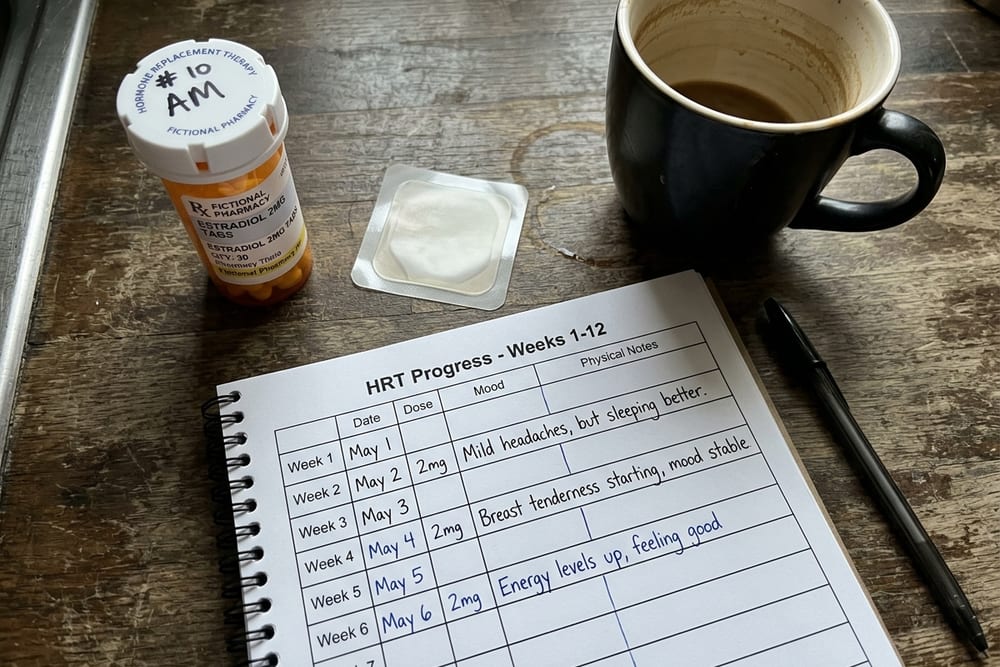
Most HRT side effects don't need a clinician. The few that do, need one today. Time-grading separates them.
Most articles on HRT side effects fail in one of two ways. The vague-reassurance failure mode says "most resolve in 4-12 weeks" without telling you which ones, leaving you guessing whether your specific symptom is the harmless kind. The scare-tactic failure mode lists stroke, breast cancer, and blood clots in relative-risk percentages ("50% higher"), which sounds enormous but is hiding the absolute numbers — and it's the absolute numbers that matter when you're deciding whether to take tomorrow's dose. The fix is the three-tier framework with time grading and absolute risk.
Citations: Manson JE, et al. Menopausal hormone therapy and long-term all-cause and cause-specific mortality: WHI randomized trials. JAMA. 2017;318(10):927-938. PMID: 28898378 · Stuenkel CA, et al. Treatment of symptoms of the menopause: An Endocrine Society clinical practice guideline. J Clin Endocrinol Metab. 2015;100(11):3975-4011. PMID: 26444994 · L'Hermite M. Bioidentical menopausal hormone therapy: registered hormones (non-oral estradiol +/- progesterone) are optimal. Climacteric. 2017;20(4):331-338. PMID: 28586835 · NAMS 2022 Hormone Therapy Position Statement. Menopause. 2022;29(7):767-794. PMID: 35797481.
Tier 1: Expected and transient (resolve 4-12 weeks)
The first tier of HRT side effects is the largest and least worrying. These are the symptoms that show up in week 1, peak around week 2-4, and almost always resolve by week 8-12 as your body recalibrates to stable hormone levels. They don't mean the medication is wrong. They mean your endocrine system is adjusting from the chaotic perimenopausal hormonal weather to the smoothed-out HRT baseline. The Stuenkel 2015 Endocrine Society guideline notes that the majority of new HRT users experience at least one of these in the first 8 weeks, and rates drop sharply by month 3.
Breast tenderness
The most common Tier 1 HRT side effect. Roughly one in three women on combined HRT report breast tenderness in the first 4-8 weeks. The mechanism is the rapid restoration of estrogen levels acting on dormant breast tissue — same biology as the breast tenderness many women feel before a period. It's almost always bilateral, diffuse, and dull. Resolves by week 6-12 in the large majority of cases. Action: wait. A supportive bra at night, reducing caffeine, and switching from oral to transdermal estradiol all help if it's bothering you. If it persists past 12 weeks unchanged, that's Tier 2 — talk about a dose or progestogen change.
Spotting and breakthrough bleeding (first 6 months)
On continuous combined HRT (estrogen plus daily progestogen), light spotting in the first 6 months is normal and expected. Up to 40% of women experience some spotting in months 1-3; the rate falls under 10% by month 6. The endometrium is recalibrating. Action: wait through the first 6 months. Track the pattern (a phone calendar is fine). Spotting that's getting heavier over time, lasts past 6 months, or starts after a period of no bleeding moves into Tier 2-3 evaluation. Postmenopausal bleeding more than 12 months after your last period is always Tier 3 — see below.
Mild nausea (especially with oral estrogen)
Oral estradiol is the formulation most associated with mild nausea — partly because it goes through the gut and partly because of first-pass hepatic effects. Roughly 10-15% of women on oral HRT report queasiness in the first 4-8 weeks. Transdermal estradiol (patch, gel, body cream) bypasses the gut and rarely produces nausea. Action: take oral HRT with food, or in the evening rather than morning. If it persists past 8 weeks or is interfering with eating, switch to transdermal — that resolves the issue in the large majority of cases.
Headache
About 8-15% of new HRT users experience headache in the first month, particularly women with a history of menstrual or hormonal headaches. The mechanism is estrogen fluctuation rather than the absolute level — which is why continuous transdermal delivery (steady levels, no daily peak) tends to produce fewer headaches than cyclic oral regimens. Action: wait 4-8 weeks. If headaches persist or worsen, switch to a continuous transdermal formulation. Severe headaches, headaches with vision changes, or new-onset migraine with aura jump straight to Tier 3 — see below.
Bloating and water retention
Mild bloating in the first 4-6 weeks is common, especially on oral estradiol or with synthetic progestins. The mechanism is mild estrogen-driven water retention — usually 1-3 lb of fluid, not fat. It almost always settles. Action: reduce sodium, increase water (counterintuitively, hydration reduces water retention), and wait. Persistent bloating past 12 weeks moves to Tier 2 — switching the progestogen often fixes it.
The pattern across Tier 1: time is the intervention. Almost all of these resolve as the endocrine system adjusts. The mistake women make is stopping HRT in week 4 because of breast tenderness or spotting, missing the window where their body would have settled into the regimen. The right move is to wait through 8-12 weeks before declaring a side effect intolerable.
Tier 2: Common but worth managing (regimen adjustment)
The second tier is HRT side effects that don't simply resolve on their own and that warrant a clinical conversation about adjusting the regimen — usually a change in formulation, dose, or progestogen choice. Tier 2 isn't dangerous. It's "we can do better than this." Most women in Tier 2 don't need to stop HRT; they need a tweak.
Weight changes (modest, not dramatic)
The fear most women bring to HRT is dramatic weight gain. The data don't support it. The Women's Health Initiative and multiple subsequent randomized trials show HRT users on average gain less weight than placebo users over the same time window. Some women experience modest 1-3 lb water retention in months 1-2 (Tier 1, transient). True fat gain on HRT is uncommon and usually reflects the underlying menopausal metabolic shift — slower resting metabolic rate, central fat redistribution, sarcopenia — that is happening with or without treatment. Action: if you've gained more than ~5 lb in the first 3 months and it's not water, the shift is more likely metabolic than HRT-driven. Strength training and protein intake matter more than the medication. Our menopause weight gain and HRT piece breaks down what's actually driving midlife weight changes.
Mood lability (especially on cyclic regimens)
Cyclic HRT (progestogen taken 10-14 days per month) produces mood swings in some women that mirror PMS — irritability, low mood, anxiety in the progestogen days. Continuous combined HRT (daily progestogen) tends to produce smoother mood. Synthetic progestins (medroxyprogesterone, norethindrone) are more associated with mood symptoms than micronized progesterone, which has a more neutral mood profile and a mild sedative effect that helps sleep. Action: if you're on cyclic HRT with mood symptoms, switching to continuous helps most cases. If you're on a synthetic progestin, switching to micronized progesterone (Prometrium) often resolves the mood issue. Persistent mood symptoms past 12 weeks warrant a regimen change, not stopping.
Persistent breast tenderness (past 12 weeks)
Breast tenderness that hasn't resolved by week 12 isn't Tier 1 anymore. It usually means the estrogen dose is slightly too high for you, or the progestogen is contributing. Action: dose reduction (e.g., 0.05 mg estradiol patch instead of 0.075 mg, or a lower oral dose), switching from synthetic progestin to micronized progesterone, or splitting the progestogen schedule can resolve it. This is a regimen-tweak conversation, not a stop-HRT conversation.
Acne or skin changes (testosterone arm, certain progestogens)
Some women adding testosterone (often used for low libido in HRT) experience mild acne or facial hair changes. Some synthetic progestins with mild androgenic activity (norethindrone) can also cause acne. Action: dose reduction of testosterone, or a switch to a non-androgenic progestogen (micronized progesterone) typically resolves it. Topical retinoid for the acne in the meantime works fine on HRT.
The Tier 2 pattern: switch, don't stop. The most underused move in HRT care is the regimen change. Women persist on a formulation that's making them miserable for months because they think the alternative is to stop entirely. It usually isn't.

Tier 3: Switch the regimen (the patch-vs-pill decision)
The third clinical tier — distinct from "stop and call today," covered separately below — is HRT side effects that mean the formulation isn't right for you and the most useful change is the delivery method. Specifically, the oral-to-transdermal switch. Oral estrogen goes through the liver before reaching the bloodstream (first-pass hepatic metabolism), which raises clotting factors, increases triglycerides slightly, and produces more nausea and headache. Transdermal estradiol (patch, gel, or compounded body cream) bypasses the liver entirely. The L'Hermite (2017) review in Climacteric argued that for most women, transdermal is the safer default — and the side-effect data agree.
The clinical situations that most clearly call for the patch-vs-pill switch:
- Migraine that's worsening on oral HRT. Estrogen fluctuation drives migraine; transdermal continuous delivery produces steadier levels. Many headache cases that are intolerable on oral resolve on transdermal.
- GI intolerance (nausea, reflux) on oral. Bypassing the gut bypasses the symptom. A patch or gel typically resolves nausea within 2-4 weeks of switching.
- Severe persistent breast pain. Some of this responds to dose reduction; some responds to the smoother delivery curve of transdermal.
- Mood instability that traces to hormonal peaks and troughs. Transdermal continuous delivery produces fewer peaks than once-daily oral dosing.
- Risk-factor profile (history of clot, varicose veins, smokers, BMI over 30, family history of stroke/DVT). Transdermal estrogen has a near-neutral VTE risk profile; oral has a small but real elevation. For higher-baseline-risk patients, transdermal isn't a choice — it's the appropriate default.
For the deeper dive on which estrogen delivery format fits which patient picture, our HRT types explained piece walks through the full menu — patch, gel, oral, ring, vaginal cream, body cream — and which fits which clinical situation.
Stop and call your doctor today
The smallest tier and the most important one. These are the symptoms that, if they show up on HRT (or any time, but especially on HRT), mean stop the medication and call your doctor today — or in the case of stroke or severe chest pain, go to the emergency room. They are rare in absolute terms. The absolute increased risk of these events on HRT is on the order of 1-5 extra cases per 10,000 women per year, and lower on transdermal than oral. But "rare" isn't "never," and the symptoms below need same-day evaluation regardless of HRT.
Stop HRT today and call your doctor immediately
- Chest pain or pressure — could be cardiac, could be a clot in the lung. Don't wait. If severe, call 911.
- Leg swelling, calf pain, or warmth in one leg — classic DVT signs. Same-day evaluation. Don't drive yourself if it's severe.
- Severe headache with vision changes, slurred speech, or weakness on one side — possible stroke. Call 911.
- Postmenopausal vaginal bleeding (any bleeding more than 12 months after your last period that isn't expected on HRT) — always needs a workup. Schedule within days, not weeks.
- New breast lump — schedule an evaluation within days.
- Sudden severe abdominal pain with jaundice or yellow skin — possible liver issue. Same-day.
The point of the list is calibration, not panic. None of these are common. All of them mean stop and get evaluated, and they mean it whether or not you're on HRT — they just have a slightly elevated probability on HRT (mostly oral) than off, which is why the threshold for action is lower. Postmenopausal bleeding in particular is the one symptom we want every reader to remember: bleeding more than 12 months after your last period, even spotting, even a single episode, always needs a workup.
The absolute risk math (with sources)
This is the part most articles get wrong on purpose, because relative risk sounds bigger than absolute risk and bigger gets clicked. The absolute numbers are smaller than the headlines suggest. Here is the actual math, drawn from the Manson 2017 JAMA Women's Health Initiative long-term follow-up, the Stuenkel 2015 Endocrine Society guideline, the Mehta 2016 American Heart Association statement, and the L'Hermite 2017 review of transdermal vs oral.

Estrogen side effects and progesterone side effects sort differently. Most of the Tier 1 list above (breast tenderness, nausea, headache, bloating, water retention, breast tenderness in particular) tracks the estrogen arm. Mood lability, breast pain that responds to switching micronized progesterone for a synthetic progestin, and progestogen-driven breakthrough bleeding tracks the progesterone arm. Getting the right molecule on the right schedule fixes most progesterone side effects without stopping HRT.
Breast cancer
The Manson 2017 WHI long-term follow-up tracked combined estrogen-plus-progestin (E+P) HRT users vs placebo over 18 years. The absolute increased breast cancer incidence on combined HRT for 5+ years was approximately 5 extra cases per 10,000 women per year. Baseline breast cancer rate for women not on HRT in the same age group: approximately 26 per 10,000 per year. On combined HRT: approximately 31 per 10,000 per year. Estrogen-only HRT (for women without a uterus) showed no increase, and in some analyses a slight decrease. The relative-risk language for the same data is "26% higher" or "1.26 hazard ratio" — same finding, different phrasing, sounds bigger.
Venous thromboembolism (VTE / blood clots)
On oral estrogen (with or without progestogen), the absolute increased VTE risk is approximately 1-2 extra cases per 10,000 women per year. On transdermal estrogen, the L'Hermite 2017 review and multiple subsequent meta-analyses show no measurable increase over placebo — the route of delivery matters because oral estrogen is metabolized first-pass through the liver and raises clotting factors; transdermal bypasses the liver. For a woman with baseline VTE risk factors (history of clot, smoker, BMI 30+, family history), the transdermal preference is essentially mandatory.
Stroke
On oral estrogen, the absolute increased stroke risk is approximately 1 extra case per 10,000 women per year. On transdermal estrogen, no measurable increase. The mechanism is the same first-pass hepatic effect on clotting factors and triglycerides.
Cardiovascular disease and the timing hypothesis
The Manson WHI re-analysis and subsequent work crystallized the "timing hypothesis": HRT started before age 60 or within 10 years of menopause is associated with neutral-to-favorable cardiovascular outcomes. HRT started later is associated with neutral-to-slightly-unfavorable. The original WHI scared a generation of women off HRT because the average participant was 63 and ten-plus years post-menopause — the unfavorable window. The newer analyses show that for women in the typical perimenopausal-to-early-postmenopausal age range (45-58), the cardiovascular profile of HRT is favorable, particularly with transdermal estradiol and micronized progesterone.
| Event | Oral E+P HRT | Transdermal E +/- P | Estrogen alone (no uterus) |
|---|---|---|---|
| Breast cancer (extra cases per 10,000/yr) | ~5 extra (5+ yrs use) | ~5 extra (similar to oral on E+P) | ~0 (some studies show slight decrease) |
| VTE (extra cases per 10,000/yr) | ~1-2 extra | ~0 (essentially neutral) | ~0 transdermal; ~1 oral |
| Stroke (extra cases per 10,000/yr) | ~1 extra | ~0 (essentially neutral) | ~0 transdermal; ~1 oral |
| CHD (under 60 / within 10 yrs) | Neutral to favorable | Neutral to favorable | Neutral to favorable |
| Bone fracture | ~5-6 fewer per 10,000/yr | ~5-6 fewer per 10,000/yr | ~5-6 fewer per 10,000/yr |
The numbers above are what most fear-based HRT side-effect articles refuse to include, because the data don't support the headline. For a woman in her late 40s or 50s starting HRT for menopausal symptoms, the absolute risk math is: a small added risk of breast cancer on combined therapy after 5 years, a near-neutral risk on transdermal estrogen for VTE and stroke, and a favorable cardiovascular and bone profile if started in the right age window. For a complementary deep-dive specifically on the breast cancer evidence, our HRT and breast cancer 2026 evidence piece breaks down the WHI data study by study.
Why transdermal estrogen is often safer than oral
The single most important variable in the HRT side-effect profile, after the choice between estrogen-only vs combined, is the route of delivery. Oral and transdermal estradiol produce broadly similar relief of menopausal symptoms — hot flashes, sleep, vaginal dryness, mood — but they produce meaningfully different side-effect profiles, and the mechanism is straightforward.
When you swallow an estradiol pill, it goes through the gastrointestinal tract, gets absorbed into portal blood, and travels first to the liver before entering the systemic circulation. This is "first-pass hepatic metabolism." The liver, sensing the estradiol load, increases production of several proteins as part of its normal estrogen-responsive machinery: clotting factors (II, VII, IX, X, fibrinogen), triglycerides, sex-hormone-binding globulin, and several inflammatory markers. The clotting-factor changes are the mechanism behind the small VTE and stroke elevation seen with oral HRT.
When you apply a transdermal estradiol patch, gel, or compounded body cream, the estradiol is absorbed through the skin into the systemic circulation directly, bypassing the liver on the first pass. The liver still sees the estradiol — it's circulating in the blood — but at much lower concentration than the bolus from a swallowed pill. The clotting-factor response is markedly attenuated. L'Hermite (2017) and multiple meta-analyses since have documented that transdermal estradiol has a near-neutral VTE and stroke profile compared with placebo.
The clinical translation: for women with any elevated baseline risk for clotting (smokers, BMI 30+, history of DVT, family history of clot or stroke, age over 60), transdermal isn't a preference — it's the appropriate default. For women with no risk factors, the choice is more open, but the side-effect profile (less nausea, fewer headaches, smoother mood) tilts the recommendation toward transdermal even in low-risk patients. The two main reasons to choose oral over transdermal: cost (some oral generics are cheaper), and the rare patient who can't tolerate transdermal adhesives or absorbs poorly through the skin.
How ClearedRx handles HRT side effects
ClearedRx is a doctor-supervised online HRT service. The flagship product is a compounded Estrogen and Progesterone Vaginal Cream, and we also prescribe a full menu of FDA-approved options — transdermal estradiol patches, gels, micronized progesterone, oral estradiol, body cream, and combination preparations. The patient picks based on cost, format preference, and clinical fit. We don't position compounded vs FDA-approved as one being "real" and the other not — both are appropriate for the right patient, and the right answer depends on the picture.
Where the side-effect framework intersects with how we prescribe: the default starting formulation for most new HRT patients in our network is transdermal estradiol with micronized progesterone (for women with a uterus), because that combination has the most favorable side-effect profile across nausea, headache, mood, and VTE risk. Our compounded body cream offers the same delivery advantage with custom dosing flexibility. If a patient comes in already on oral HRT and reports side effects that fit the Tier 2 or Tier 3 (switch) pattern above, the most common move is the oral-to-transdermal swap, and the side effects typically resolve within 2-6 weeks.
Our 24-hour MD review process means a patient experiencing a Tier 2 side effect doesn't wait three weeks for an appointment to get the regimen tweaked — they message their clinician, the prescription is adjusted, and the new formulation ships. Pricing: compounded preparations from $49/month, FDA-approved generics from $89/month, all-in (medication, doctor reviews, free shipping in all 50 states). New patients receive 50% off the first month. For broader cost context, our HRT cost comparison walks through every formulation across every channel.

"Hormone therapy remains the most effective treatment for vasomotor symptoms and the genitourinary syndrome of menopause and has been shown to prevent bone loss and fracture. Risks of HRT differ depending on type, dose, duration of use, route of administration, timing of initiation, and whether a progestogen is used. Treatment should be individualized to identify the most appropriate hormone therapy type, dose, formulation, route of administration, and duration of use." — The North American Menopause Society. The 2022 Hormone Therapy Position Statement. Menopause. 2022;29(7):767-794.
If you also want to map the rest of the picture
Side effects aren't the only piece of the HRT decision. The bigger question is whether HRT is right for you in the first place, what timeline to expect for symptom relief, and how the cost works. Our free Menopause Symptom Score is a 60-second self-check that quantifies the symptom cluster as a single score and can help frame the HRT conversation. For sister-article context: our signs you need HRT piece walks through when the conversation is worth having; our HRT timeline — how long to work piece covers what to expect week by week; our HRT types explained piece is the formulation menu; our HRT cost comparison covers pricing across channels; our perimenopause vs menopause piece walks through which symptom-stage maps to which treatment; our 34 symptoms of perimenopause piece is the full symptom catalogue; our HRT and breast cancer 2026 evidence piece is the deep-dive on the cancer numbers; and our menopause statistics 2026 page has the prevalence numbers across the conditions.
Frequently asked questions about HRT side effects
What are the most common HRT side effects?
The most common HRT side effects in the first 12 weeks are breast tenderness, breakthrough spotting, mild nausea (especially with oral estrogen), headache, and bloating. All five are expected, almost always transient, and resolve within 4-12 weeks as your body adjusts to stable hormone levels. About 20-40% of women experience at least one of these in the first 8 weeks, and the rate drops sharply after week 12. They are not red flags.
How long do HRT side effects last?
Most HRT side effects resolve within 4-12 weeks of starting treatment. Breast tenderness is usually the first to settle (4-6 weeks). Spotting is normal in the first 6 months on continuous combined HRT and on average resolves by month 4-6. Mild nausea typically resolves in 4-8 weeks, often faster if you switch from oral to transdermal. Headache and bloating typically resolve in 4-8 weeks. Side effects that persist past 12 weeks are not normal and warrant a regimen change — not stopping HRT, but adjusting the formulation, dose, or delivery method.
Does HRT cause weight gain?
Modest weight changes are common but the dramatic weight gain women fear is not supported by the evidence. Randomized trial data including the Women's Health Initiative shows HRT users gain on average less weight than placebo users over the same time window. Some women experience temporary water retention in the first 4-8 weeks (1-3 lb of fluid, not fat). True fat gain on HRT is uncommon and usually reflects the underlying menopausal metabolic shift that is happening with or without treatment, not the medication itself. See our menopause weight gain and HRT piece for the deeper breakdown.
What HRT side effects are dangerous?
Stop HRT and call your doctor the same day for: chest pain or pressure, leg swelling or calf pain (DVT signs), severe headache with vision changes, postmenopausal vaginal bleeding (after 12 months without periods), or a new breast lump. Go to the ER for: stroke symptoms (face droop, arm weakness, speech changes, sudden severe headache), severe chest pain, or severe sudden leg pain with swelling and warmth. These events are rare in absolute terms — the absolute increased risk on HRT is on the order of 1-5 extra cases per 10,000 women per year, depending on the event and formulation — but the symptoms above need same-day evaluation regardless.
When should I stop HRT?
Stop HRT immediately and seek evaluation if you have any of the red-flag symptoms above (chest pain, leg swelling, severe headache with vision changes, postmenopausal bleeding, breast lump, stroke symptoms). For non-emergency dissatisfaction with side effects: do not stop on your own. Talk to a clinician about adjusting the regimen — switching from oral to transdermal, changing the progestogen, adjusting the dose, or trying a different formulation. Most side effects that drive women to stop HRT can be solved with a regimen change rather than stopping treatment entirely.
Why do I have spotting on HRT?
Breakthrough spotting is normal in the first 6 months of continuous combined HRT (estrogen plus daily progestogen). The endometrium is recalibrating to a new hormonal environment, and irregular shedding is expected. Up to 40% of women experience some spotting in the first 3 months; the rate drops to under 10% by month 6. Spotting that persists past 6 months, becomes heavier over time, or starts after a period of no bleeding warrants evaluation — usually a regimen tweak (different progestogen dose or schedule) rather than stopping. Postmenopausal bleeding more than 12 months after your last period always needs a workup.
Is the patch safer than the pill?
For VTE (blood clots) and stroke specifically, yes — transdermal estrogen is associated with a substantially lower risk than oral estrogen. The mechanism is first-pass hepatic metabolism: oral estrogen is processed through the liver before reaching the bloodstream, which increases production of clotting factors. Transdermal estrogen bypasses the liver and does not raise clotting factors meaningfully. L'Hermite (2017) reviewed the evidence and concluded transdermal estrogen has a near-neutral VTE and stroke profile compared with placebo, while oral estrogen carries a small but real increased risk. For breast cancer, the route of estrogen delivery matters less than the choice of progestogen and duration.
What's the absolute risk of breast cancer on HRT?
On combined estrogen-plus-progestin HRT for 5 or more years, the absolute increased breast cancer risk is approximately 5 extra cases per 10,000 women per year (Manson 2017, JAMA, WHI long-term follow-up). For context, the baseline risk for women not on HRT is around 26 cases per 10,000 per year, so combined HRT raises it to approximately 31 per 10,000 per year. Estrogen-only HRT (for women without a uterus) shows little to no increased breast cancer risk, and may slightly reduce it. Articles that quote a 'doubled' or '50% higher' relative risk are technically describing the same data more frighteningly — relative risk sounds bigger than it feels in absolute terms. Our HRT and breast cancer 2026 evidence piece walks through the WHI data in detail.
Can I switch HRT formulations if I have side effects?
Yes — and switching is the most underused fix in HRT care. Persistent nausea, headache, or breast tenderness past 12 weeks is rarely a reason to stop HRT entirely. The first-line move is usually switching from oral to transdermal estradiol (patch, gel, or compounded body cream) — this resolves most GI side effects, many headache cases, and substantially lowers VTE risk. Persistent mood lability or breast tenderness on a synthetic progestin can often be resolved by switching to micronized progesterone. Persistent spotting can usually be resolved by adjusting the progestogen dose or schedule. Talk to a clinician before changing anything — but know the options exist.
Are bioidentical hormones safer than synthetic HRT?
The evidence is more nuanced than the marketing on either side. "Bioidentical" refers to hormones that are molecularly identical to what the body produces (17-beta estradiol, micronized progesterone) and many FDA-approved HRT products meet that definition. Compounded bioidentical preparations are also bioidentical but custom-mixed by a pharmacy. Both can be appropriate. Compared with older synthetic combinations (conjugated equine estrogen plus medroxyprogesterone acetate, the WHI regimen), micronized progesterone shows a more favorable side-effect profile for breast tenderness, mood, and possibly breast cancer risk. The "bioidentical" label by itself is less important than the specific molecule, dose, and route. ClearedRx prescribes both compounded and FDA-approved options — the right choice depends on the patient.
Sources & references
- Manson JE, Aragaki AK, Rossouw JE, et al. Menopausal hormone therapy and long-term all-cause and cause-specific mortality: The Women's Health Initiative randomized trials. JAMA. 2017;318(10):927-938. PMID: 28898378
- Stuenkel CA, Davis SR, Gompel A, et al. Treatment of symptoms of the menopause: An Endocrine Society clinical practice guideline. J Clin Endocrinol Metab. 2015;100(11):3975-4011. PMID: 26444994
- L'Hermite M. Bioidentical menopausal hormone therapy: registered hormones (non-oral estradiol +/- progesterone) are optimal. Climacteric. 2017;20(4):331-338. PMID: 28586835
- Mehta LS, Beckie TM, DeVon HA, et al. Acute myocardial infarction in women: A scientific statement from the American Heart Association. Circulation. 2016;133(9):916-947. PMID: 26811316
- The North American Menopause Society. The 2022 Hormone Therapy Position Statement of The North American Menopause Society. Menopause. 2022;29(7):767-794. PMID: 35797481
- Endocrine Society. Menopause and Hormone Therapy Clinical Practice Guideline. endocrine.org
- Rossouw JE, Anderson GL, Prentice RL, et al. Risks and benefits of estrogen plus progestin in healthy postmenopausal women: principal results from the Women's Health Initiative randomized controlled trial. JAMA. 2002;288(3):321-333. PMID: 12117397
- Hodis HN, Mack WJ, Henderson VW, et al. Vascular effects of early versus late postmenopausal treatment with estradiol. N Engl J Med. 2016;374(13):1221-1231. PMID: 27028912
- Internal: signs you need HRT · HRT cost comparison · HRT types explained · HRT timeline — how long to work · perimenopause vs menopause · 34 symptoms of perimenopause · HRT and breast cancer 2026 evidence · menopause statistics 2026 · menopause symptom score tool
Side effects you can't shake? The fix is usually a regimen change, not stopping.
ClearedRx prescribes evidence-based HRT — transdermal estradiol patches, gels, oral, micronized progesterone, and compounded body cream — based on your full picture, with 24-hour MD review and free shipping in all 50 states. Compounded preparations from $49/month, FDA-approved generics from $89/month. No insurance hassle. New patients save 50% on the first month.
Find out if HRT is right for me