
Last reviewed May 10, 2026
Quick answer: Most perimenopause breast pain is cyclic mastalgia — hormonal, benign, and responsive to hormonal management. The single most diagnostically important question is whether your perimenopause breast pain is cyclic (both breasts, upper outer, related to the now-irregular ovulatory pattern) or non-cyclic (focal, often unilateral, no rhythm) — those two patterns get different workups. HRT often makes the breast tenderness transiently worse during weeks 4-12 before improving it. Imaging is for red-flag features (palpable lump, skin changes, bloody discharge, focal pain >2 weeks), not for diffuse bilateral cyclic soreness.
The 60-second version
If your breasts hurt and your cycle stopped making sense
You used to know your cycle by your breasts. The familiar tenderness would hit around cycle day 24, peak the day before you bled, and dissolve overnight when your period started. You could set your calendar by it. Then somewhere around 45 or 47, the pattern fell apart. Now your breasts hurt for two weeks straight. Or they ache when you bump them on the edge of the kitchen counter and the soreness lingers for days. Or your last period was three months ago and you've still been sore on and off the whole time. Or — and this is the one that scares people — one breast hurts and the other doesn't.
You are not imagining it. Perimenopause breast pain is one of the most common and least-discussed symptoms of the menopausal transition. The estrogen swings that drive hot flashes and sleep disruption also drive breast tenderness, and the breast tissue is exquisitely hormone-sensitive — more so than almost any other organ. As ovulation becomes erratic, as cycles get longer or shorter or skip entirely, as estrogen spikes and crashes within a single month, the breast tissue gets hit with these signals repeatedly. Cyclic mastalgia (the technical name) becomes louder, longer, and less predictable than it ever was in your 30s.
This article is the part most "perimenopause breast pain" content skips. We will walk through the cyclic-vs-non-cyclic-vs-extramammary distinction (the single most important diagnostic question), the diagnostic flowchart your clinician should follow, what actually helps (with the evidence ranked honestly), the imaging red flags that change everything, and the awkward truth about HRT — which often makes perimenopause breast pain transiently worse before it improves it, and why many women stop too early.
Cyclic vs non-cyclic mastalgia — the single most diagnostically important question, and most "perimenopause breast pain" articles skip it.
Goodwin's 1997 review in the Canadian Medical Association Journal and Iddon and Dixon's 2013 mastalgia management paper in British Journal of General Practice both open the same way: every breast-pain consultation begins by classifying the pain into one of three buckets — cyclic mastalgia, non-cyclic mastalgia, or extramammary (pseudomastalgia) pain that is not actually originating in breast tissue at all. The buckets get different workups, and the misclassification rate in primary care is high. Olawaiye et al.'s 2005 paper in the Journal of the American Board of Family Practice documented that only about half of patients presenting with "breast pain" actually had primary breast pathology when worked up systematically.
Citations: Goodwin PJ, Miller A, Del Giudice ME, Ritchie K. Breast health and associated premenstrual symptoms in women with severe cyclic mastopathy. Can Med Assoc J. 1997. PMID: 9012728 · Iddon J, Dixon JM. Mastalgia. BMJ. 2013;347:f3288. PMID: 23735409 · Olawaiye A, Withiam-Leitch M, Danakas G, Kahn K. Mastalgia: a review of management. J Reprod Med. 2005;50(12):933-939. PMID: 16444894 · Smith RL, Pruthi S, Fitzpatrick LA. Evaluation and management of breast pain. Mayo Clin Proc. 2004;79(3):353-372. PMID: 15065617 · Rosolowich V, et al. Mastalgia. SOGC clinical practice guideline. J Obstet Gynaecol Can. 2006;28(1):49-71. PMID: 16626523.
Cyclic vs non-cyclic vs extramammary — the three-bucket framework
Every clinician who is good at evaluating breast pain starts here. Three buckets. The bucket determines the workup, the prognosis, and the treatment. Most "perimenopause breast pain" articles online lump all three together and tell you to take evening primrose oil — that advice is fine for one bucket and unhelpful or actively misleading for the other two. Knowing which bucket you are in is the single highest-leverage thing you can do before your appointment.
Cyclic mastalgia — the most common, the most hormonal, the most benign
Cyclic mastalgia is the textbook perimenopause breast pain. It is almost always bilateral (both breasts), almost always upper outer quadrant (the upper-outside corner of each breast, near the armpit), and historically followed the ovulatory pattern — worst in the late luteal phase, settles when menses starts. In perimenopause, the pattern often loses its predictability because the ovulatory pattern itself loses its predictability, but the underlying biology is the same: estrogen and progesterone signals are driving fluid retention, ductal swelling, and tissue tenderness, and the breast tissue is responding the way it always has. The pain is often described as heavy, full, achy, or swollen — not sharp, not focal. Cyclic mastalgia accounts for roughly two-thirds of all mastalgia presentations (Iddon 2013) and almost never reflects underlying pathology. It is the bucket where hormonal management works.
Non-cyclic mastalgia — focal, often unilateral, deserves a closer look
Non-cyclic mastalgia is the other one. It is often unilateral (one breast), often focal (a specific spot, a specific tender point), and has no rhythm with your cycle (when you still have one) or with anything else. It is often described as burning, stabbing, or pulling rather than fullness. Common benign causes include a localized cyst, a fibroadenoma, focal fibrocystic change, an old scar from a biopsy or surgery, mastitis (uncommon in perimenopause), and ductal ectasia. Less commonly, focal non-cyclic pain can be the first symptom of breast pathology that requires imaging. The clinical handling is different: a careful clinical breast exam, often a diagnostic ultrasound, and sometimes a mammogram if you are due. Non-cyclic mastalgia does not respond to hormonal management the way cyclic mastalgia does, because hormones are not the dominant driver.
Extramammary pain (pseudomastalgia) — not actually breast pain at all
The third bucket is the one most articles miss completely, and it accounts for an underappreciated share of "breast pain" presentations — about half, by Olawaiye et al.'s 2005 audit. Extramammary pain is pain that feels like it is coming from the breast but is actually originating elsewhere in the chest wall, the gastrointestinal tract, or (more rarely) the cardiac region. The breast is just where the pain is being referred or where the nerve coverage happens to be. The most common offenders:
- Costochondritis — inflammation of the costal cartilage where ribs meet the sternum. Produces sharp, localized chest-wall pain that worsens with deep breathing, twisting, or pressing on the rib joints. Very commonly mistaken for left-breast pain.
- GERD (reflux) — esophageal irritation produces a deep chest discomfort that can radiate to the breast area. Often worse lying down or after large meals, and frequently associated with a burning sensation behind the sternum. Estrogen relaxes the lower esophageal sphincter, so GERD escalates in perimenopause for exactly the same hormonal reason as the breast pain — and the two can coexist.
- Cardiac pain — uncommon but the one you cannot afford to miss. Exertional chest discomfort, pain with shortness of breath, pain that radiates to jaw or left arm, pain associated with sweating — these are red flags that demand same-day evaluation. Women experience atypical cardiac presentations more often than men.
- Cervical or thoracic radiculopathy — pinched nerve in the neck or upper back can refer pain to the chest wall and feel like breast pain. Usually associated with neck or shoulder pain on the same side.
- Shingles — early herpes-zoster pain can precede the rash by days. Localized, burning, follows a dermatome.
The handling diverges immediately. Cyclic mastalgia goes to the hormonal-management bucket. Non-cyclic mastalgia goes to the clinical-exam-plus-imaging bucket. Extramammary pain goes to the workup-the-actual-source bucket (cardiac evaluation, GI workup, musculoskeletal exam). The most common error in primary-care evaluation of breast pain — documented in the Olawaiye paper — is treating all three as if they were the same condition, which leads to unnecessary imaging in the cyclic group and missed pathology in the other two.

The six questions your clinician should ask (and you should answer)
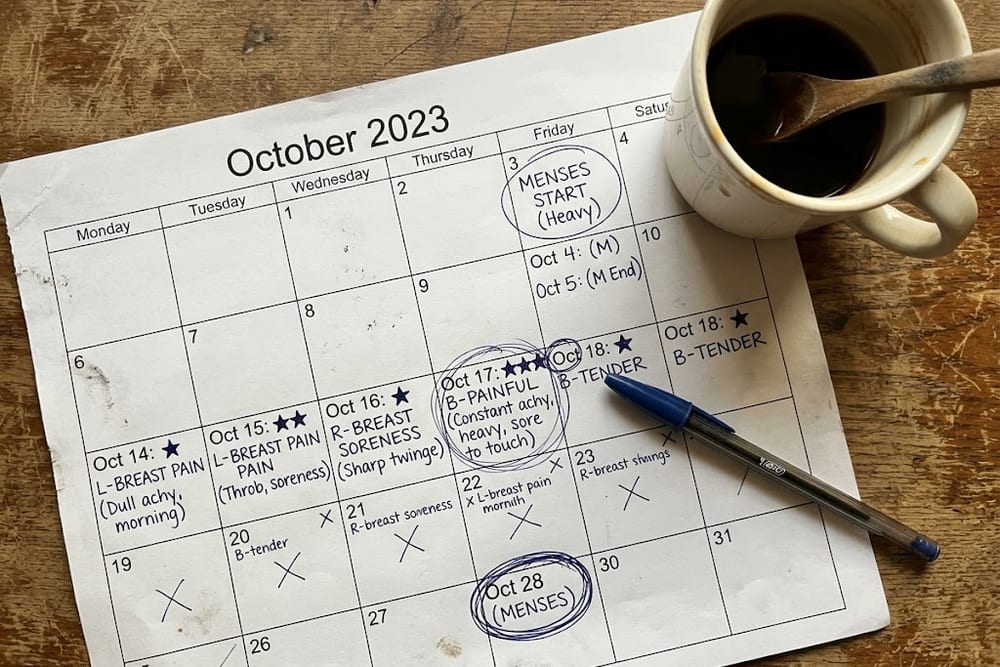
An efficient breast-pain visit is essentially six questions. If you walk in with the answers already organized, the visit is shorter, the recommendation is more accurate, and the wasted-time-and-anxiety cost drops sharply. Two weeks of tracking on a paper calendar — or a simple notes file on your phone — is enough to populate every one of these.
- When does it hurt? Track which days you have pain, which days you do not. If you are still cycling (even irregularly), mark the days of any bleeding. If a pattern emerges over 4-6 weeks — pain in the second half of any "cycle," resolution with bleeding — that is the cyclic signature. If pain hits randomly with no rhythm, that points away from cyclic.
- Where exactly? Point to it. Diffuse, both-breasts, upper-outer = cyclic. Focal, one specific spot you can point to with one finger = non-cyclic or extramammary. If the spot is on the rib cartilage and reproduces with pressure, that is costochondritis until proven otherwise.
- Both breasts or one? Bilateral is reassuring and points to cyclic. Unilateral pushes you toward non-cyclic or extramammary and warrants closer look.
- Any palpable lump? Examine yourself in the shower, both flat and standing. Most lumps women find in perimenopause are benign cysts that change with the cycle, but a new, persistent, dominant lump that does not change with the cycle is the single most important physical finding to surface to your clinician promptly.
- Skin or nipple changes? Dimpling, peau d'orange (orange-peel texture), redness, eczematous changes on the nipple, new nipple inversion, or bloody/clear nipple discharge from one duct on one side — any of these change the visit from "evaluate breast pain" to "evaluate for breast pathology" and bring imaging forward.
- When was your last mammogram? If you are over 40 and overdue, get it scheduled regardless of what is going on now. Perimenopause breast pain is also a good prompt to get back on schedule if you have lapsed.
For a structured way to walk through the broader symptom picture (not just the breast pain in isolation), our free Menopause Symptom Score takes 60 seconds and produces a single hormonal-fingerprint number across the whole cluster.
What helps cyclic perimenopause breast pain (evidence-ranked)
For confirmed cyclic mastalgia — diffuse, bilateral, upper outer, related to the (now-irregular) ovulatory pattern — the evidence-ranked hierarchy is shorter than the supplement aisle suggests. Seven interventions make the list. The first hits the cause; the next several are receptor- or mechanism-targeted; the last reserved for severe cases is a prescription. Several popular "breast detox" / lymphatic / cream products do not make this list because the evidence is absent.
1. HRT — the counterintuitive cause-targeted intervention
This is the part most articles get wrong. Many women assume HRT will make breast pain worse — and in the first 4-12 weeks, it often does. But for cyclic perimenopause breast pain, stabilizing the underlying hormonal weather is the only intervention that targets the root cause, and the long-term effect on cyclic mastalgia is usually improvement, not worsening, once the tissue adapts. The Rosolowich 2006 SOGC mastalgia guideline and the Iddon 2013 review both list hormonal stabilization (in selected patients) as a reasonable approach for severe cyclic mastalgia that has not responded to first-line conservative measures. The mechanism: instead of estrogen spiking and crashing erratically two or three times per month, the breast tissue receives a steady, controlled signal, and the cyclic swelling-and-tenderness loop quiets down. ClearedRx prescribes both compounded and FDA-approved HRT formulations; our companion piece on signs you need HRT walks through when the conversation is worth having. The transient worsening problem is real and addressed in its own section below.
2. Caffeine reduction — an 8-week trial worth doing
The randomized-trial evidence for caffeine and mastalgia is mixed; some studies show clear benefit, others show no effect. The methylxanthine mechanism (cAMP and breast-tissue cyclic-nucleotide effects) is biologically plausible. The pragmatic recommendation from most mastalgia guidelines (Goodwin 1997; Rosolowich 2006): try an 8-week trial of low or no caffeine — under 200 mg/day, roughly two cups of coffee or less. If symptoms improve substantially over the trial period, you have your answer and you can keep caffeine low. If symptoms are unchanged after 8 weeks, add it back; caffeine is not driving your pain and you can stop blaming it. Eight weeks is the minimum trial; anything shorter does not give the breast tissue time to respond.
3. Evening primrose oil — mixed evidence, modest expectations
Evening primrose oil (EPO) contains gamma-linolenic acid, an omega-6 fatty acid that may modulate prostaglandin signaling in breast tissue. Early small trials suggested benefit; larger and better-designed trials have been mostly negative. The current guideline-level summary (Rosolowich 2006; Iddon 2013) acknowledges inconsistent effect — some women improve, many do not, and we have no reliable way to predict who will respond. A reasonable trial is 1,000-3,000 mg daily for 8 weeks; if there is no improvement by then, stop. The marketing around EPO substantially overstates the underlying evidence. It is not the first-line intervention; it is a reasonable second-tier option if you are not ready for or not a candidate for HRT.
4. Magnesium
Magnesium glycinate or magnesium citrate at 300-400 mg in the evening has some evidence in premenstrual symptom clusters and is often included in the mastalgia toolkit. The effect is modest, side effects are minimal, and many perimenopausal women are running low on magnesium anyway. It will not single-handedly fix mastalgia, but combined with caffeine reduction and a properly fitted supportive bra, it can shift the needle.
5. A properly fitted, genuinely supportive bra — the underrated intervention
This is the part the mastalgia guidelines have been making for thirty years and most online articles ignore. Several studies estimate that roughly 70-80% of women are wearing the wrong bra size — usually a band too loose and a cup too small. For cyclic perimenopause breast pain, the mechanical contribution of inadequate support is real and often the cheapest fix on the list. A professional fitting at a dedicated bra retailer (not a department-store kiosk) often reveals a sizing change of two or three sizes from what the woman has been wearing. For exercise specifically, a high-impact sports bra is non-negotiable during pain windows. Iddon (2013) and the Rosolowich SOGC guideline both list a well-fitted supportive bra as a first-line non-pharmacologic intervention.
6. NSAIDs around expected pain windows
Ibuprofen, naproxen, or topical diclofenac applied to the breast skin during pain windows can blunt the symptom. The systemic dose (oral) addresses inflammation-mediated tenderness; the topical preparation has fewer GI side effects and is recommended by several guidelines as the first-line NSAID strategy specifically for mastalgia. Use at standard dosing for short windows only — daily long-term systemic NSAID use has its own risks (GI, renal) and is not a sustainable strategy.
7. Tamoxifen / danazol — for severe cases, prescribed
For severe, persistent cyclic mastalgia that has failed conservative measures and where the impact on quality of life is significant, two prescription options have RCT-level evidence: low-dose tamoxifen (10 mg/day) and danazol. Both reduce mastalgia severity reliably; both have meaningful side effects (especially danazol, which causes androgenic side effects in some women), and both require careful clinical selection. These are not first-line and not over-the-counter — they are tools for the small minority of women whose cyclic mastalgia is genuinely disabling and unresponsive to the simpler interventions above. Iddon (2013) and Smith (2004) review the evidence in detail; Rosolowich (2006) places them clearly at the end of the treatment ladder.
Don't waste money on these
- "Breast detox" supplements. No mechanism, no evidence, no rationale. The breast does not "detoxify" in any meaningful biological sense that a supplement could improve.
- Lymphatic drainage massage as a primary intervention. Manual lymphatic drainage has a legitimate role in post-surgical lymphedema management. It does not have evidence as a primary intervention for cyclic mastalgia.
- Expensive "menopause breast" creams. Topical preparations marketed as "balancing" or "soothing" breast creams generally do not contain anything that hits the underlying mechanism. The exception is properly prescribed topical estradiol gel or a clinician-prescribed transdermal preparation — those are real HRT, not creams from the supplement aisle.
- Phytoestrogen "natural HRT" supplements as a substitute for actual HRT. The phytoestrogen evidence base for mastalgia is thin and the products vary dramatically in potency. If hormonal stabilization is what you need, talk to a clinician.

When you need imaging — the red flags
Diffuse, bilateral, cyclic perimenopause breast pain by itself does not require imaging. Stay on your routine screening mammogram schedule (current U.S. guidelines have shifted toward starting at 40 with annual or biennial screening) and get it scheduled if you are due. Imaging becomes indicated when any of the following are present:
- A palpable lump — particularly one that is firm, fixed (does not move freely), distinct from the surrounding tissue, and does not change with your cycle. Persistent dominant lumps need diagnostic ultrasound and often mammogram, regardless of pain.
- Skin or nipple changes — dimpling, peau d'orange (orange-peel skin texture), redness, eczematous-looking changes on the nipple-areolar complex, new nipple inversion, or any sense that the skin's contour has changed.
- Nipple discharge that is bloody, unilateral, or from a single duct — this is different from bilateral, milky, or clear discharge with breast stimulation, which is usually benign. Spontaneous, one-sided, bloody discharge from a single duct deserves prompt evaluation.
- Focal non-cyclic pain that persists more than 2 weeks — pain in one specific spot, in one breast, that does not change with the cycle and does not resolve over a 2-week window is the threshold most clinicians use for diagnostic imaging (ultrasound first, usually).
- Strong family history + new symptoms — if you have a first-degree relative with premenopausal breast or ovarian cancer, or a known BRCA mutation in the family, the threshold for imaging in response to new symptoms drops, and the screening schedule may be more aggressive than the general population.
- Overdue routine screening — perimenopause breast pain is a reasonable prompt to get back on schedule if you have lapsed, regardless of whether the current pain itself requires imaging.
Red flags that mean call your doctor this week, not next month: a new palpable lump that does not change with your cycle, skin dimpling or peau d'orange, bloody single-duct nipple discharge, focal one-sided pain >2 weeks, or pain associated with exertion / shortness of breath / radiation to jaw or arm (the cardiac differential). None of these are typical cyclic perimenopause breast pain. All deserve prompt clinical evaluation.
The HRT-makes-it-worse-then-better paradox
This is the section most "perimenopause breast pain" articles either skip or fudge. We are going to tell you the honest version, because the dishonest version costs women treatment they would have benefited from. Here it is: when you start systemic HRT, breast tenderness is one of the most common transient side effects in the first 4-12 weeks. Some women experience it as mildly noticeable; some experience it as significant. The breast tissue has been operating in an erratic, generally low-estrogen environment for months or years, and you have now introduced a steady, slightly higher hormonal signal. The tissue responds with fluid retention, ductal swelling, and tenderness — the same way it would respond to a hormonal stimulus in any other context.
The transient worsening usually resolves within 8-12 weeks as the breast tissue adapts. By weeks 12-16, most women on HRT either notice that the breast tenderness has settled back to a low baseline, or — if their original symptom was cyclic mastalgia driven by erratic perimenopausal estrogen swings — that the underlying cyclic mastalgia has improved compared with where it was before HRT, because the hormonal weather is now steady instead of swinging wildly. Iddon (2013) and the Rosolowich SOGC guideline both discuss this pattern.
The clinical problem is that many women interpret the first 4-12 weeks of breast tenderness as evidence that "HRT isn't working" or "HRT is making things worse" and stop the treatment too early — before the tissue has had a chance to adapt. This is one of the most common reasons women abandon HRT in the first three months. The honest framing: expect breast tenderness during weeks 4-12. It is usually mild to moderate. It usually resolves by weeks 12-16. If you can ride out the adaptation window, the steady hormonal input typically resolves the underlying cyclic mastalgia better than no treatment at all.
What helps during the adaptation window: continue the supportive-bra and caffeine-reduction steps, use NSAIDs as needed during pain windows, and have a single 10-minute conversation with your prescribing clinician at week 4 or 6 if the tenderness is significant — sometimes a small change in dose, formulation, or progesterone schedule materially improves the experience without abandoning the treatment plan. Our HRT timeline piece walks through what happens week by week for context.
How ClearedRx prescribes HRT for perimenopause breast pain
ClearedRx is a doctor-supervised HRT service for women, online. You take a one-minute quiz. A licensed physician in our network reviews your symptoms and history within 24 hours. If you are a fit, they prescribe — and your treatment ships discreetly to your door, usually the same week. We prescribe both compounded and FDA-approved HRT formulations; the patient picks based on cost, format preference, and clinical fit.
For perimenopause breast pain specifically — assuming the diagnosis is cyclic mastalgia and not the non-cyclic or extramammary buckets — the goal is hormonal stabilization. Transdermal estradiol (patch or gel), oral estradiol with progesterone if you have a uterus, or a compounded estrogen-and-progesterone body cream are the most common starting preparations. The expectation we set with patients: breast tenderness may transiently worsen during weeks 4-12 of treatment, then settle by weeks 12-16, with the underlying cyclic mastalgia usually quieter at the end of the adaptation window than at the start of treatment. Cost framing as our patients experience it: ClearedRx HRT starts at $49/month for compounded preparations and $89/month for FDA-approved generics, all-in (medication, doctor reviews, free shipping in all 50 states). New patients receive 50% off the first month. Our HRT cost comparison piece walks through every formulation across every channel.

"The first decision in evaluating breast pain is whether the pain is cyclic, non-cyclic, or extramammary. That decision determines the workup. Most cyclic mastalgia is benign and responsive to conservative measures and hormonal management; non-cyclic and extramammary pain require different evaluation pathways." — Iddon J, Dixon JM. Mastalgia. BMJ. 2013;347:f3288.
If you also want to map the rest of the picture
Perimenopause breast pain rarely travels alone. The same erratic-estrogen environment that drives cyclic mastalgia typically also produces hot flashes, night sweats, sleep disruption, mood changes, and irregular periods on overlapping timelines. Mapping the constellation is the cheapest diagnostic move you can make before deciding what to do next. Our free Menopause Symptom Score is a 60-second self-check that scores the cluster as a single hormonal-fingerprint number. For the broader symptom catalogue, see our menopause symptoms overview; the comprehensive pillar piece is 34 symptoms of perimenopause. Sister-article context: our perimenopause vs menopause piece walks through which symptom-stage maps to which treatment, our perimenopause cramps when you have no period piece covers the same erratic-cycle territory, our signs you need HRT piece walks through when the conversation is worth having, our HRT timeline piece is the week-by-week expectation map, and our menopause statistics 2026 page has the prevalence numbers across symptoms.
Frequently asked questions
Is breast pain a sign of perimenopause?
Yes. Perimenopause breast pain is one of the most common and least-discussed symptoms of the menopausal transition. As ovulation becomes erratic and estrogen levels swing widely cycle to cycle, the breast tissue, which is exquisitely hormone-sensitive, responds with tenderness, fullness, and aching. The pattern usually shifts from the predictable late-luteal soreness of regular cycles to a more random, prolonged, and often more severe pain. Mastalgia overall affects an estimated 70% of women at some point, and prevalence peaks in the perimenopausal years (Goodwin 1997; Iddon 2013). For the broader symptom cluster, see our 34 symptoms of perimenopause pillar piece.
Why are my breasts so sore in perimenopause?
Two reasons. First, your estrogen is no longer rising and falling on a smooth 28-day curve — it is spiking and crashing erratically, sometimes two or three times in a single month. The breast tissue gets hit with these signal swings repeatedly. Second, anovulatory cycles often produce unopposed estrogen (estrogen without enough progesterone to balance it), which is particularly inflammatory for ductal and lobular tissue. The combination produces longer pain windows, often bilateral, often upper-outer, often more severe than the cycle-day-25 soreness you remember from your 30s. This is cyclic mastalgia, and it is benign — but the new severity is real.
Does HRT cause breast pain?
Initially, yes — for many women. Breast tenderness is one of the most common transient side effects in the first 4-12 weeks of starting HRT, especially combined estrogen-and-progesterone therapy. The mechanism is that the breast tissue, which has been operating in an erratic low-estrogen environment, now receives a steady, slightly higher hormonal signal and responds with fluid retention and tenderness. This usually resolves within 8-12 weeks as the tissue adapts. Many women interpret this transient worsening as "HRT isn't working" and stop too early. If you can ride out the first 12 weeks, the steady hormonal input typically resolves the underlying cyclic mastalgia better than no treatment at all (Rosolowich 2006). Our HRT timeline piece walks through the adaptation window week by week.
When should I worry about perimenopause breast pain?
See a clinician promptly if you have any of the following: (1) a palpable lump that does not change with your cycle; (2) skin changes like dimpling, peau d'orange (orange-peel texture), or redness; (3) nipple inversion that is new, or nipple discharge that is bloody or unilateral; (4) focal, persistent, non-cyclic pain in one spot that lasts more than 2 weeks; (5) a strong family history of breast or ovarian cancer combined with any new symptom; or (6) you are overdue for your screening mammogram. Most perimenopause breast pain is benign cyclic mastalgia, but these are the red flags that change the workup (Olawaiye 2005; Smith 2004).
Should I get a mammogram for perimenopause breast pain?
Diffuse bilateral cyclic breast pain by itself does not require imaging if you are otherwise up to date on screening. Stay on your routine mammogram schedule (most U.S. guidelines now recommend starting at 40 with annual or biennial screening). Imaging becomes indicated when pain is focal and non-cyclic, when there is a palpable lump or skin change, when there is a strong family history, or when pain persists for more than 2 weeks in one spot. Diagnostic mammogram and targeted ultrasound are the usual first-line imaging in those cases. The American College of Radiology has clear criteria — your clinician should walk you through which category your symptoms fall in (Smith 2004).
Does evening primrose oil really work for breast pain?
Mixed. Evening primrose oil contains gamma-linolenic acid (GLA), an omega-6 fatty acid that may modulate prostaglandin signaling in breast tissue. Early small trials suggested benefit; larger, better-designed trials have been mostly negative. The current evidence-based mastalgia guidelines (Rosolowich 2006 SOGC; Iddon 2013) note inconsistent effect — some women genuinely improve, many do not, and we have no reliable way to predict who will respond. A reasonable trial is 1,000-3,000 mg daily for 8 weeks; if there is no improvement by then, stop. It is not the first-line intervention, and the strong marketing around it overstates the underlying evidence.
Why does only one breast hurt?
Unilateral breast pain is one of the features that shifts your symptom from cyclic mastalgia to the non-cyclic category, which warrants a closer look. Common benign causes of one-sided breast pain include a localized cyst, fibroadenoma, or a focal area of dense fibrocystic change. Less commonly, costochondritis (inflammation of the chest-wall cartilage) presents as one-sided "breast" pain that is actually extramammary. Rarely, focal unilateral pain can be the first symptom of a breast pathology that needs imaging. The clinical rule of thumb: focal, one-sided, persistent (>2 weeks) pain that does not vary with your cycle deserves a clinical breast exam and probably a diagnostic ultrasound (Olawaiye 2005).
Will perimenopause breast pain go away after menopause?
Usually, yes. Once you are past 12 consecutive months without a period and your estrogen has stabilized at the low postmenopausal baseline, the cyclic mastalgia that perimenopause produced typically resolves on its own. The exception is women who start HRT after menopause — they may experience a return of mild breast tenderness during the first 4-12 weeks of treatment, then settle. If you are postmenopausal, not on HRT, and developing new breast pain, that is a different conversation; new pain in a stable hormonal environment is more likely to be non-cyclic and may warrant imaging (Iddon 2013).
Can perimenopause breast pain feel like a heart attack?
It can — and the reverse is also true, which is the more dangerous direction. Chest-wall pain (costochondritis), GERD, and even cardiac pain can radiate to the breast area, and many women in midlife mistake them for breast pain. The features that point toward cardiac rather than mastalgia: pain triggered by exertion, pain associated with shortness of breath or sweating, pain that radiates to the left arm or jaw, and pain that lasts more than a few minutes at a time. If any of these are present, treat it as cardiac until proven otherwise. Women experience atypical heart attack symptoms more often than men do; do not dismiss chest pain as "just perimenopause" without ruling out the urgent things first.
Is caffeine really causing my breast pain?
Maybe — for some women. The randomized-trial evidence for caffeine and mastalgia is mixed. Some studies show clear improvement on caffeine reduction; others show no effect. The mechanism (methylxanthine effects on cAMP and breast-tissue cyclic nucleotides) is plausible but not airtight. The pragmatic recommendation in most mastalgia guidelines (Goodwin 1997; Rosolowich 2006): try an 8-week trial of low or no caffeine (under ~200 mg/day, roughly two cups of coffee or less). If your symptoms improve substantially, you have your answer. If not, add caffeine back — it is not driving your pain, and you can stop blaming it.
Sources & references
- Goodwin PJ, Miller A, Del Giudice ME, Ritchie K. Breast health and associated premenstrual symptoms in women with severe cyclic mastopathy. Can Med Assoc J. 1997. PMID: 9012728
- Iddon J, Dixon JM. Mastalgia. BMJ. 2013;347:f3288. PMID: 23735409
- Olawaiye A, Withiam-Leitch M, Danakas G, Kahn K. Mastalgia: a review of management. J Reprod Med. 2005;50(12):933-939. PMID: 16444894
- Smith RL, Pruthi S, Fitzpatrick LA. Evaluation and management of breast pain. Mayo Clin Proc. 2004;79(3):353-372. PMID: 15065617
- Rosolowich V, Saettler E, Szuck B, et al. Mastalgia. SOGC clinical practice guideline. J Obstet Gynaecol Can. 2006;28(1):49-71. PMID: 16626523
- The North American Menopause Society. The 2022 Hormone Therapy Position Statement of The North American Menopause Society. Menopause. 2022;29(7):767-794. PMID: 35797481
- American College of Radiology. ACR Appropriateness Criteria: Breast Pain. acr.org
- Internal: menopause symptoms overview · 34 symptoms of perimenopause · perimenopause vs menopause · perimenopause cramps no period · signs you need HRT · HRT timeline · menopause statistics 2026 · menopause symptom score tool
If you want to address the cause and not just the symptom — talk to a clinician
ClearedRx prescribes evidence-based HRT — bioidentical estradiol, progesterone, or a combined cream — based on your full picture, with 24-hour MD review and free shipping in all 50 states. Compounded preparations from $49/month, FDA-approved generics from $89/month. No insurance hassle. New patients save 50% on the first month.
Find out if HRT is right for me