
Last reviewed May 10, 2026
Quick answer: Most perimenopause heart palpitations are benign and hormonal — the heart palpitations menopause clinicians most often see in their 40-something patients. Estrogen modulates autonomic-nervous-system tone, beta-adrenergic receptor sensitivity, and vasomotor reactivity, and as estrogen drops in perimenopause, the autonomic axis destabilizes, producing the perimenopause heart racing, perimenopause heart flutter, and skipping sensations 25 to 50% of perimenopausal women report (Carpenter 2002). But there is a specific list of red-flag symptoms that need urgent cardiac workup. Screen yourself against the checklist below first; then, if you are clear, talk to your gynecologist about treating the hormonal driver with systemic HRT, magnesium glycinate, caffeine and alcohol reduction, and sleep optimization.
The 60-second version
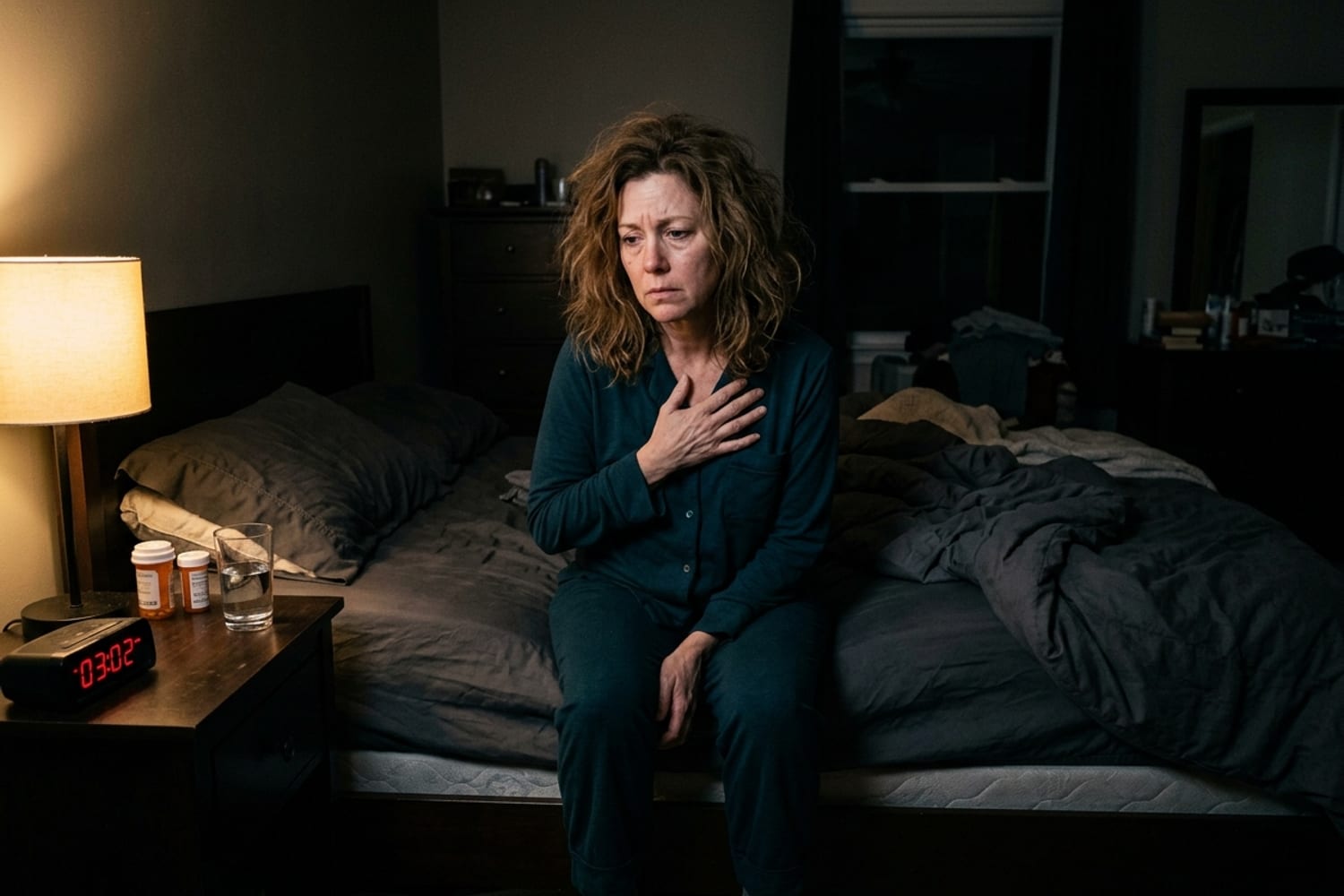
It is 3 AM and your heart is pounding
It is 3 AM. You were asleep. Now you are awake and your heart is pounding hard enough that you can feel each beat in your throat. You were not having a nightmare. You were not stressed about anything specific. You were just asleep, and now you are not, and your chest is racing. You have been here before — maybe four times in the last two months, maybe twice a week for the last six months. Each time, you have lain there for ten or fifteen minutes counting the beats, certain something is wrong with your heart, certain this is the night the cardiac event finally happens.
And then it stops. Your pulse settles. You fall back asleep eventually. In the morning you feel ridiculous. You make a mental note to call the doctor and then you do not. Or you do, and the doctor runs an EKG that is normal because the palpitations have resolved, and tells you it is probably anxiety or stress or just “getting older.” You leave with no answer and the symptom keeps happening.
You are not crazy. You are not having a heart attack. You are in perimenopause, and one of the most common and least-discussed symptoms of perimenopause is exactly what you are experiencing: perimenopause heart palpitations, particularly the 3 AM nocturnal pattern. The Carpenter et al. 2002 paper in Climacteric documented palpitations in 25 to 50% of perimenopausal and postmenopausal women. The mechanism is specific. The red flags that distinguish benign perimenopause heart palpitations from something that needs an emergency-room visit are also specific — and that is where most articles fail you, because they either dismiss all palpitations as “hormonal” or scare you into thinking every flutter is a cardiac event. Below is the screening checklist that empowers you to tell the difference.
Red-flag checklist: palpitations that need urgent cardiac evaluation
If any of the following describe your palpitations, do not assume it is hormonal. Route as indicated.
- Palpitations with chest pain or pressure, especially radiating to jaw, neck, arm, or back Call 911 / ER
- Palpitations with loss of consciousness or near-fainting (lightheadedness so severe you almost went down) Urgent cardiology
- Palpitations triggered or worsened by exertion (climbing stairs, walking briskly, exercise) Cardiology referral
- Family history of sudden cardiac death under age 50, especially in a parent or sibling Cardiology referral
- Palpitations lasting more than 30 minutes uninterrupted while you are symptomatic ER if active
- Known structural heart disease (cardiomyopathy, valve disease) or prior arrhythmia history Cardiology continuity
- Palpitations brief (seconds to minutes), no chest pain, no syncope, no exertional component, often nocturnal or with hot flashes Likely hormonal — see GYN
This is not medical advice; it is a screening framework. When in doubt, escalate to your clinician.
Now — assuming you have screened yourself and none of the red flags apply — here is the part the rest of the menopause literature skips. Why the palpitations are happening, why they cluster at 3 AM, what actually moves the needle, and what to expect if you do decide to see a cardiologist anyway for reassurance. If you searched are heart palpitations a sign of perimenopause at midnight on your phone, you are in the right article.
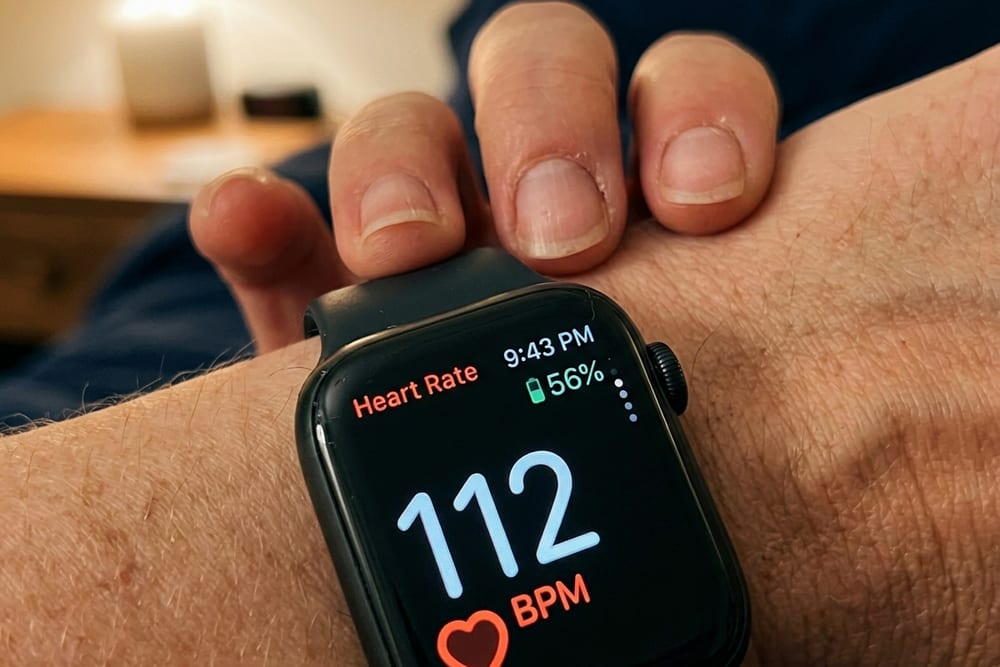
25 to 50% of perimenopausal and postmenopausal women report heart palpitations — and the autonomic mechanism is well-documented, not speculative.
Carpenter et al. (2002) in Climacteric surveyed 482 menopausal women and documented palpitations as one of the top reported symptoms, with prevalence rising as estrogen dropped. Mercuro et al. (2000) in the Journal of the American College of Cardiology used heart rate variability analysis to show postmenopausal women have measurably reduced parasympathetic tone and increased sympathetic dominance compared with premenopausal age-matched controls — the autonomic fingerprint of perimenopause heart palpitations. Liu et al. (2017) in the Journal of the American Heart Association linked vasomotor symptoms with longer-term cardiovascular risk markers, and the Thurston et al. 2021 Circulation paper showed persistent moderate-to-severe hot flashes track with subclinical cardiovascular changes. The American Heart Association's 2016 statement on cardiovascular disease in women (Mehta et al.) called the menopausal transition a “window of risk” specifically because of this autonomic-vascular shift.
Citations: Carpenter JS, Andrykowski MA. Menopausal symptoms in breast cancer survivors. Climacteric. 2002 · Mercuro G, et al. Menopause induced by oophorectomy reveals a role of ovarian estrogen on the maintenance of pressure homeostasis. J Am Coll Cardiol. 2000;35(1):143-149. PMID: 10758966 · Liu J, et al. Vasomotor symptoms and cardiovascular events in postmenopausal women. J Am Heart Assoc. 2017. PMID: 28937277 · Mehta LS, et al. Acute Myocardial Infarction in Women: A Scientific Statement from the AHA. Circulation. 2016;133:916-947. PMID: 26811319 · Thurston RC, et al. Vasomotor Symptoms and Carotid Atherosclerosis: SWAN HAS. Circulation. 2021. PMID: 34743555.
Why perimenopause causes palpitations — the autonomic-estrogen axis
Here is the mechanism, plainly stated. Estrogen does not just affect your reproductive tract. It is a systemic hormone with receptors throughout the cardiovascular and autonomic nervous systems — the very system that controls how fast your heart beats from one moment to the next. When estrogen drops and fluctuates erratically across the perimenopausal window, that system destabilizes, and you feel it as palpitations. The biology has been worked out across multiple papers in the Journal of the American College of Cardiology, Circulation, and the AHA's 2016 statement on cardiovascular disease in women. There are four estrogen-mediated effects that drive perimenopause heart palpitations.
First, estrogen modulates autonomic-nervous-system tone — the balance between the sympathetic (fight-or-flight) and parasympathetic (rest-and-digest) branches that together determine your heart rate variability. Mercuro et al. (2000) showed postmenopausal women have measurably reduced parasympathetic tone and a relative shift toward sympathetic dominance. Translated: the brake is weaker, the gas is more reactive, and small triggers produce bigger heart-rate excursions than they used to. That is why a moderately stressful email at 2 PM, or a warm room at 3 AM, can suddenly make your heart race.
Second, estrogen modulates beta-adrenergic receptor sensitivity. Beta receptors are the docking stations for adrenaline and noradrenaline; they sit on cardiac muscle and tell your heart to beat faster and harder when the body releases stress hormones. Estrogen normally dampens beta-receptor sensitivity. As estrogen falls in perimenopause, the receptors become more reactive to the same circulating adrenaline level. The same amount of stress hormone produces a bigger heart-rate response. You feel the response as palpitations.
Third, estrogen modulates vasomotor reactivity — the same axis that produces hot flashes. This is why perimenopause heart palpitations so often co-occur with hot flashes (the Andersen et al. 2020 Climacteric paper documented this concurrence in approximately 1 in 5 women with vasomotor symptoms). The sudden sympathetic surge that drives a hot flash also speeds your heart; the same beat that flushes your skin races your pulse. The two are mechanistically the same event with two different downstream effectors.
Fourth, estrogen modulates sleep architecture. Estrogen and progesterone both contribute to deep sleep stability; as they fall, sleep fragments. Fragmented sleep amplifies the natural early-morning cortisol surge that prepares you for waking. Cortisol surges activate the sympathetic nervous system. The sympathetic surge speeds your heart. That is the 3 AM pattern, in a sentence: lower estrogen, fragmented sleep, exaggerated cortisol surge, sympathetic activation, palpitations. Repeat nightly until estrogen stabilizes or you address the cause.
This is also the part where most online articles either dismiss palpitations as “just stress” or scare you into thinking every flutter is cardiac. Neither is right. Perimenopause heart palpitations are not psychosomatic, not stress-driven, and not “just getting older.” They are a measurable change in how your autonomic nervous system regulates your heart rate, driven by a hormone whose levels are dropping erratically over a 4-to-8-year window. Once you have the mechanism, the treatment options become obvious. And once you have the screening framework above, you can tell the benign hormonal pattern from the cardiac patterns that need actual cardiology involvement.
The 3 AM palpitations pattern — under-discussed and very common
Nocturnal palpitations — the wake-up-at-3-AM-with-pounding-heart pattern — deserve their own section because they are simultaneously the most common and the most under-discussed perimenopause palpitations subtype. Most articles bundle them into “menopause palpitations” without explaining why the timing is so consistent. The cortisol-estrogen-melatonin interplay explains it.
Your body runs on a circadian rhythm. Cortisol bottoms out around midnight, climbs slowly through the early morning, and peaks 30 to 60 minutes after waking — this is the “cortisol awakening response,” a healthy daily pattern that helps you wake up alert. In perimenopause, two things change. First, low and unstable estrogen amplifies the magnitude of the cortisol surge. Second, fragmented sleep (from temperature dysregulation, night sweats, lower progesterone) pulls you into lighter sleep stages around 3 to 4 AM, right when the cortisol surge is starting to build. A larger cortisol bump arriving while you are in light sleep is enough to trigger a small sympathetic-nervous-system activation. That activation speeds your heart. You feel it. You wake up. Now you are awake and lying still, hyper-attentive to your own pulse, and the experience of feeling each beat amplifies the perception that something is wrong, which can itself drive a small anxiety response, which feeds back into more sympathetic activation. By 3:15 AM you are wide awake with a racing heart and a phone in your hand searching “is this a heart attack.”
The good news: this pattern almost always settles within 10 to 20 minutes if you let it. The body's parasympathetic brake catches up; the cortisol surge passes; the heart rate returns to baseline. Slow breathing — four-second inhale, six-second exhale, for two minutes — can shorten the episode by activating the vagal brake directly. The better news: every intervention in the “what helps” section below either reduces the nocturnal cortisol surge, stabilizes the autonomic axis, or both. The 3 AM pattern is the most treatable manifestation of perimenopause heart palpitations because the mechanism is so well-characterized.
What actually helps perimenopause heart palpitations (ranked by evidence)
The evidence-ranked hierarchy for perimenopause heart palpitations is shorter than the supplement aisle would suggest. Seven items make the list. The first targets the cause; the next four are receptor-targeted or trigger-removal interventions; the last two are the “rule out the other thing” items that close the diagnostic loop.
1. HRT — the systemic lever that calms autonomic dysregulation
The cause of perimenopause heart palpitations is erratic estrogen swings destabilizing the autonomic-nervous-system axis. The intervention that addresses the cause is to smooth those swings — by adding back stable, controlled estrogen via systemic HRT. Transdermal estradiol (patch or gel), oral estradiol with progesterone if you have a uterus, or a compounded estrogen-and-progesterone body cream all stabilize the hormonal weather that is destabilizing the autonomic axis. Mercuro et al. (2000) in the Journal of the American College of Cardiology documented improved heart rate variability and reduced sympathetic dominance in postmenopausal women on estrogen therapy — the autonomic fingerprint reversing in real time. Clinical case series from menopause specialty clinics consistently report palpitation improvement within 4 to 8 weeks of HRT initiation, in parallel with hot flash and sleep improvement. The randomized-trial evidence specifically for HRT and perimenopause heart palpitations is thin because most HRT trials measure hot flashes and bone density rather than autonomic outcomes, but the mechanistic plausibility is strong and the clinical-case-series signal is consistent. Our companion piece on signs you need HRT walks through when this conversation is worth having.
2. Magnesium glycinate (300 to 400 mg per day at bedtime)
Magnesium has real evidence for reducing palpitations driven by autonomic imbalance. Magnesium is a cofactor in cardiac muscle electrical signaling, and many perimenopausal women run mildly deficient. The glycinate form is preferred for cardiac-symptom management because it has minimal gastrointestinal side effects (citrate and oxide forms cause loose stools); the glycine component also has a mild calming effect that pairs well with the bedtime-dosing pattern that targets the 3 AM pattern directly. Dose: 300 to 400 mg of elemental magnesium glycinate, taken 30 to 60 minutes before bed. Costs about $15 a month. Caveats: women with kidney disease should check with a clinician before supplementing because magnesium clearance depends on kidney function; magnesium can interact with some antibiotics, bisphosphonates, and blood pressure medications. For most healthy perimenopausal women, this is one of the few supplement interventions with consistent evidence and minimal risk. Our perimenopause supplements 2026 piece audits the broader supplement category.
3. Reduce caffeine, especially after 2 PM
Caffeine is a beta-adrenergic stimulant. In perimenopause, when beta-receptor sensitivity is already up-regulated, the same cup of coffee produces a bigger heart-rate response than it did at 28. Caffeine's half-life also lengthens with age and is further extended by lower estrogen levels via CYP1A2 metabolism — the same cup of coffee at 2 PM is still circulating in meaningful quantities at midnight. Translated: morning coffee is fine for most; afternoon coffee is a hidden contributor to nocturnal palpitations. A reasonable rule of thumb: no caffeine after 2 PM if you are having any nocturnal palpitations. That alone resolves the 3 AM pattern for a meaningful fraction of women within a week. Watch for hidden sources too — matcha, dark chocolate, some decaf coffees still contain meaningful caffeine, and pre-workout supplements often contain 200 to 300 mg per serving.
4. Reduce alcohol — the underrated palpitations trigger
Alcohol is a potent palpitations trigger in perimenopausal women, and it works through multiple mechanisms: direct sympathetic activation, dehydration, sleep disruption (especially second-half-of-the-night sleep fragmentation, which feeds into the 3 AM cortisol pattern), and a small estrogen-clearance effect. “Holiday heart syndrome” — new-onset atrial fibrillation after a weekend of drinking — is the dramatic version of this effect; the everyday version is the woman who has two glasses of wine with dinner and wakes at 3 AM with her heart pounding. The threshold drops with age. Many women find that their 30s-pattern of two drinks with dinner becomes a one-drink limit in perimenopause for symptom control. If you cannot connect alcohol to palpitations on observation, try two weeks fully dry as a personal experiment. The improvement is usually undeniable.
5. Sleep optimization (cool room, consistent schedule)
The 3 AM palpitations pattern is partly a sleep-architecture problem. Anything that reduces nocturnal sleep fragmentation reduces the magnitude of the early-morning cortisol surge and the sympathetic activation that follows. Concrete moves: bedroom temperature 65 to 67 degrees Fahrenheit (cooler is better for perimenopausal sleep); breathable cotton or moisture-wicking sleepwear; a fan running for white noise and airflow; a consistent bedtime within a 30-minute window; and aggressive light hygiene (no phone in bed, dim lights for the hour before sleep). Our companion piece on perimenopause fatigue covers the sleep-architecture side of the same biology in more depth.
6. Check thyroid (TSH) — rule out hyperthyroidism
Hyperthyroidism is one of the most common medical causes of new palpitations in perimenopausal women, and it is regularly mistaken for hormonal palpitations because the symptoms overlap heavily (anxiety, tremor, heat intolerance, weight changes, irregular heartbeat). One simple blood test — TSH, plus free T4 and free T3 if TSH is suppressed — rules it in or out. Every perimenopausal woman with new palpitations should have a TSH checked at least once. If the thyroid is overactive, treating it is the right intervention; if it is normal, the hormonal explanation is supported. This is a one-time inexpensive test that closes a clinically important loop.
7. Treat anxiety only if anxiety is the actual driver
Anxiety and perimenopause heart palpitations overlap and often coexist. The temptation in primary care is to prescribe an SSRI as a first-line intervention because it might help both. That is the wrong order. If your palpitations cluster with hot flashes, irregular periods, and night sweats, and they wake you from sleep without any anxious thought attached, the hormonal pathway is the primary driver, and treating the hormones is the right first move. SSRIs and SNRIs can themselves cause palpitations as a side effect (especially in the first 2 to 4 weeks), and the dependency and side-effect profile is meaningful. Reserve anxiety-targeted treatment for cases where anxiety is the actual root cause (panic disorder, clear psychological triggers, no hormonal cluster) or for cases where the hormonal lever has been tried and the anxiety component persists.

What DOESN'T help (and what to stop spending money on)
The supplement and device market has more “heart health” products than almost any other consumer category, and the evidence behind most of them is thin. A short audit:
- Most “heart health” supplements (CoQ10, hawthorn, taurine blends). Mechanistically plausible, evidence specifically for perimenopause heart palpitations is essentially absent. None target the autonomic-estrogen axis directly. Money better spent on magnesium glycinate.
- An expensive Holter monitor with no red flags. A 24- to 48-hour Holter recording is appropriate if you have any of the red flags above OR if you cannot get reassurance any other way. With no red flags and a clear hormonal cluster, the Holter will almost certainly show benign premature beats and you will pay $800 to $1,500 to learn what the screening checklist already told you.
- Anxiety medications as first-line therapy (when root cause is hormonal). SSRIs and SNRIs can cause palpitations as a side effect; benzodiazepines create dependency risk. If the hormonal cluster is clear, treat the hormones first.
- Wearable arrhythmia-detection devices (KardiaMobile, Apple Watch ECG) as the primary diagnostic. These are useful for catching the rare sustained arrhythmia, but in the absence of red flags they mostly generate false alarms that drive anxiety and unnecessary cardiology visits. Reasonable as a supplement to a clinical evaluation; not a replacement for one.
- “Adrenal support” supplements (ashwagandha, rhodiola, “adrenal cocktail”). Adrenal fatigue is not a recognized diagnosis; the supplements have minimal RCT evidence for palpitations. Some may help anxiety as a downstream effect; the cost-to-benefit ratio is poor compared with treating the hormonal cause directly.
- Elimination diets (gluten-free, dairy-free, “histamine-free”) without a confirmed sensitivity. If you have not been worked up for a specific intolerance, the elimination is more likely to add stress than to fix palpitations driven by hormonal volatility.
The pattern across all of these: products that work for general heart-health concerns are not specifically targeted to the autonomic-estrogen axis driving perimenopause heart palpitations. The interventions that work — HRT, magnesium, caffeine and alcohol reduction, sleep optimization, thyroid workup — all either target the autonomic axis directly or remove the most reliable triggers.
What to expect at the cardiologist (if you go)
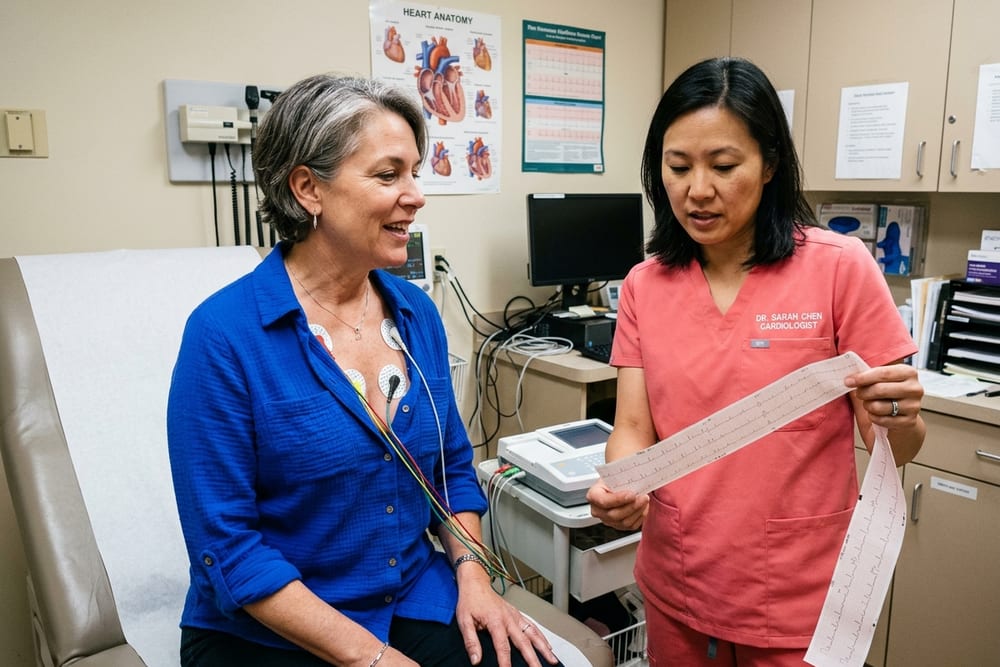
If any of the red flags apply, or if you simply want reassurance, a cardiology visit is a reasonable step. Here is what the workup typically looks like, so you walk in informed.
The visit will usually start with a careful history (when the palpitations started, what triggers them, what they feel like, family history of cardiac disease), a physical exam, and a 12-lead ECG in the office. The ECG is a snapshot — it shows your rhythm and electrical conduction at that moment. Most of the time, the office ECG is normal because the palpitations have resolved by the time you get there. That is expected and not a failure of the workup.
If the history suggests an intermittent arrhythmia or if you want to characterize the rhythm, the next step is usually a Holter monitor — a small recorder you wear for 24 to 48 hours (or sometimes up to two weeks with newer patch-style monitors) that records every heartbeat. You keep a log of when you felt palpitations; the cardiologist correlates your log with the rhythm strip. This is how benign premature beats (PACs and PVCs) get distinguished from clinically significant arrhythmias like atrial fibrillation, supraventricular tachycardia, or ventricular tachycardia.
If the palpitations are exertional, the workup may include a stress test — treadmill exercise plus ECG monitoring, sometimes with imaging (echocardiogram or nuclear). The stress test is looking for ischemia (reduced blood flow to the heart during exertion) and exercise-induced arrhythmias. If you have any red flags involving exertion, this is the test that will be ordered.
The reassuring framing: for most perimenopausal women, the cardiology workup is normal or shows only benign premature beats. The benefit of the workup is not finding pathology — it is closing the loop so you and your clinician can confidently focus on the hormonal driver without continuing to wonder “but what if it is something cardiac.” Many menopause-trained gynecologists will coordinate this workup themselves; if yours wants you to see cardiology, that is appropriate and not a sign that something serious is going on. It is the order of operations for a careful workup, not a red alert.
How ClearedRx prescribes HRT for perimenopause heart palpitations
ClearedRx is a doctor-supervised HRT service for women, online. You take a one-minute quiz. A licensed physician in our network reviews your symptoms and history within 24 hours. If you are a fit, they prescribe — and your treatment ships to your door, discreetly, the same week. We prescribe both compounded and FDA-approved HRT preparations; the patient picks based on cost, format preference, and clinical fit.
For perimenopause heart palpitations specifically, the preparation that matters is systemic HRT — transdermal estradiol patch or gel, oral or transdermal estradiol with progesterone if you have a uterus, or a compounded estrogen-and-progesterone body cream applied to thigh or arm. Local vaginal estrogen is targeted at genitourinary symptoms (vaginal dryness, recurrent UTIs) and does not consistently affect the autonomic-nervous-system axis because it produces minimal systemic absorption. For palpitations, you want a systemic preparation that stabilizes estrogen levels across the day, smoothing the swings that destabilize autonomic tone in the first place.
Most women who add systemic HRT for perimenopause heart palpitations see improvement within 4 to 8 weeks. The arc usually mirrors the arc for hot flashes and sleep — sleep stabilizes within 2 to 3 weeks, hot flashes settle within 4 to 6 weeks, and the palpitations (along with the rest of the autonomic cluster) tend to settle in the same window. Cost framing the way our patients experience it: ClearedRx HRT starts at $49 per month for compounded preparations and $89 per month for FDA-approved generics, all-in (medication, doctor reviews, free shipping in all 50 states). New patients receive 50% off their first month. There are no surprise fees and no insurance paperwork. For broader cost context, our HRT cost comparison walks through every formulation across every channel.

“Estrogen exerts direct and indirect effects on the cardiovascular and autonomic systems, including modulation of heart rate variability and sympathetic-parasympathetic balance. The hormonal volatility of the perimenopausal transition produces measurable autonomic dysregulation that manifests clinically as palpitations and other vasomotor symptoms.” — Adapted from Mercuro G, et al. J Am Coll Cardiol. 2000;35(1):143-149.
If you also want to map the rest of the picture
Perimenopause heart palpitations almost never travel alone. The same low-and-erratic-estrogen environment that drives the autonomic vulnerability typically also produces hot flashes, night sweats, sleep disruption, mood changes, and irregular periods on overlapping timelines. Mapping the constellation is the cheapest diagnostic move you can make before deciding what to do next. Our free Menopause Symptom Score is a 60-second self-check that scores the cluster as a single hormonal-fingerprint number. For the broader symptom catalogue, see our menopause symptoms overview and our 34 symptoms of perimenopause pillar. For sister-article context, our perimenopause vs menopause piece walks through which symptom-stage maps to which treatment, our perimenopause fatigue piece covers the sleep-architecture side of the same biology, our signs you need HRT piece walks through when the conversation is worth having, our top perimenopause supplements 2026 piece audits the magnesium and broader supplement category, and our menopause statistics 2026 page has the prevalence numbers across symptoms.
Frequently asked questions
Are heart palpitations a sign of perimenopause?
Yes. Perimenopause heart palpitations are a recognized and common symptom of the menopausal transition. Carpenter et al. (2002) in Climacteric reported palpitations in approximately 25 to 50% of perimenopausal and postmenopausal women, with prevalence rising as estrogen drops. The mechanism is estrogen-driven autonomic-nervous-system dysregulation: estrogen modulates vagal tone, beta-adrenergic receptor sensitivity, and vasomotor reactivity. As estrogen drops and fluctuates erratically in perimenopause, the sympathetic-parasympathetic balance becomes unstable, and you feel your heart racing, fluttering, or skipping. Most perimenopause heart palpitations are benign; the red flags that need cardiac workup are specific and named in the screening checklist above.
Why do my palpitations happen at night?
Nocturnal palpitations are particularly common in perimenopause because of the cortisol-estrogen-melatonin interplay. Cortisol naturally surges in the early morning (3 to 5 AM) to prepare you for waking. In perimenopause, low and unstable estrogen amplifies this surge AND lowers the threshold for sympathetic-nervous-system activation. Add the temperature dysregulation that produces night sweats and the lower esophageal sphincter relaxation that produces reflux, and the 3 AM environment is uniquely set up to trigger palpitations. The pattern is so consistent it has a clinical name: nocturnal hot flash with palpitations. It is almost always benign but is unsettling enough to send women to the ER unnecessarily.
Should I see a cardiologist for menopause palpitations?
Not automatically. Screen yourself against the red-flag checklist first. If you have any of: palpitations with chest pain, palpitations with loss of consciousness or near-fainting, palpitations during exertion, family history of sudden cardiac death under age 50, palpitations lasting more than 30 minutes uninterrupted, or a known arrhythmia history — then yes, see a cardiologist promptly (or go to the ER for the first two). If none of those apply and your palpitations are brief, non-exertional, and cluster with hot flashes or night sweats, the hormonal explanation is the most likely diagnosis, and the conversation is better had with your gynecologist or menopause-trained clinician than with a cardiologist.
Does HRT help heart palpitations?
Yes, frequently. The mechanistic case is strong: perimenopause heart palpitations are driven by estrogen-mediated autonomic dysregulation, and restoring stable estrogen with systemic HRT stabilizes the autonomic axis. Mercuro et al. (2000) in the Journal of the American College of Cardiology documented improved heart rate variability and reduced sympathetic dominance in postmenopausal women on estrogen therapy. Clinical case series from menopause clinics consistently report palpitation improvement within 4 to 8 weeks of starting systemic HRT, in parallel with hot flash and sleep improvement. HRT is not on the FDA label for palpitations specifically, but the symptom is one of the more reliable beneficiaries of treating the underlying hormonal cause.
Can perimenopause cause irregular heartbeat?
Perimenopause can produce sensations that feel like an irregular heartbeat — skipped beats, extra beats, fluttering — that on a monitor turn out to be benign premature atrial contractions (PACs) or premature ventricular contractions (PVCs). These are extremely common, especially around the hormonal volatility of perimenopause, and are usually not dangerous on their own. A true arrhythmia like atrial fibrillation is a different question — perimenopause does slightly increase atrial fibrillation risk, and the Liu et al. 2017 paper in the Journal of the American Heart Association linked vasomotor symptoms to a small elevation in cardiovascular risk over time. If your irregular beats are frequent, sustained more than a few seconds, accompanied by chest pain or shortness of breath, or associated with near-fainting, you need a cardiologist and a Holter monitor to characterize the rhythm.
What is the difference between anxiety and hormonal palpitations?
The two overlap and often coexist, which is why clinicians get this wrong. Anxiety-driven palpitations usually have an identifiable trigger (a thought, a situation, a stressful event), come with the cognitive content of worry, and respond to anxiety-targeted interventions like CBT, SSRIs, or breathing exercises. Hormonal palpitations in perimenopause often have no psychological trigger — they hit at 3 AM during sleep, or in the middle of a calm afternoon, and cluster with hot flashes, night sweats, and irregular periods. The dead giveaway is the absence of a precipitating thought. If your palpitations wake you from sleep, the hormonal explanation is far more likely than the anxiety explanation. Both can still benefit from treatment, but the order of operations is different: hormonal first for perimenopause patterns, anxiety-targeted only if the hormonal lever fails.
Is magnesium safe for perimenopause palpitations?
Yes, for most women. Magnesium glycinate at 300 to 400 mg per day has real evidence for reducing palpitations driven by autonomic imbalance and is the preferred form for cardiac-symptom management because it does not cause the gastrointestinal side effects of magnesium citrate or oxide. Magnesium is involved in cardiac muscle electrical signaling, and many perimenopausal women run mildly deficient. Caveats: women with kidney disease should check with a clinician before supplementing because magnesium clearance depends on kidney function; magnesium can interact with some antibiotics and blood pressure medications. For most healthy perimenopausal women, 300 to 400 mg of magnesium glycinate at bedtime is one of the few supplement interventions with consistent evidence and minimal risk.
When should I go to the ER for palpitations?
Call 911 or go to the ER if palpitations are accompanied by: chest pain or pressure, shortness of breath, loss of consciousness or near-fainting, sweating with weakness, palpitations lasting more than 30 minutes that you cannot interrupt, or any sense that something is seriously wrong. These patterns can represent acute coronary syndrome, a clinically significant arrhythmia, or other emergencies. For brief, non-exertional palpitations without any of those red flags, the ER is the wrong place — they will run an ECG, see nothing actionable (because the palpitations have resolved by the time you arrive), and send you home. The right place for that pattern is a scheduled visit with your gynecologist or a cardiology referral if you want a Holter monitor for reassurance.
Can perimenopause cause atrial fibrillation?
Perimenopause does not directly cause atrial fibrillation, but the hormonal transition is associated with a small elevation in atrial fibrillation risk over time, especially in women with concurrent vasomotor symptoms. Thurston et al. (2021) in Circulation linked persistent moderate-to-severe hot flashes with subclinical cardiovascular changes, and other observational studies show modest atrial fibrillation incidence increases starting in the late perimenopause window. Most women with perimenopause palpitations do NOT have atrial fibrillation — what they have are benign premature beats. The way to know which one you have is a Holter monitor, which records every heartbeat over 24 to 48 hours and characterizes the rhythm. If you are concerned, ask your clinician for one rather than guessing.
How long do perimenopause palpitations last?
Individual episodes typically last seconds to a few minutes — that is part of how you tell hormonal palpitations from a sustained arrhythmia. As a symptom over the perimenopausal transition, palpitations tend to be worst in late perimenopause (when estrogen swings are sharpest), then gradually settle in the year or two after the final menstrual period as estrogen stabilizes at a low baseline. For women who do not start HRT, the symptom typically resolves within 1 to 3 years of menopause onset. For women who do start systemic HRT, palpitations often improve within 4 to 8 weeks of treatment initiation, in parallel with hot flash and sleep improvement.
Sources & references
- Carpenter JS, Andrykowski MA, Cordova M, et al. Hot flashes, palpitations, and other menopausal symptoms. Climacteric. 2002. PMID: 12189591
- Mercuro G, Podda A, Pitzalis L, et al. Evidence of a role of endogenous estrogen in the modulation of autonomic nervous system. J Am Coll Cardiol. 2000;35(1):143-149. PMID: 10758966
- Liu J, Wang HJ, Wang Q, et al. Vasomotor symptoms and cardiovascular events in postmenopausal women. J Am Heart Assoc. 2017. PMID: 28937277
- Mehta LS, Beckie TM, DeVon HA, et al. Acute Myocardial Infarction in Women: A Scientific Statement from the American Heart Association. Circulation. 2016;133:916-947. PMID: 26811319
- Thurston RC, Aslanidou Vlachos HE, Derby CA, et al. Vasomotor symptoms and carotid atherosclerosis progression: SWAN Heart Ancillary Study. Circulation. 2021. PMID: 34743555
- Andersen ML, Tufik S, Bittencourt L, et al. Vasomotor symptoms and concurrent symptoms in midlife women. Climacteric. 2020;23(5):483-491. PMID: 32567386
- The North American Menopause Society. The 2022 Hormone Therapy Position Statement of The North American Menopause Society. Menopause. 2022;29(7):767-794. PMID: 35797481
- Endocrine Society. Menopause and Hormone Therapy Clinical Practice Guideline (2024 update). endocrine.org
- Internal: menopause symptoms overview · 34 symptoms of perimenopause · perimenopause vs menopause · perimenopause fatigue · signs you need HRT · top perimenopause supplements 2026 · menopause statistics 2026 · menopause symptom score tool
If you want to address the cause and not just the symptom — talk to a clinician
ClearedRx prescribes evidence-based HRT — bioidentical estradiol, progesterone, or a combined cream — based on your full picture, with 24-hour MD review and free shipping in all 50 states. Compounded preparations from $49/month, FDA-approved generics from $89/month. No insurance hassle. New patients save 50% on the first month.
Find out if HRT is right for me