
Last reviewed May 10, 2026
Quick answer: Women lose approximately 30 percent of skin collagen in the first 5 years post-menopause (Brincat 1985, BJOG). The face changes you see in the mirror — collagen loss, bone resorption, mid-face fat redistribution, hyaluronic acid loss, the dry-and-oily acne paradox, pigmentation shifts — are real, measurable, and follow a predictable timeline. There is a hierarchy of what actually slows menopause face: tretinoin, daily sunscreen, and topical vitamin C have the strongest evidence; HRT modestly slows further loss; collagen drinks and most "anti-aging serums" do almost nothing. HRT slows but does not fully reverse the change.
The 60-second version
The mirror moment that sent you here
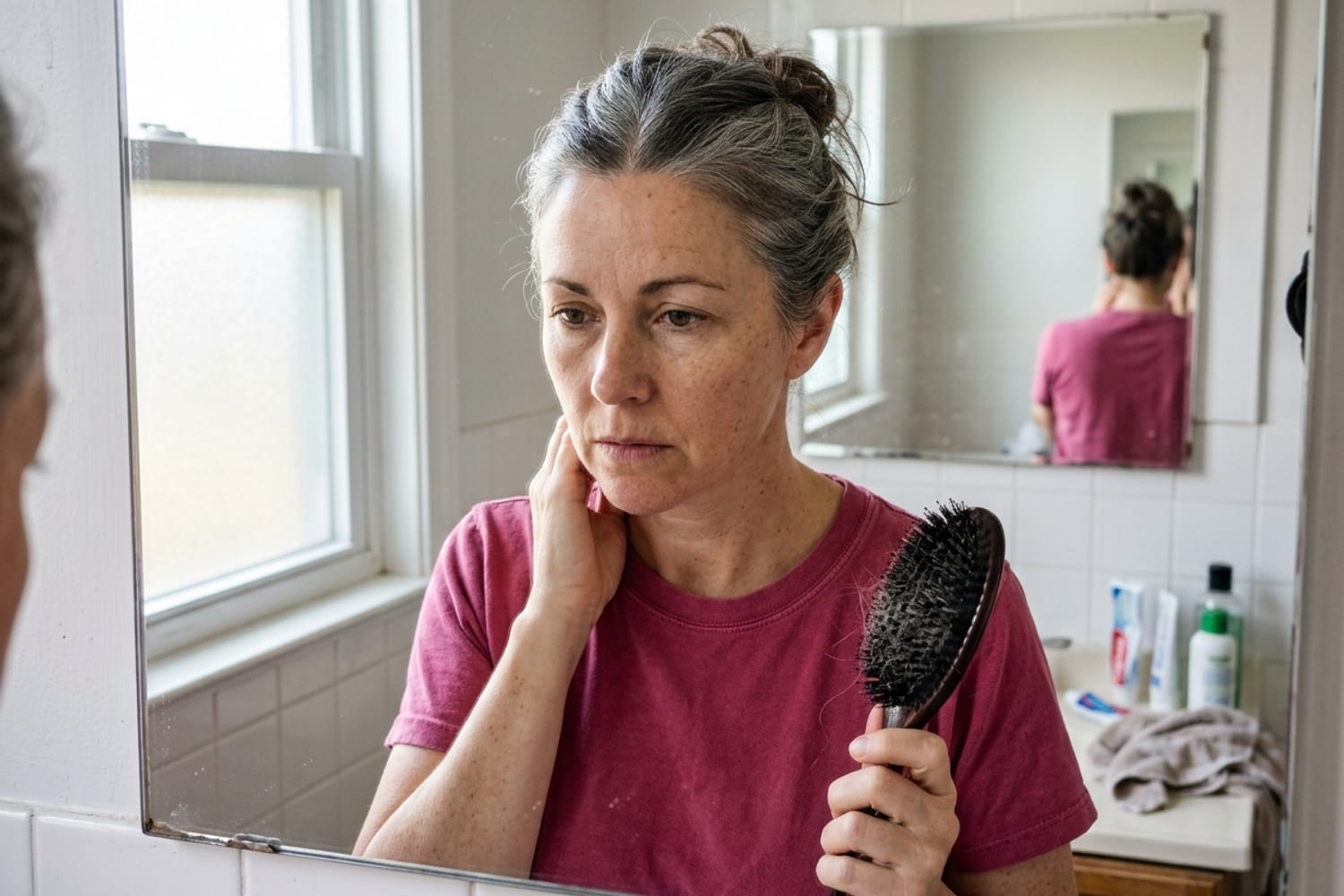
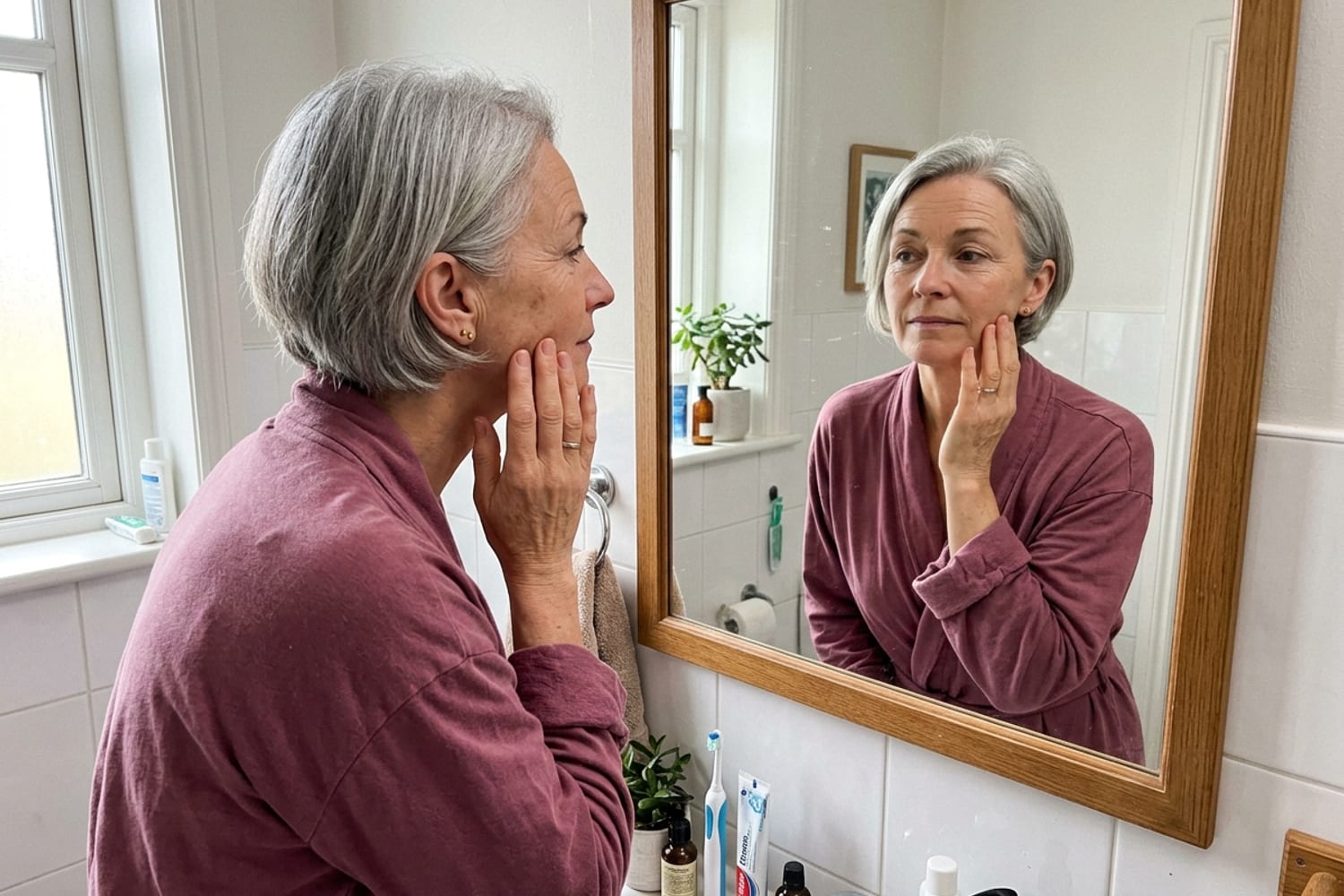
Your face looks different in the mirror. Sharper jawline, softer below it, sudden hollowing under the eyes, jowls where there weren't jowls. The skin around your mouth folds in a way it never used to. The cheekbones you used to like are still there but the cheeks themselves are flatter, and the lower face looks heavier than the upper face for the first time in your life. That's menopause face. It's real. It's measurable. It's not your imagination, not "stress," not poor sleep, and not because you stopped using the right cream.
This is the part most "menopause skin" articles get vague about. They tell you collagen drops. They do not tell you 30 percent in 5 years. They list "treatments" without ranking the evidence. They sell you a $90 collagen drink. They never explain why your face is suddenly drier on the cheeks and breaking out on the jawline at the same time. They do not say out loud that HRT slows the loss but does not fully reverse it. This article does. It is the menopause face explainer with the original-research timeline most blogs miss, the six mechanisms behind what you are seeing, and the evidence-ranked list of what actually slows the change. If you searched menopause face at the bathroom sink on a Tuesday morning, you are in the right article.
Two things to set up front. Menopause face is not a moral failure or a hygiene failure. It is a measurable consequence of an estrogen drop on connective tissue, bone, fat, and skin glands. And — more honestly than competitor articles — nothing fully reverses it. The interventions that work are loss-rate reducers and partial restorers. Earlier is always better than later. The first 5 years post-menopause is the steepest section of the curve and the window where intervention has the most leverage. After that, the rate slows substantially and the curve flattens.
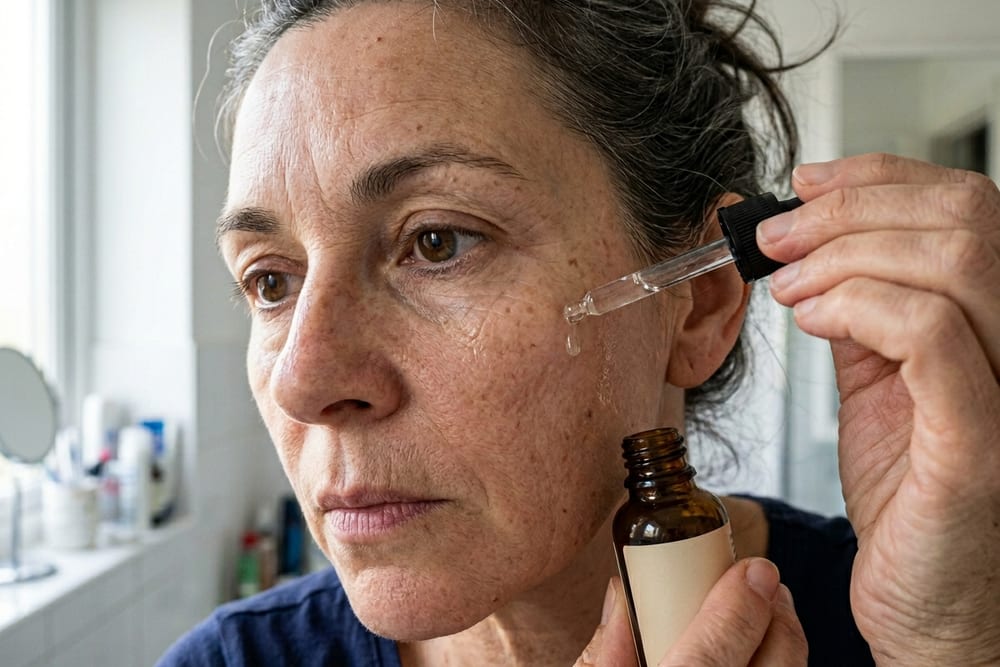
Women lose approximately 30 percent of dermal collagen in the first 5 years post-menopause, with roughly 2 percent additional loss per year after that.
Brincat et al. (1985) in the British Journal of Obstetrics and Gynaecology measured skin thickness and skin collagen content in postmenopausal women across years since menopause. The headline number is the one that should anchor every conversation about menopause face: 30 percent dermal collagen loss in the first 5 years, then approximately 2 percent further loss per year. Affinito et al. (1999) in Maturitas independently confirmed the relationship — postmenopausal collagen content correlates strongly with years since menopause, and the relationship is dose-dependent on cumulative estrogen deficit. Hall and Phillips (2005) in the Journal of the American Academy of Dermatology consolidated the evidence and added that estrogen treatment in postmenopausal women repeatedly increases collagen content, dermal thickness, and elasticity — modestly, but reliably.
Citations: Brincat M, et al. Long-term effects of the menopause and sex hormones on skin thickness. Br J Obstet Gynaecol. 1985;92(3):256-9. PMID: 3978054 · Affinito P, et al. Effects of postmenopausal hypoestrogenism on skin collagen. Maturitas. 1999;33(3):239-247. PMID: 10656502 · Brincat MP, Muscat Baron Y, Galea R. Estrogens and the skin. Climacteric. 2005;8(2):110-23. PMID: 16096167 · Hall G, Phillips TJ. Estrogen and skin: the effects of estrogen, menopause, and hormone replacement therapy on the skin. J Am Acad Dermatol. 2005;53(4):555-68. PMID: 16198774.
Translating the curve into a calendar matters because it tells you where you have leverage. A 45-year-old in early perimenopause who starts daily sunscreen and a topical retinoid is intervening on the steepest part of the curve before it has happened. A 55-year-old starting the same routine 5 years past menopause is intervening after most of the steep loss has already occurred. The interventions still help — but the leverage is in the early window. The same dollar of effort buys more skin in year 1 than in year 10.
What actually changes — the six mechanisms
Menopause face is not one thing. It is six things on the same face, on overlapping timelines, all driven by the same upstream estrogen drop. The six mechanisms are independent enough that any given woman's "menopause face" looks slightly different — some women lose a lot of mid-face volume, some keep volume but get the dry-and-acne paradox, some get pigmentation changes nobody warned them about. Understanding the six mechanisms is the difference between buying products at random and choosing the lever that matches your particular pattern.
1. Collagen loss (the dominant driver)
~30% dermal collagen in the first 5 years post-menopause (Brincat 1985). Collagen is the structural protein that gives skin firmness and thickness. Its loss is the mechanism behind the most visible change: skin that creases more easily, looks thinner, and bounces back less.
2. Bone resorption
The facial skeleton itself gets smaller. The eye sockets enlarge slightly, the maxilla retracts, and the mandibular angle changes. Brincat et al. (2005) discuss the bone-skin relationship explicitly. This is part of why no cream returns a postmenopausal face to its premenopausal shape — the underlying bone framework has changed.
3. Mid-face fat redistribution
The malar fat pads (the cheek "apples") thin and descend. Fat redistributes downward and outward, contributing to jowls and a fuller lower face. This is the structural reason a postmenopausal face often looks softer below the cheekbones than above.
4. Hyaluronic acid loss
Hyaluronic acid (HA) holds water in the dermis. Estrogen drives HA synthesis; the postmenopausal drop reduces HA content. The skin holds less water, looks less plump, and feels drier. This is the mechanism behind the "my skin used to look dewy and now it doesn't" complaint.
5. Sebaceous shift (the dry+oily paradox)
Estrogen falls; relative androgen activity rises (Zouboulis 2007 Horm Metab Res). Sebaceous glands on the chin and jawline get more reactive, producing the menopausal-acne pattern, while the rest of the face becomes drier from the estrogen-driven HA loss. Same hormonal shift; opposite-looking outcomes on the same face.
6. Pigmentation changes
Estrogen modulates melanocyte activity. Postmenopausal women are more prone to uneven pigmentation, melasma persistence, and cumulative sun-spot accumulation. The skin's response to UV changes — which is why daily sunscreen becomes more important after menopause, not less.
If your menopause face is mostly hollow cheeks and a heavier jawline, the dominant drivers are bone and fat. If your menopause face is mostly thin, papery skin that creases easily, the dominant driver is collagen. If your menopause face is dry cheeks and chin acne, the dominant driver is the sebaceous shift. The treatment hierarchy is the same in any case, but knowing your dominant pattern tells you where to expect the most visible improvement and where to manage expectations. No topical cream is going to rebuild your facial bone. No HRT regimen is going to fully restore mid-face volume. The honest version is that menopause face is partly modifiable, partly not.
The "menopause acne" paradox
If you are 47, broke out for the first time since high school, and Google has been telling you to wash your face better, this is the section. The menopausal-onset acne pattern is real, well-described in the dermatology literature, and the opposite of teenage acne in two important ways. First, it clusters on the lower face — chin, jawline, sometimes the upper neck — rather than the forehead and T-zone of adolescence. Second, it coexists with dry skin on the rest of the face, which makes the conventional "use a stronger cleanser and a benzoyl peroxide wash" advice actively counterproductive.
The mechanism is the estrogen-androgen ratio shift. Estrogen falls; testosterone and DHEA fall less, or in some women rise transiently; the net result is more relative androgen activity on the sebaceous glands of the lower face — which are the most androgen-sensitive zones (Zouboulis et al., 2007, Horm Metab Res). The same shift is responsible for the chin-and-jaw whisker hairs that show up in the same window. The same hormonal shift, two skin manifestations on the same face, both driven by the loss of estrogenic opposition to androgen activity.
What works: gentle, non-stripping cleansers (because the rest of your face is dry); a topical retinoid at night (which addresses both the acne mechanism and the collagen loss simultaneously — the highest-leverage product in the routine); spot treatment with benzoyl peroxide or salicylic acid only on active lesions, not as a wash; and, for stubborn cases, a clinician conversation about hormonal modulation. Spironolactone at low doses (50-100 mg/day) is the most common targeted medication for adult-onset hormonal acne; it antagonizes androgen receptors specifically. HRT, by restoring estrogen and shifting the ratio back, often improves menopausal acne as a side effect of treating systemic symptoms. What does not work: aggressive cleansing routines, drying alcohol-based toners, and the OTC anti-aging products marketed to perimenopausal women that are actually formulated for dry skin and which clog the lower-face acne-prone zones.
What actually slows menopause face — ranked by evidence
This is the section to read twice. The published evidence is uneven. Some interventions have decades of randomized-trial support; some are in the "plausible mechanism, weak data" zone; some are in the "expensive marketing with little science" zone; some are actively counterproductive. The hierarchy below ranks the actual evidence base, not the marketing budget.
Tretinoin / topical retinoids
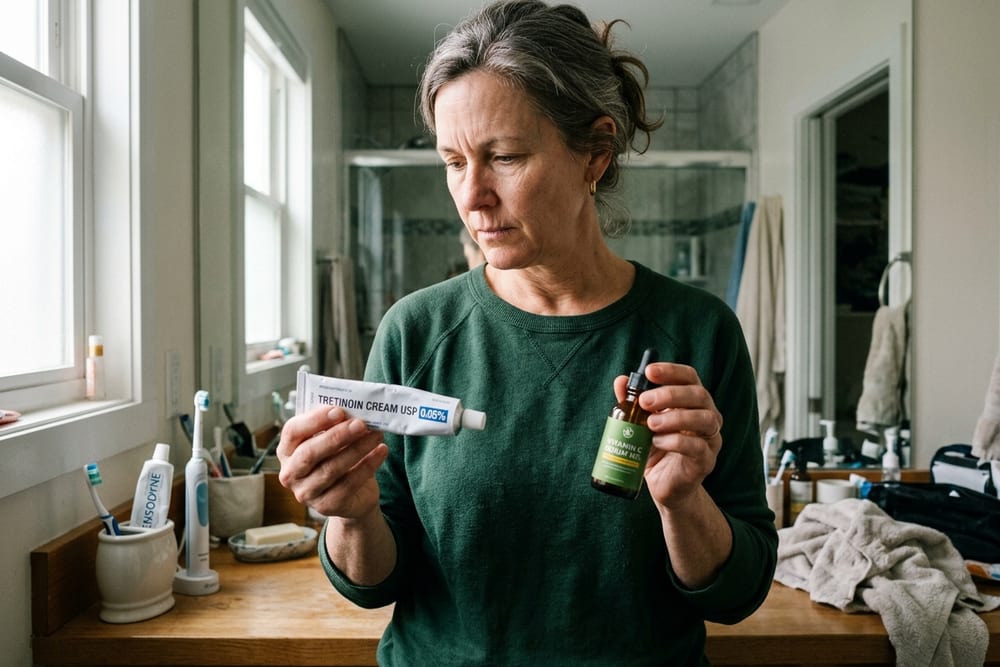
Tretinoin (prescription) and its OTC cousins (adapalene, retinol) are the most evidence-backed topical interventions for collagen loss in any cause, including the menopausal version. Decades of RCTs show topical retinoids increase dermal collagen production, accelerate cell turnover, improve fine wrinkles, and improve uneven pigmentation. Start with 0.025% or 0.05% tretinoin three nights a week, ramp up over 6-8 weeks, expect mild flaking and redness in the first month. The evidence base for tretinoin is older, larger, and more robust than for any product marketed specifically for "menopause skin."
Daily broad-spectrum sunscreen (SPF 30+)
Photoaging accelerates and compounds the menopausal collagen loss. UV is the single largest extrinsic driver of skin aging; in a postmenopausal face that is already losing collagen on its own, UV exposure makes the visible change worse, faster. A broad-spectrum sunscreen, SPF 30 or higher, applied every morning, is the highest-leverage prevention move you can make. There is no version of menopause-skin discipline that doesn't start here. Pick a formulation you'll actually wear daily — mineral or chemical, tinted or not, doesn't matter — daily wear is what matters.
Topical vitamin C (ascorbic acid)
Vitamin C is a cofactor for the enzymes that crosslink and stabilize collagen during synthesis — without it, the collagen your skin makes is structurally weaker. Topical L-ascorbic acid (10-20%) applied in the morning under sunscreen provides photoprotection, supports collagen synthesis, and modestly improves pigmentation. The published evidence is solid, the side-effect profile is mild, and at $20-40 a bottle for a serum that lasts 2-3 months, the cost-benefit is favorable.
Systemic HRT (estradiol +/- progesterone)
Multiple studies summarized in Hall and Phillips (2005) show systemic estrogen therapy increases skin collagen content, dermal thickness, and skin elasticity in postmenopausal women — but the effect sizes are modest and largely apply to women who start HRT in the early postmenopause window. The honest framing: HRT slows the loss and partially restores some thickness, but does not return your skin to its premenopausal state. We do not prescribe HRT for cosmetic indications alone; if you are already starting HRT for vasomotor symptoms, sleep, or bone, the skin benefit is a real but secondary effect.
Topical hyaluronic acid
Topical HA serums and creams hold water in the upper layers of the skin, modestly improving the "plumpness" and reducing the appearance of fine surface lines. They do not penetrate deeply enough to rebuild dermal HA content, and the effect is largely cosmetic-day-of rather than structural-over-time. Useful as a moisturizer adjunct; not useful as a replacement for retinoid or sunscreen.
Niacinamide and peptides
Niacinamide (vitamin B3, typically 2-5% in serum) has small-to-modest evidence for improving barrier function, mild pigmentation, and surface hydration. Peptides are heterogeneous — copper peptides have some evidence, signal peptides have weaker evidence, and most marketing claims outrun the data. Both are reasonable additions if your skin tolerates them; neither is essential, and neither replaces the Tier 1 trio.
Microneedling, IPL, and laser resurfacing
In-office procedures (microneedling, IPL/intense pulsed light, fractional laser) offer cosmetic-procedure-level improvements that no topical can match. They induce dermal remodeling, improve pigmentation, and can produce visible results — but they cost $300-1500 per session, typically need a series of 3-6, and the durability of the result varies. They are reasonable for women who have already optimized the Tier 1 routine and want further improvement; they are not where to start if you are not yet using sunscreen and a retinoid daily.
Collagen drinks, "anti-aging serums" without active ingredients, most expensive supplements
Oral collagen peptides are broken down in the gut to constituent amino acids; they do not arrive at the dermis as collagen. A protein-adequate diet provides the same building blocks at a fraction of the cost. "Anti-aging serums" without a named active (retinoid, vitamin C, niacinamide, peptide) are typically expensive moisturizers with marketing copy. Most "menopause skin" supplements outside of a basic vitamin D and protein-adequate diet have weak-to-no evidence specifically for skin outcomes. The marketing budget on this category is enormous; the evidence base is not.
The HRT-skin connection — honest
This is the section we deliberately keep honest because most articles oversell. Yes, systemic HRT increases skin collagen content modestly. Yes, women on HRT have better skin thickness and elasticity than postmenopausal women not on HRT, on average. The Hall and Phillips (2005) review in the Journal of the American Academy of Dermatology consolidated this literature; Brincat et al. (2005) in Climacteric reviewed the same evidence with more focus on the mechanism. The estrogen-skin relationship is real and measurable.
What the evidence does not show is that HRT returns a postmenopausal face to its premenopausal state. The bone resorption is not fully reversible. The cumulative collagen loss is partly recovered, not fully recovered. The fat redistribution does not unwind. Women on HRT who start in the early postmenopause window get more skin benefit than women who start late, because the early window is when the steep collagen loss is happening and slowing it has more leverage than trying to reverse it later. This is a "slow the loss, modestly partially restore" story, not a "look ten years younger" story.
Topical estrogen creams (estriol or estradiol) applied directly to facial skin are used off-label by some menopause specialists and dermatologists. The local effect is real — increased collagen and thickness at the application site — but the published evidence base is small, and most U.S. clinicians do not prescribe topical facial estrogen in isolation for cosmetic indications. If you are already on systemic HRT, your facial skin is getting estrogen exposure as a side effect; if you are not, having that conversation with a clinician who specifically understands menopausal skin is a separate visit, usually with a dermatologist rather than an HRT prescriber.
The integrity-respecting summary: HRT is not an anti-aging treatment. HRT is a treatment for menopause symptoms (vasomotor, sleep, mood, GU, bone) that has a real-but-modest skin benefit as part of its profile. We at ClearedRx prescribe HRT for those primary indications. If you have a flagship menopause skin concern with no other symptoms, a dermatologist visit is a more direct path than starting HRT for skin alone.
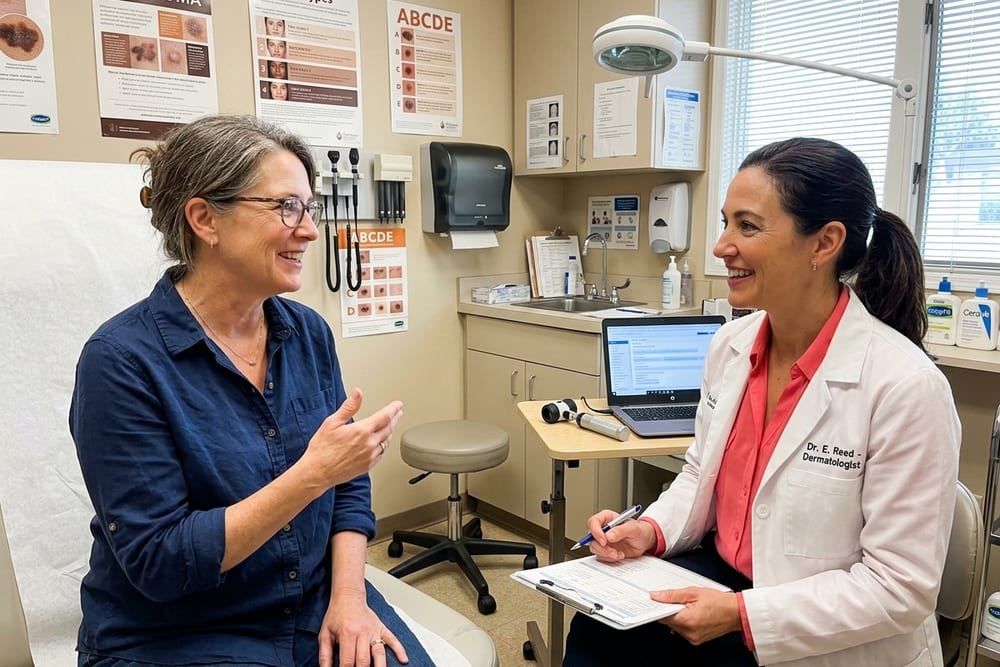
How ClearedRx fits in (and where it doesn't)
ClearedRx is a doctor-supervised HRT service for women, online. You take a one-minute quiz. A licensed physician in our network reviews your symptoms and history within 24 hours. If you are a fit, they prescribe — and your treatment ships to your door, discreetly, the same week. We prescribe both compounded and FDA-approved HRT preparations; the patient picks based on cost, format preference, and clinical fit.
Where ClearedRx is the right service: if your menopause-face concern travels with hot flashes, night sweats, sleep disruption, mood changes, vaginal dryness, or other systemic menopause symptoms — meaning the underlying estrogen drop is producing a constellation of issues — then systemic HRT is on the table because of the constellation, and the skin benefit is part of the upside. Most women who start HRT for menopause symptoms see their skin improve over 3-6 months as a real but secondary outcome, alongside the primary symptom relief.
Where ClearedRx is not the right first stop: if your only concern is cosmetic skin change and you have no other menopause symptoms, the higher-leverage first move is a daily sunscreen, a prescription retinoid, and a vitamin C serum — and a dermatologist visit if you want to escalate beyond topicals. We are a menopause provider, not a dermatology clinic. The honest framing matters: HRT for cosmetic indication alone is not how the best menopause specialists prescribe, and not how we prescribe. Our companion piece on signs you need HRT walks through when the conversation is worth having.
For broader cost and product context, our HRT cost comparison covers every formulation across every channel, our HRT types explained page walks through the patch / pill / cream options, and our HRT timeline piece sets realistic expectations for which symptoms improve first.

"Estrogen treatment in postmenopausal women has been repeatedly shown to increase collagen content, dermal thickness, and elasticity. The skin's hormonal milieu is integral to its function and structure, and the loss of estrogen at menopause produces measurable, predictable changes in connective tissue, glandular activity, and pigmentation." — Brincat MP, Muscat Baron Y, Galea R. Estrogens and the skin. Climacteric. 2005;8(2):110-23.
The menopause-face intervention comparison table
Side by side, here is how the evidence-ranked options stack up. The "notes" column is the one that determines whether each tool is right for your specific picture.
| Intervention | What it targets | Evidence | Notes |
|---|---|---|---|
| Tretinoin / topical retinoids | Dermal collagen synthesis, cell turnover, pigmentation | Strong (decades of RCTs) | Single highest-leverage topical; expect 6-8 weeks of adjustment |
| Daily SPF 30+ sunscreen | Photoaging-driven collagen breakdown | Strong (decades of evidence) | Non-negotiable; pick a formulation you'll wear daily |
| Topical vitamin C (10-20%) | Collagen synthesis cofactor, photoprotection, pigmentation | Strong | Morning routine, under sunscreen; $20-40/bottle |
| Systemic HRT | Underlying estrogen drop driving collagen, HA, sebaceous shifts | Moderate (Brincat 2005, Hall & Phillips 2005) | Modest skin benefit as secondary effect; not first-line for cosmetic-only indication |
| Topical hyaluronic acid | Surface hydration, "plumpness" | Moderate (cosmetic, not structural) | Useful adjunct moisturizer; not a replacement for retinoid or SPF |
| Niacinamide / peptides | Barrier function, mild pigmentation, modest collagen support | Weak / mixed | Reasonable add-on; not essential |
| Microneedling, IPL, laser | Dermal remodeling, pigmentation, surface texture | Moderate (procedure-dependent) | $300-1500/session; series of 3-6; after Tier 1 is dialed in |
| Topical estrogen creams (off-label) | Local collagen content, dermal thickness | Weak (small studies) | Off-label; specialist prescribers; not a first-line intervention |
| Spironolactone (for menopausal acne) | Androgen receptor antagonism | Strong for adult-onset hormonal acne | Targeted to the lower-face acne pattern; clinician-prescribed |
| Oral collagen peptides | Marketed for "skin elasticity" | Weak; broken down in gut to amino acids | Skip; protein-adequate diet provides same building blocks |
| "Anti-aging serums" without named actives | Marketing | None | Skip; expensive moisturizers |
The honest framing your dermatologist would give you in private. No topical, no procedure, and no HRT regimen returns a postmenopausal face to its premenopausal state. The interventions that work slow the loss and partially restore some of what was lost. The realistic goal is a face that ages on a flatter trajectory than it would otherwise — not a face that "looks 35 again." Articles and products that promise the latter are selling you something.
If you also want to map the rest of the picture
Menopause face almost never travels alone. The same low-and-erratic-estrogen environment that drives the connective-tissue and glandular changes typically also produces hot flashes, night sweats, sleep disruption, mood changes, vaginal dryness, hair thinning, and changes in body composition on overlapping timelines. Mapping the constellation is the cheapest diagnostic move you can make before deciding what to do next. Our free Menopause Symptom Score is a 60-second self-check that scores the cluster as a single hormonal-fingerprint number. For the broader symptom catalogue, see our menopause symptoms overview; for sister-article context, our perimenopause itching piece covers another under-recognized skin symptom on the same hormonal-volatility axis, our perimenopause hair loss piece covers the parallel beauty/aging concern that travels with menopause face, our menopause belly piece covers the body-composition sister article, our 34 symptoms of perimenopause pillar maps the full constellation, our signs you need HRT piece walks through when the conversation is worth having, and our menopause statistics 2026 page has prevalence numbers across symptoms.
Frequently asked questions
What is menopause face?
Menopause face is the constellation of facial changes driven by the estrogen drop of menopause: collagen loss, bone resorption in the facial skeleton, fat redistribution from the mid-face, hyaluronic acid loss, sebaceous gland shifts (dry skin plus chin and jawline acne paradoxically together), and pigmentation changes. Brincat et al. (1985) in the British Journal of Obstetrics and Gynaecology first quantified the dominant driver: women lose approximately 30 percent of dermal collagen in the first 5 years post-menopause. The face changes that follow are real, predictable, and on a measurable timeline.
How fast does menopause skin change?
Faster in the first 5 years than at any other point. Brincat et al. (1985) measured roughly 30 percent dermal collagen loss in the first 5 years post-menopause, with about 2 percent loss per year after that. Translation: year 1 you lose roughly 5-10 percent, year 3 you are in the 15-20 percent range, year 5 you reach the 30 percent mark, and the rate then slows substantially. The first 5 years is when intervention has the most leverage. Affinito et al. (1999) in Maturitas independently confirmed that postmenopausal collagen loss correlates strongly with years since menopause.
Does HRT help menopause skin?
Yes — modestly. Multiple studies summarized in Hall and Phillips (2005) J Am Acad Dermatol and Brincat et al. (2005) Climacteric show that systemic estrogen therapy increases skin collagen content, dermal thickness, and skin elasticity in postmenopausal women. The honest framing: HRT slows the loss and partially restores what was lost, but it does not return your face to its pre-menopause state. The earlier you start in the perimenopause-to-early-menopause window, the more leverage HRT has on skin specifically. We do not prescribe HRT for cosmetic indications alone — but if you are starting it for hot flashes, sleep, or bone, the skin benefit is real. See our signs you need HRT piece for the conversation.
Why do I suddenly have acne in my 40s?
The menopausal acne paradox. As estrogen drops, androgens (testosterone, DHEA) become relatively more active because there is less estrogen opposing them. Androgens stimulate sebaceous glands, which is why menopausal-onset acne tends to cluster on the chin, jawline, and lower face — the androgen-sensitive zones. Zouboulis et al. (2007) in Hormone and Metabolic Research documented the sebaceous-gland responsiveness shift. The same hormonal shift that makes the rest of your face drier (estrogen-driven) makes the lower face more acne-prone (androgen-driven). It is one shift, two opposite-looking outcomes, on the same face. Treatment: a topical retinoid at night, a gentle non-stripping cleanser, spot treatment with benzoyl peroxide or salicylic acid, and — for stubborn cases — a clinician conversation about spironolactone or HRT.
Can collagen supplements really help menopause skin?
Largely no, despite the marketing. Oral collagen peptides are broken down to constituent amino acids in the gut; they do not arrive at the dermis as intact collagen. The body assembles dermal collagen from amino acid building blocks under estrogen and growth factor signaling — and that signaling is exactly what is missing in menopause. A protein-adequate diet provides the raw materials. Spending $40-80 a month on collagen drinks chasing menopause face is the wrong lever. The same money on a tube of prescription tretinoin and a bottle of broad-spectrum SPF 50 has a far better evidence base.
What's the best skincare routine for perimenopause?
Three actives, in this order of evidence weight. Daily broad-spectrum sunscreen SPF 30+ every morning is the single highest-leverage intervention because UV drives collagen breakdown that compounds the menopausal loss. Topical retinoid at night (tretinoin 0.025-0.05% prescription, or adapalene over-the-counter) increases dermal collagen and accelerates cell turnover. Topical vitamin C serum in the morning under sunscreen is the third pillar; it provides photoprotection and supports collagen synthesis. Add hyaluronic acid serum if your skin feels dry. Everything else is optional. Niacinamide and peptides have weaker evidence but minimal downside.
Why does my face look hollow after menopause?
Three things at once. First, the facial skeleton itself thins as bone density drops post-menopause — your bony framework gets smaller, particularly around the eye sockets and the maxilla. Second, fat redistributes away from the mid-face (cheek pads thin) toward the lower face and neck, which is why you can lose mid-face volume and gain a softer jawline simultaneously. Third, dermal collagen and hyaluronic acid loss reduce the skin's structural support, so what fat remains doesn't sit the same way it did at 35. The hollow look is the bone, fat, and skin all changing together — which is why no single intervention reverses it completely.
Does estrogen cream work on facial skin?
Topical estriol or estradiol creams applied to the face are used off-label by some menopause specialists, with limited but real evidence of improved skin thickness and collagen density at the application site. Brincat et al. (2005) Climacteric reviews this literature. The benefit is local — the systemic absorption from a face-only application is small. Risks include uneven pigmentation if applied unevenly and the general considerations of topical hormone therapy. If you are already on systemic HRT for menopause symptoms, the systemic estrogen reaches your facial skin too. We do not prescribe topical facial estrogen in isolation for cosmetic indications; it is a conversation to have with a menopause-trained dermatologist.
How early should I start anti-aging in perimenopause?
Yesterday. The first 5 years post-menopause is when collagen loss is steepest (Brincat 1985). The interventions with the strongest evidence — sunscreen, retinoids, vitamin C — work best as prevention rather than reversal. A 45-year-old in early perimenopause who starts daily SPF and a low-strength retinoid will be in materially better shape at 55 than a 50-year-old starting the same routine after the steepest loss has already happened. None of these are face-lifts; they are loss-rate reducers. Earlier is always better.
Is menopause face reversible?
Honest answer: partially, not fully. Topical retinoids increase dermal collagen modestly. HRT slows further loss and can restore some thickness. Sunscreen prevents further damage. Hyaluronic-acid fillers, microneedling, and laser resurfacing offer cosmetic-procedure-level improvements. But the bone resorption is not reversible without surgical intervention, and the cumulative collagen and elastin loss accumulated over years is not fully recovered. The realistic goal is to slow the rate of change, partially restore what is restorable, and stop expecting a 30-year-old face. Articles that promise full reversal are selling you something.
Sources & references
- Brincat M, Moniz CJ, Studd JW, Darby A, Magos A, Emburey G, Versi E. Long-term effects of the menopause and sex hormones on skin thickness. Br J Obstet Gynaecol. 1985;92(3):256-9. PMID: 3978054
- Affinito P, Palomba S, Sorrentino C, Di Carlo C, Bifulco G, Arienzo MP, Nappi C. Effects of postmenopausal hypoestrogenism on skin collagen. Maturitas. 1999;33(3):239-247. PMID: 10656502
- Brincat MP, Muscat Baron Y, Galea R. Estrogens and the skin. Climacteric. 2005;8(2):110-23. PMID: 16096167
- Hall G, Phillips TJ. Estrogen and skin: the effects of estrogen, menopause, and hormone replacement therapy on the skin. J Am Acad Dermatol. 2005;53(4):555-68. PMID: 16198774
- Zouboulis CC, Chen WC, Thornton MJ, Qin K, Rosenfield R. Sexual hormones in human skin. Horm Metab Res. 2007;39(2):85-95. PMID: 17326004
- The North American Menopause Society. The 2022 Hormone Therapy Position Statement of The North American Menopause Society. Menopause. 2022;29(7):767-794. PMID: 35797481
- Endocrine Society. Menopause and Hormone Therapy Clinical Practice Guideline (2024 update). endocrine.org
- Internal: menopause symptoms overview · perimenopause itching · 34 symptoms of perimenopause · perimenopause hair loss · menopause belly · signs you need HRT · menopause statistics 2026 · menopause symptom score tool
If you want to address the underlying hormonal driver — talk to a clinician
ClearedRx prescribes evidence-based HRT — bioidentical estradiol, progesterone, or a combined cream — based on your full picture, with 24-hour MD review and free shipping in all 50 states. Compounded preparations from $49/month, FDA-approved generics from $89/month. No insurance hassle. New patients save 50% on the first month.
Find out if HRT is right for me